
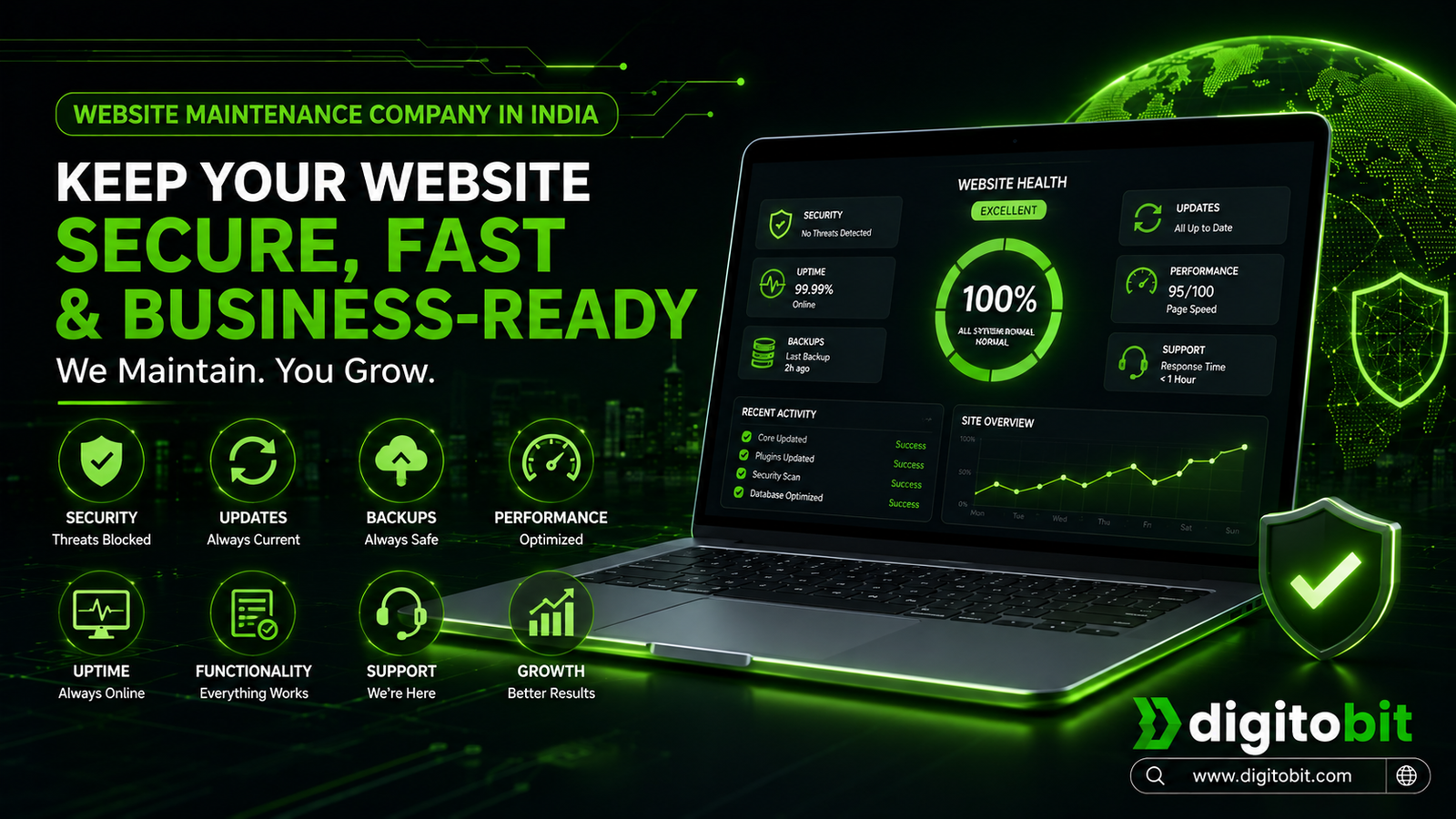
Your website may be live today, but that does not mean it will keep working reliably tomorrow. Plugins need updates, security threats evolve, forms can stop working, pages can become slow, and small technical issues can quietly turn into lost leads or missed sales.
For that reason, choosing the right website maintenance company India businesses can rely on is an important part of protecting your online investment. A professional maintenance partner does more than fix a website after something breaks. Instead, the goal is to keep your website secure, functional, fast, and ready to support your business every day.
Whether you run a small business website, a WordPress website, a service-based company, or an ecommerce store, ongoing maintenance can help reduce avoidable technical problems. More importantly, it gives your team someone responsible for handling the technical side of your website while you focus on customers and growth.
In this guide, we explain what website maintenance services include, how much website maintenance can cost in India, what different maintenance plans cover, and what you should check before hiring a maintenance company.
Table of Contents
- The Real Problem Business Owners Face
- Quick Answer
- What Does a Website Maintenance Company in India Do?
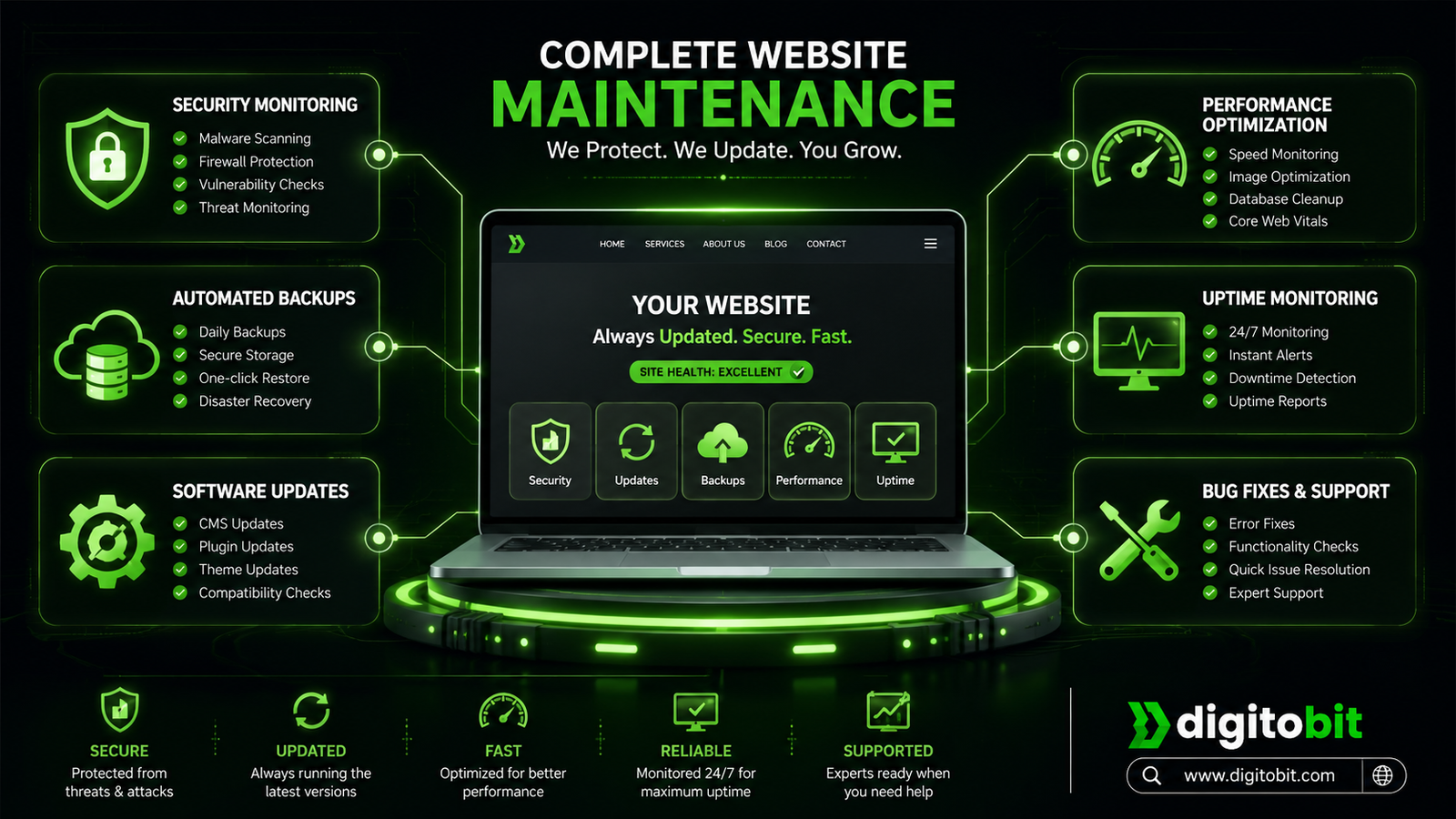
- Website Maintenance Services: What’s Included?
- Website Maintenance Services at a Glance
- Benefits of Professional Website Maintenance
- What Happens If You Don’t Maintain Your Website?
- How Much Does Website Maintenance Cost in India?
- Website Maintenance Cost in India: Pricing Comparison
- What Determines Website Maintenance Cost in India?
- WordPress Website Maintenance Cost in India
- Ecommerce Website Maintenance Cost in India
- Hosting vs Website Maintenance: What’s the Difference?
- What Is Usually Not Included in Website Maintenance?
- Cheap Website Maintenance vs Professional Website Maintenance
- How to Choose the Right Website Maintenance Company in India
- 10 Questions to Ask Before Hiring a Website Maintenance Company
- The ROI of Proactive Website Maintenance
- When Should You Hire a Website Maintenance Company?
- Final Verdict
- Keep Your Website Secure, Fast & Business-Ready
- Website Maintenance CTA Options
- Frequently Asked Questions
The Real Problem Business Owners Face
Many businesses invest significant time and money into building a professional website, but maintenance often becomes an afterthought. Once the website launches, business owners may assume the work is finished. However, websites are not static business assets. They depend on software, hosting, plugins, integrations, databases, security systems, and third-party services that can change over time.
Consider a simple example. A customer visits your website after searching for one of your services on Google. They find the right page, decide to enquire, and submit your contact form. If that form stopped working weeks earlier and nobody noticed, you could lose a valuable lead without realizing it.
Similarly, an outdated plugin can create compatibility problems after another component of the website is updated. A security vulnerability can expose your website to malicious activity. Meanwhile, an unoptimized website may gradually become slower as content, plugins, images, and database records accumulate.
These problems are especially important for businesses that depend on their website for enquiries, bookings, ecommerce transactions, or customer information. A few hours of downtime may be inconvenient for one business but financially damaging for another.
The challenge is that most business owners do not have the time or technical expertise to monitor all these areas themselves. That is where a website maintenance company can add value.
Rather than waiting for an emergency, professional maintenance focuses on preventing problems, identifying issues early, and keeping the website aligned with the needs of the business.
Quick Answer
Website maintenance is the ongoing technical care required to keep a website secure, updated, functional, and performing properly. A professional website maintenance company in India may handle regular software updates, backups, security checks, performance monitoring, troubleshooting, minor content changes, and technical support, depending on the selected plan.
- Security: Regular checks can help identify potential security problems before they become larger issues.
- Updates: CMS software, plugins, themes, and other website components can be kept current and compatible.
- Backups: Regular backups provide a recovery option if something goes wrong with the website.
- Performance: Ongoing monitoring can identify speed and performance problems that may affect visitors.
- Functionality: Forms, links, integrations, checkout processes, and other important features can be checked and maintained.
- Support: A dedicated maintenance partner gives businesses a point of contact when technical problems occur.
The exact scope varies between providers. Therefore, businesses should compare maintenance packages based on what is actually included rather than choosing a provider only because it advertises the lowest monthly price.
What Does a Website Maintenance Company in India Do?
A website maintenance company takes responsibility for the ongoing technical health of a website. The exact responsibilities depend on the platform, website complexity, and maintenance package, but the purpose remains the same: keeping the website dependable for both the business and its visitors.
Technical Website Updates
Websites often rely on a combination of CMS software, plugins, themes, libraries, and integrations. Keeping these components updated can improve compatibility, security, and reliability. However, updates should not always be performed blindly. A professional maintenance process may include checking compatibility and testing important functionality after updates.
Security Monitoring
Security is another important part of ongoing maintenance. Depending on the website and service plan, maintenance may include security monitoring, malware scanning, vulnerability checks, SSL monitoring, and assistance when suspicious activity is detected. Proactive security work can reduce the likelihood that a small vulnerability becomes a major business problem.
Website Backups
A reliable backup strategy gives your business a recovery option when something goes wrong. Backups can be especially valuable after failed updates, accidental changes, technical errors, or security incidents. A professional plan should clearly explain how frequently backups are taken, where they are stored, and how restoration is handled.
Performance Monitoring
Website performance can change as a site grows. New images, plugins, scripts, content, and integrations can affect loading speed and overall user experience. Maintenance teams can monitor performance and identify areas that need attention before slowdowns begin affecting visitors or conversions.
Bug Fixes and Troubleshooting
Even well-built websites can experience occasional problems. A form may stop sending enquiries, a plugin may conflict with another component, or an update may create an unexpected display issue. Having a maintenance company available means these problems can be investigated and resolved without forcing business owners to manage technical troubleshooting themselves.
Content and Website Support
Some maintenance plans also include minor content changes, such as updating business information, replacing images, changing service details, or making small page edits. These services can be particularly useful for businesses that need their website to reflect changing offers, prices, services, or contact information without commissioning a separate development project every time.
Ultimately, the best maintenance arrangement is one that matches how important the website is to the business. A simple brochure website may need basic updates and backups, while an ecommerce website or lead-generation platform may require much more frequent monitoring, stronger security, and faster technical support.
Website Maintenance Services: What’s Included?
A professional website maintenance plan should cover the routine work required to keep your website reliable and business-ready. However, every company defines its packages differently. Therefore, it is important to understand the services before comparing monthly maintenance prices.
Core and CMS Updates
Content management systems need regular updates to remain compatible with modern browsers, plugins, themes, and security requirements. A maintenance company can manage these updates while checking that important website functions continue to work correctly.
Plugin and Theme Updates
Plugins and themes add functionality and design features to many websites, especially WordPress websites. Keeping them updated can help address bugs, compatibility problems, and known security weaknesses. Because updates can sometimes conflict with other components, professional maintenance should include appropriate testing rather than simply clicking an update button.
Security Checks and Malware Monitoring
Website security requires ongoing attention. Depending on the maintenance package, services may include security scans, malware monitoring, vulnerability checks, login protection, SSL monitoring, and assistance with security incidents. These checks help businesses identify potential problems before they cause prolonged disruption.
Backup and Restore
Backups provide an important safety net. A good maintenance plan should explain how often backups are created, what website data is included, where the backups are stored, and how the website can be restored if necessary. For business websites, having a recovery process is just as important as having a backup.
Website Speed and Performance
Performance can change as a website grows. Large images, additional plugins, scripts, database records, and third-party integrations may gradually affect loading speed. Maintenance teams can monitor these areas and recommend or implement appropriate optimizations.
Broken Links, Forms and Error Checks
A website can look perfectly normal while an important function is no longer working. Consequently, maintenance may include checking contact forms, important links, buttons, integrations, and other conversion-related features. Finding these problems early can help protect enquiries and sales opportunities.
Minor Content Updates
Some maintenance packages include a limited number of small content changes. These may include updating contact information, replacing an image, changing service details, adding a short announcement, or correcting existing website copy. Larger content projects or new page development are normally handled separately.
Technical Support
Technical support gives business owners a clear point of contact when something goes wrong. Instead of searching for a developer every time an issue appears, the business can report the problem to its maintenance partner and follow an established support process.
Website Maintenance Services at a Glance
The easiest way to compare website maintenance packages is to look beyond the monthly price and examine what each service actually protects. A low-cost package may cover basic updates, while a more comprehensive plan may include security, monitoring, backups, performance work, and technical support.
| Service | What It Does | Why It Matters |
|---|---|---|
| Website Updates | Keeps CMS, plugins and themes current | Improves compatibility and security |
| Backups | Creates recoverable copies of website data | Provides a recovery option |
| Security Monitoring | Checks for potential threats | Reduces security risk |
| Performance Monitoring | Identifies speed and performance issues | Supports better user experience |
| Bug Fixes | Investigates technical problems | Keeps important functions working |
| Uptime Monitoring | Checks whether the website is accessible | Helps identify downtime quickly |
| Content Support | Handles agreed minor website changes | Keeps business information current |
Benefits of Professional Website Maintenance
Business Benefits
- Better website security
- Fewer unexpected technical problems
- More reliable website performance
- Better protection for lead-generation forms
- Faster access to technical support
- Longer useful website lifespan
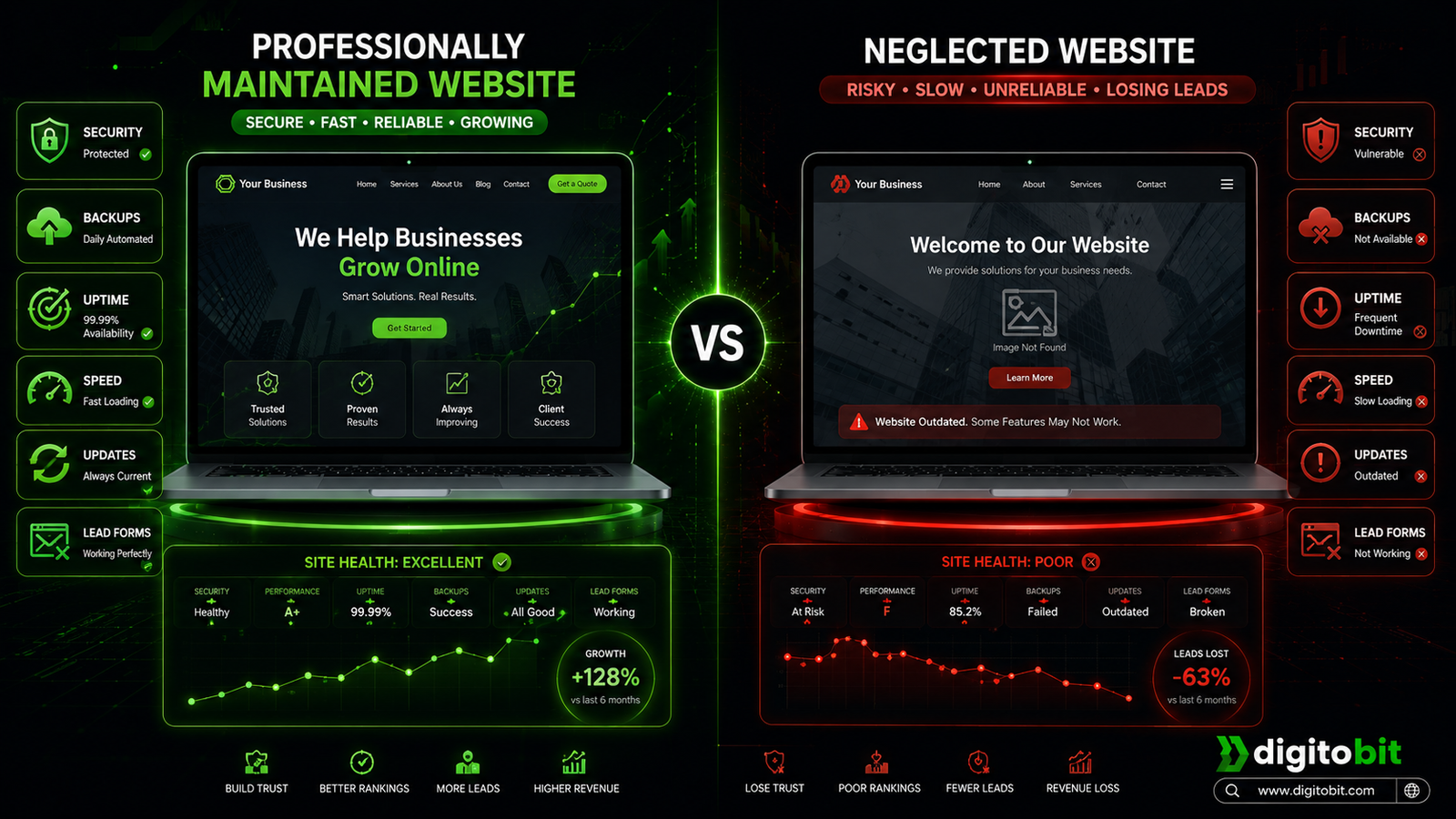
Risks of Neglecting Maintenance
- Security vulnerabilities
- Unexpected website downtime
- Broken forms and integrations
- Slower page performance
- Plugin and theme conflicts
- Potentially higher emergency repair costs
What Happens If You Don’t Maintain Your Website?
Ignoring website maintenance does not necessarily cause an immediate problem. That is exactly why businesses often underestimate the risk. A website can appear normal for months while outdated software, failed backups, broken functionality, or security weaknesses gradually accumulate in the background.
Security Risks Can Increase
Outdated website components may expose a website to known vulnerabilities. While no maintenance plan can guarantee that a website will never be attacked, regular updates and security monitoring can help reduce avoidable risks and identify suspicious activity sooner.
Website Functionality Can Break
Websites often depend on multiple components working together. An update to one plugin, theme, payment system, or integration can affect another component. Without regular checks, a problem can remain unnoticed until a customer encounters it.
Performance May Decline
As websites accumulate content, plugins, images, scripts, and database records, performance can change. Slow pages may create a poor visitor experience and can make it harder for users to complete important actions such as submitting a form, requesting a quote, or completing a purchase.
Recovery Can Become More Difficult
If a serious problem occurs and there is no recent, reliable backup, recovery may become much harder. In contrast, a defined backup and restoration process gives the business a clearer path when technical problems occur.
Ultimately, website maintenance is about reducing uncertainty. Instead of discovering problems only after they affect customers, businesses can use regular monitoring, updates, backups, and support to keep their website in a healthier condition.
How Much Does Website Maintenance Cost in India?
The cost of website maintenance in India can vary significantly because every website has different technical requirements. A simple brochure website with a few pages does not require the same level of support as an ecommerce store handling payments, orders, customer accounts, and multiple integrations.
For that reason, there is no single website maintenance price that applies to every business. The monthly cost usually depends on factors such as the website platform, number of plugins, website complexity, security requirements, traffic, frequency of updates, content support, and the level of technical assistance required.
As an indicative market reference, businesses in India may find basic website maintenance plans starting from a few hundred or a few thousand rupees per month, while more comprehensive WordPress, ecommerce, or custom website support can cost considerably more.
Basic Website Maintenance Cost
A basic website with limited functionality may require only occasional updates, backups, security checks, and minor technical changes. Such websites generally have fewer moving parts, so maintenance requirements can remain relatively simple.
WordPress Website Maintenance Cost
WordPress websites can require more regular attention because they often use multiple plugins and themes. Maintenance may include WordPress core updates, plugin and theme updates, security monitoring, backups, performance checks, and troubleshooting. Consequently, WordPress maintenance packages can range from basic support to comprehensive monthly management.
Business Website Maintenance Cost
A business website that generates leads may need more than routine software updates. Forms, landing pages, analytics, integrations, service information, and conversion paths all need to remain functional. A maintenance plan can therefore include technical support and minor content changes in addition to standard maintenance.
Ecommerce Website Maintenance Cost
Ecommerce websites generally require a higher level of maintenance because they can involve products, payments, customer accounts, shipping systems, inventory, promotional tools, and third-party integrations. A problem with checkout or payment functionality can directly affect revenue, making reliable technical support especially important.
Custom Website Maintenance Cost
Custom-built websites and web applications can require specialist development support. Their maintenance cost depends on the technology stack, architecture, integrations, hosting environment, security requirements, and amount of ongoing development work required.
Website Maintenance Cost in India: Pricing Comparison
The following ranges can be used as a general planning reference for businesses comparing website maintenance services in India. Actual pricing can vary by provider and website complexity, so these figures should not be treated as fixed industry rates.
| Website Type | Indicative Monthly Cost | Typical Requirements |
|---|---|---|
| Basic Website | ₹500–₹1,500+ | Basic updates, backups and support |
| Small WordPress Website | ₹2,500–₹5,000+ | Updates, backups, security and minor fixes |
| Business WordPress Website | ₹4,000–₹8,000+ | Proactive maintenance and technical support |
| Lead-Generation Website | ₹3,000–₹10,000+ | Monitoring, forms, performance and support |
| Ecommerce Website | ₹7,000–₹15,000+ | Checkout, payments, security and integrations |
| Complex Custom Website | ₹15,000+ | Specialist support and ongoing development |
The most important point is that businesses should compare scope rather than price alone. Two companies may quote very different monthly fees while offering completely different levels of security, monitoring, support, backups, and development assistance.
What Determines Website Maintenance Cost in India?
When comparing a website maintenance company in India, the monthly price is usually influenced by several practical factors. Understanding these variables makes it easier to evaluate whether a quotation is reasonable for your particular website.
Website Platform
The technology used to build your website has a direct impact on maintenance requirements. WordPress, Shopify, custom PHP applications, and other platforms each require different types of technical support.
Website Size and Complexity
A five-page brochure website generally requires less maintenance than a large website containing hundreds of pages, multiple integrations, customer accounts, advanced forms, or custom functionality.
Plugins and Integrations
Every additional plugin or third-party integration can introduce another component that needs monitoring. Payment gateways, CRM connections, booking systems, email platforms, analytics tools, and marketing automation can all increase the technical workload.
Security Requirements
A website that handles customer information, payments, or other sensitive business data may require stronger security controls and more frequent monitoring than a simple informational website.
Content Update Requirements
Some businesses only need technical maintenance, while others require regular text, image, product, pricing, or service updates. The more hands-on content support you need, the more comprehensive the maintenance plan may become.
Support and Response Time
A plan that includes priority support or faster response times can cost more than an arrangement where issues are handled on a best-effort basis. Businesses that depend heavily on their website should consider how quickly they need technical problems addressed.
Hosting Environment
The hosting setup can also affect maintenance requirements. Managed hosting, dedicated resources, backups, server monitoring, and specialized infrastructure may involve additional costs beyond the website maintenance fee.
WordPress Website Maintenance Cost in India
WordPress is widely used by businesses because it offers flexibility, a large ecosystem of plugins, and the ability to expand a website over time. However, that flexibility also means the website needs ongoing management.
A professional WordPress maintenance service can help keep the core software, themes, and plugins updated while reducing the risk of compatibility problems. Depending on the plan, the service may also cover backups, security monitoring, performance optimization, troubleshooting, and minor website changes.
What WordPress Maintenance Can Include
- WordPress core updates
- Plugin updates
- Theme updates
- Website backups
- Security checks
- Malware monitoring
- Performance checks
- Bug troubleshooting
- Form and functionality testing
- Minor content changes
However, businesses should check whether the quoted package includes actual testing and troubleshooting. Simply updating plugins is not the same as managing the health of an entire WordPress website.
For example, imagine a business website using a contact form plugin, an SEO plugin, a caching plugin, a security plugin, and several design components. Updating one component without checking the others could potentially create an unexpected conflict. A more professional maintenance process considers the website as a complete system rather than a collection of individual updates.
Who Needs WordPress Maintenance?
- Small and medium-sized businesses
- Professional service businesses
- Lead-generation websites
- Blogs and content websites
- Agencies and organizations
- Businesses without an in-house developer
Ecommerce Website Maintenance Cost in India
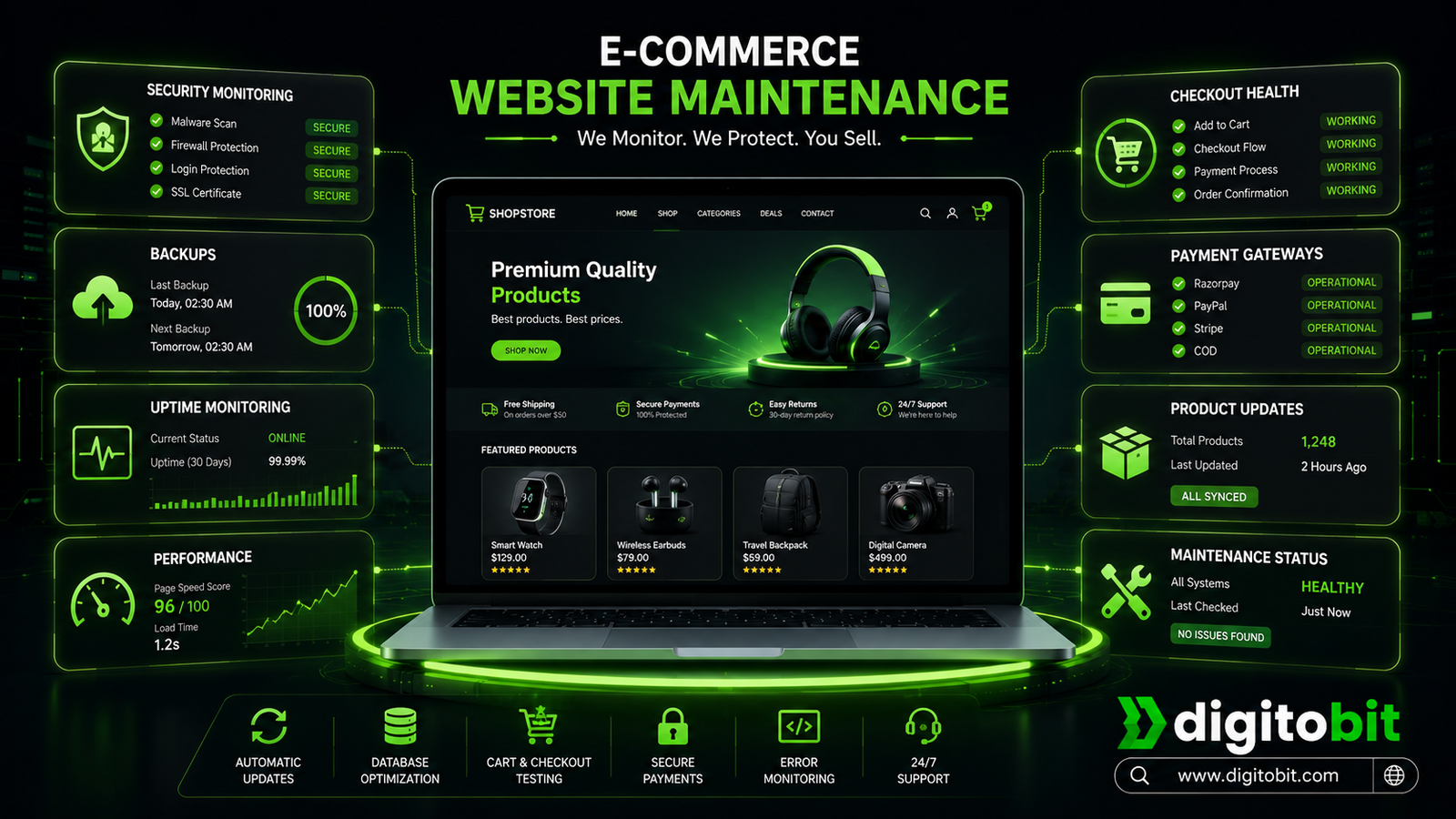
Ecommerce websites generally require more attention than standard business websites because their functionality is directly connected to transactions and revenue. A customer may browse products, add items to a cart, enter personal information, select a payment method, and complete an order through several interconnected systems.
As a result, ecommerce maintenance should focus on more than keeping the website online. The objective is to ensure that important customer journeys continue to work correctly.
Payment Gateway Monitoring
Payment failures can directly affect sales. Maintenance may therefore include checking payment-related functionality and investigating technical issues that prevent customers from completing transactions.
Checkout Testing
The checkout process should remain functional after significant updates or changes. Testing can help identify issues with carts, checkout fields, shipping calculations, coupons, taxes, or payment integrations.
Product and Content Updates
Depending on the maintenance agreement, support may include agreed changes to product information, pricing, images, categories, promotional banners, and other ecommerce content.
Security and Backups
Ecommerce businesses should pay particular attention to security and recovery because the website can process customer and transaction-related information. Regular backups and appropriate security monitoring can provide an additional layer of protection when technical problems occur.
Performance Optimization
Speed matters throughout the shopping journey. Product pages, search, cart functionality, and checkout all need to remain responsive. Consequently, ecommerce maintenance often combines performance monitoring and optimization with routine technical updates.
Moreover, ecommerce businesses should evaluate a maintenance plan based on the potential cost of checkout failures, extended downtime, or unresolved technical issues rather than simply choosing the lowest monthly quotation.
Hosting vs Website Maintenance: What’s the Difference?
Website hosting and website maintenance work closely together; however, they serve different purposes. Therefore, understanding this difference is essential when comparing website maintenance packages, as providers may offer hosting, maintenance, or both as separate services.
What Hosting Provides
Hosting provides the infrastructure where your website files, databases, and other resources are stored and delivered to visitors. Depending on the hosting plan, this may include server resources, storage, bandwidth, SSL support, backups, and other infrastructure-related features.
What Website Maintenance Provides
Website maintenance focuses on the ongoing health of the website itself. This can include software updates, plugin and theme management, security checks, backups, performance monitoring, bug fixes, content changes, and technical support.
| Factor | Hosting | Website Maintenance |
|---|---|---|
| Main purpose | Provides website infrastructure | Maintains website health |
| Server resources | Yes | Usually separate |
| Software updates | Not necessarily | Often included |
| Security monitoring | Depends on host | Often included depending on plan |
| Bug fixes | Usually not included | Often included within agreed scope |
| Content changes | Usually not included | May be included |
For businesses that want a single point of responsibility, combining reliable hosting with professional maintenance can make website management simpler. However, always check exactly what each service covers before signing a plan.
What Is Usually Not Included in Website Maintenance?
One of the most important questions to ask a website maintenance company in India is what the package does not include. After all, a low monthly price may look attractive at first; however, you could end up paying significantly more when the provider bills you separately for every major request.
- Complete website redesign: Businesses usually treat visual design or structural changes as a separate project.
- New website development: Building a new website or migrating to a completely different platform generally requires a separate development engagement.
- Major feature development: Custom calculators, portals, advanced booking systems, dashboards, and other substantial functionality may require additional development fees.
- Large content projects: Uploading hundreds of products or rewriting an entire website may fall outside routine maintenance.
- Full SEO campaigns: Technical maintenance can support website health, but ongoing SEO strategy, content production, link building, and ranking campaigns are usually separate services.
- Paid advertising: Google Ads, Meta Ads, and other advertising campaigns are separate marketing activities.
- Premium licences: Paid plugins, themes, software subscriptions, or third-party services may require separate payment.
- Domain renewal: Domain registration and renewal may be billed separately from maintenance.
Clear boundaries are beneficial for both sides. Before choosing a plan, ask the provider to specify the included work, monthly limits, additional charges, emergency support terms, and development rates in writing.
Cheap Website Maintenance vs Professional Website Maintenance
The cheapest maintenance package is not automatically the best option. In fact, businesses can sometimes spend more over time when a low-cost plan provides only basic updates without proactive monitoring or meaningful technical support.
Low-Cost Maintenance
- Basic software updates
- Limited backups
- Minimal monitoring
- Limited support
- Additional charges for many fixes
Professional Maintenance
- Regular updates and checks
- Reliable backup strategy
- Security monitoring
- Performance monitoring
- Proactive troubleshooting
- Defined technical support process
The right choice depends on how important your website is to your business. If the website is simply an online brochure, basic maintenance may be sufficient. On the other hand, if your website generates leads, processes payments, or supports daily operations, proactive maintenance can provide considerably more business value.
How to Choose the Right Website Maintenance Company in India
Choosing a website maintenance company should be treated like choosing a long-term technical partner. The company you select may have access to your website, hosting environment, plugins, databases, and other important systems. Therefore, reliability and transparency matter just as much as price.
Check What the Package Includes
Ask for a clear list of included services. Look for specifics rather than broad claims such as “complete website support.” A good proposal should explain updates, backups, security, monitoring, content changes, bug fixes, and support responsibilities.
Ask About Backup and Recovery
Find out how frequently backups are taken, where they are stored, how long they are retained, and whether restoration assistance is included. A backup is useful only when it can actually be recovered when needed.
Understand Security Coverage
Ask whether the maintenance plan includes security scanning, malware monitoring, vulnerability checks, SSL monitoring, and assistance after a security incident. Also clarify whether security cleanup is included or charged separately.
Check Response Times
Technical support is most valuable when you know when help will arrive. Ask about normal response times, emergency support, working hours, escalation procedures, and whether urgent issues receive priority.
Clarify Extra Charges
Before signing a contract, ask which requests are included and which are billed separately. Clarifying these boundaries early can prevent unexpected invoices later.
Check Platform Expertise
Your maintenance provider should understand the technology behind your website. WordPress, ecommerce platforms, custom applications, and specialized integrations can each require different technical knowledge.
Ask About Reporting
Regular reporting can make the maintenance relationship more transparent. Depending on the service, reports may summarize updates, backups, security checks, uptime, performance issues, completed tasks, and recommendations.
10 Questions to Ask Before Hiring a Website Maintenance Company
Before signing a monthly or annual maintenance agreement, use these questions to compare providers on value rather than price alone.
- What exactly is included in the monthly maintenance plan?
- How frequently will my website be checked and updated?
- Are website backups included?
- How are backups stored and restored?
- What security monitoring is included?
- What happens if my website goes down?
- How quickly will urgent technical issues be addressed?
- Are content updates included in the monthly fee?
- Which services or development tasks cost extra?
- Will I receive a regular maintenance report?
The ROI of Proactive Website Maintenance
Website maintenance can look like a recurring expense when viewed only as a technical service. However, the better way to evaluate it is to consider the business risks it helps manage.
Suppose your website generates ten qualified enquiries each month and one important form stops working. The maintenance fee may suddenly look very small compared with the value of the leads that could be lost. Similarly, an ecommerce business can face a direct revenue impact when checkout or payment functionality stops working.
- Protecting leads: Regular functionality checks can help identify broken enquiry paths.
- Reducing downtime: Monitoring and responsive support can help detect and address availability problems.
- Reducing emergency costs: Proactive work can help prevent small technical issues from becoming larger repair projects.
- Protecting customer trust: A secure, functional website creates a more reliable experience for visitors.
- Extending website life: Regular technical care can help businesses get more value from an existing website before a major rebuild becomes necessary.
The ROI is therefore not always a direct calculation of “maintenance cost versus revenue.” It is also about reducing avoidable risk and keeping a business-critical digital asset dependable.
When Should You Hire a Website Maintenance Company?
Not every website needs the same level of ongoing support. However, professional maintenance becomes particularly valuable when your website plays an important role in generating revenue or serving customers.
- Your business depends on website enquiries or lead generation.
- Your website accepts online payments or orders.
- Your website runs on WordPress with multiple plugins.
- You do not have an in-house developer.
- Your team frequently changes website content.
- You have experienced recurring technical problems.
- You want proactive monitoring rather than emergency repairs.
- Your website is important to daily business operations.
If several of these situations apply to your business, a recurring maintenance plan can provide a more predictable way to manage your website instead of finding technical help every time something goes wrong.
Final Verdict
A website should not be treated as a one-time project that can be forgotten after launch. Software changes, security threats evolve, integrations need attention, and customer expectations continue to rise.
The right website maintenance company in India can help businesses keep their websites secure, functional, updated, and ready to generate business. More importantly, professional maintenance gives business owners a reliable technical partner instead of leaving them to deal with unexpected website problems on their own.
When comparing providers, look beyond the monthly price. Evaluate what is included, how backups are handled, what security protection is provided, how quickly support responds, which changes cost extra, and whether the service matches the importance of your website.
For a business website that generates leads, supports customers, or processes transactions, proactive maintenance is not simply a technical convenience. It is a practical way to protect the digital asset your business depends on.
Keep Your Website Secure, Fast & Business-Ready
Your website should support your business, not become another technical problem for your team. Get professional website maintenance support designed around your website’s actual needs.
- Regular website updates and technical checks
- Security, backup and performance support
- Technical troubleshooting when issues occur
- Ongoing support from a professional website team
Let Digitobit help you identify maintenance priorities and build a practical plan for keeping your website reliable and ready for growth.
Website Maintenance CTA Options
Consultation CTA
Get a Website Maintenance Consultation — Review your website’s current technical health and identify the right maintenance approach for your business.
Urgency CTA
Don’t Wait for Your Website to Break — Move from reactive repairs to proactive website maintenance before technical problems affect your customers or leads.
Value CTA
Get Your Website Health Check — Find potential maintenance, security, performance, and functionality issues before they become expensive problems.
Problem-Solution CTA
Turn Reactive Website Fixes Into Proactive Maintenance — Give your business a reliable technical partner for ongoing website care and support.
Authority CTA
Let Digitobit Manage Your Website’s Ongoing Technical Health — Keep your website updated, secure, functional, and ready to support your business.
Frequently Asked Questions
Website maintenance is the ongoing technical care required to keep a website updated, secure, functional, backed up, and performing properly. Depending on the plan, it can include software updates, security checks, backups, performance monitoring, bug fixes, content changes, and technical support.
Website maintenance costs in India vary according to the platform, website complexity, security requirements, support needs, and included services. Basic websites may cost a few hundred or a few thousand rupees per month, while WordPress, ecommerce, and complex websites can require higher monthly budgets.
Website maintenance services can include CMS, plugin and theme updates, backups, security monitoring, malware checks, performance monitoring, bug fixes, uptime monitoring, minor content updates, and technical support. The exact scope depends on the provider and maintenance package.
WordPress maintenance pricing depends on the number of plugins, website complexity, security requirements, support level, performance needs, and included services. Small WordPress websites may use basic plans, while business and ecommerce websites generally require more comprehensive maintenance.
Not always. Hosting and website maintenance are different services. Hosting provides the infrastructure where the website runs, while maintenance focuses on updates, security, backups, performance, troubleshooting, and website support. Some providers offer both as part of a combined package.
Website maintenance should be ongoing rather than performed only when something breaks. The appropriate frequency depends on the platform, plugins, integrations, website traffic, security requirements, and business importance. Active business and ecommerce websites generally need more regular monitoring.
Small businesses can benefit from website maintenance when their website generates enquiries, provides important business information, supports customers, or contributes to sales. A suitable maintenance plan can reduce the need for business owners to handle technical issues themselves.
An unmaintained website can develop outdated software, security vulnerabilities, broken functionality, slower performance, failed forms, compatibility problems, and recovery difficulties. Problems may remain unnoticed until they affect visitors or business operations.
The right choice depends on your website and support requirements. A freelancer may work well for straightforward websites and occasional tasks, while a maintenance company can be useful when you need structured support, monitoring, security processes, backup management, and ongoing technical accountability.
Some website maintenance providers offer malware cleanup and hacked-website recovery, while others treat security incidents as separate projects. Businesses should confirm whether security cleanup, recovery, and emergency support are included before choosing a maintenance plan.

Author: Neeraj Mourya
Founder, Systems Architect – Digitobit
Specializing in scalable backend architecture and performance-focused SaaS systems