
Choosing a custom web application development company is a business and technology decision, not simply a search for developers who can build screens. The right partner should help translate operational workflows into a reliable product, make defensible architecture decisions, manage risk, and leave your organization able to operate and evolve the application.
This is especially important when the application connects customers, employees, financial systems, identity providers, CRM platforms, or legacy software. A polished demo does not prove that a vendor can handle permissions, data consistency, outages, accessibility, security updates, or long-term maintenance.
Use the following process to compare partners for a bespoke application. For broader context on the service category, see Web App Development.
1. Start with discovery, not a feature list
A feature list describes what users may see. Discovery explains what the business must accomplish and under which conditions. Before requesting a meaningful implementation estimate, a prospective partner should investigate:
- user types, roles, permissions, and organizational boundaries;
- current workflows, exceptions, approvals, and handoffs;
- business rules, deadlines, thresholds, and regulatory constraints;
- data entities, ownership, retention, quality, and migration needs;
- external systems and integration dependencies;
- nonfunctional requirements such as performance, availability, accessibility, and security;
- risks, assumptions, dependencies, and measurable acceptance criteria.
For example, an approval platform may need requester, reviewer, administrator, and auditor roles. It may also require approval thresholds, delegation, escalation timers, notifications, audit records, and exception paths. Estimating only “build an approval workflow” hides most of the work.
What good discovery produces
Ask the company to show how discovery outputs become delivery artifacts. Useful outputs may include process maps, user stories, use cases, wireframes, a prioritized backlog, data models, integration notes, a risk register, architecture decisions, and acceptance tests.
Strong teams can trace a requirement from its original business need through a backlog item, design decision, implementation, and test. Ask for a representative traceability example. If discovery ends with a slide deck and a broad feature list, the project may still contain substantial unknowns.
2. Compare scope, assumptions, and delivery models
Proposals are comparable only when they estimate the same target. Give each company a prioritized MVP definition and ask it to identify what is included, excluded, assumed, and dependent on your team.
Review:
- milestones and deliverables;
- dependencies on client decisions, data, environments, or third parties;
- acceptance criteria and sign-off responsibilities;
- change-control procedures;
- the proposed team and each person’s expected involvement;
- hosting, licensing, testing, documentation, and support exclusions.
A fixed-price proposal is useful when scope, assumptions, deliverables, acceptance criteria, and change handling are explicit. It is not automatically safer when requirements remain uncertain. Time-and-materials delivery can accommodate evolving requirements, but it requires active product ownership and budget controls. A practical hybrid is to fund discovery separately, then deliver a prioritized implementation in increments.
Also compare the type of supplier. A boutique specialist may provide senior access and focused expertise, while a large agency may offer broader staffing capacity and formal redundancy. Neither model guarantees success. Confirm the actual architect, engineers, QA lead, and delivery manager rather than relying on the company’s brand or portfolio.
3. Evaluate architecture against business constraints
Architecture should be explained in terms of business requirements, operational burden, and future change—not technology fashion. Ask the vendor to document key decisions, alternatives considered, trade-offs, and the conditions under which the design would need to change.
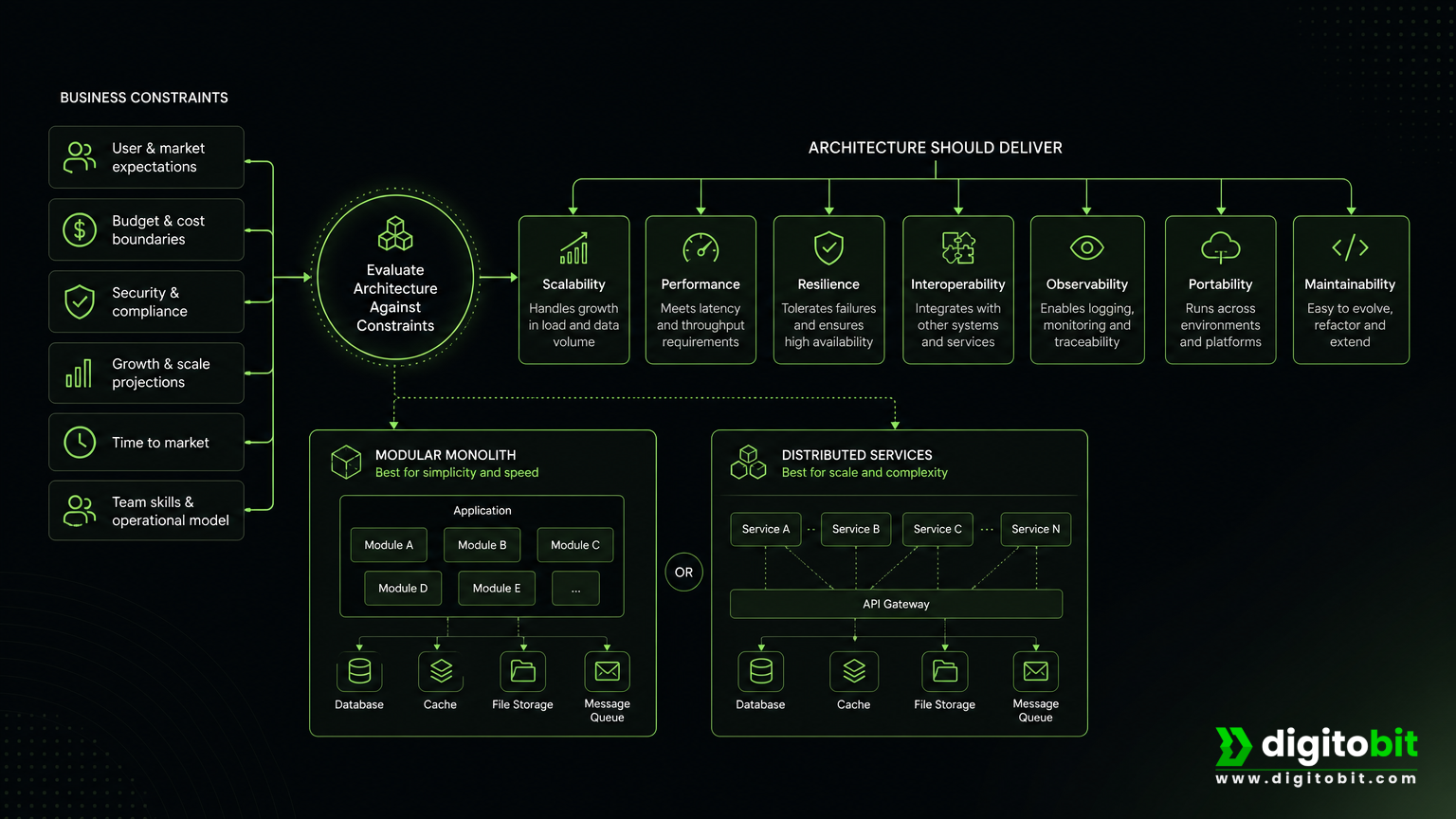
Evaluate whether the proposed system supports:
- Scalability: growth in users, transactions, data volume, and background jobs;
- Performance: response-time targets for critical workflows and reports;
- Resilience: graceful behavior when services, networks, or dependencies fail;
- Interoperability: stable APIs and clear boundaries between systems;
- Observability: useful logs, metrics, traces, and alerts;
- Portability: reasonable ability to change cloud or service providers;
- Maintainability: understandable modules, tests, documentation, and manageable dependencies.
ISO/IEC 25010 provides a recognized product-quality model that can help structure this discussion.
Monolith or distributed services?
A modular monolith can be an effective starting point because it reduces deployment, monitoring, and integration complexity while preserving internal boundaries. Microservices may be justified by independent scaling, separate team ownership, or strong isolation requirements, but they introduce additional operational overhead.
Ask what problem the proposed architecture solves. A technically elaborate design is not inherently more robust. The best initial architecture is one the organization can monitor, secure, test, and maintain.
4. Examine integrations and data ownership
Integrations frequently cause schedule and cost overruns because proposals describe systems by name without defining their interaction. For every important integration, ask for:
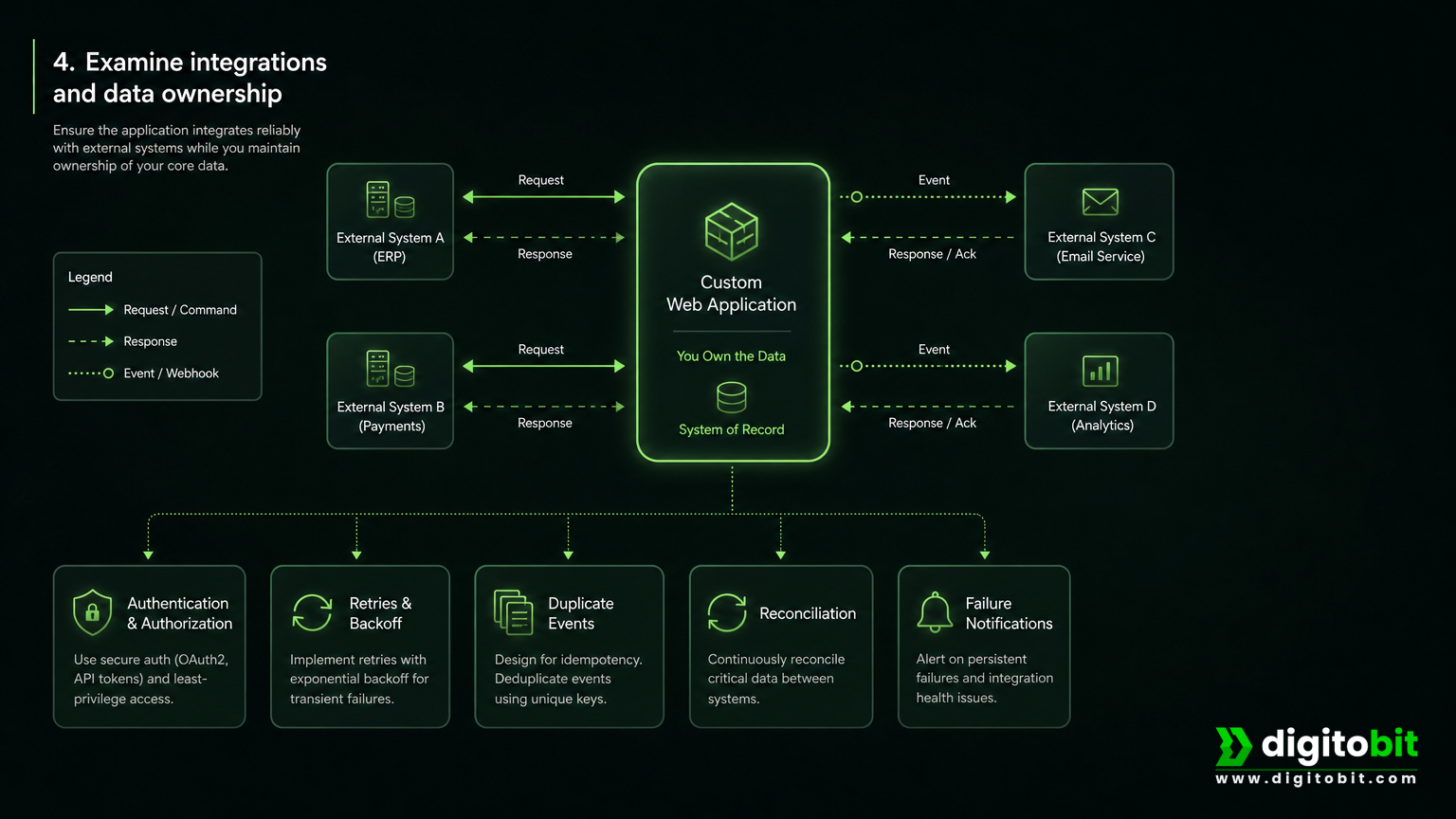
- the system of record for each data entity;
- API ownership, authentication, authorization, and versioning;
- request limits, timeouts, retry rules, and idempotency behavior;
- webhook processing, duplicate events, and out-of-order messages;
- data synchronization frequency and conflict resolution;
- failure notifications, reconciliation processes, and support ownership;
- migration, rollback, and provider-exit plans.
For an application connecting a CRM, payment provider, and identity system, the proposal should explain which platform owns customer and payment status, how credentials are protected, what happens when a webhook is delayed, and how inconsistent records are identified and reconciled.
Request representative API documentation. An OpenAPI contract can make HTTP interfaces easier to review, document, test, and maintain. It should define authentication, request and response schemas, errors, pagination, and compatibility expectations—not just endpoint names.
5. Verify security and privacy practices
“Secure” is too vague to evaluate. Ask the company how security is designed, implemented, tested, monitored, and maintained throughout the lifecycle.
A credible approach should address:
- threat modeling and abuse cases;
- identity management, single sign-on, multifactor authentication, and session handling;
- role-based or attribute-based authorization, including object-level access checks;
- secrets management and environment separation;
- encryption in transit and at rest;
- input validation, output encoding, and secure file handling;
- audit logging, log access, and sensitive-data redaction;
- dependency scanning, patching, vulnerability triage, and incident response;
- backup protection, retention, restoration, and disaster recovery.
OWASP ASVS provides a practical basis for specifying and testing web-application security controls. It supports choosing an appropriate verification level instead of applying every requirement indiscriminately. The NIST Secure Software Development Framework is also useful for setting supplier expectations across planning, development, review, and response.
Ask for examples of threat models, security test results, remediation workflows, and incident communications. Do not accept a final security scan as a substitute for secure design and development.
6. Make accessibility a delivery requirement
Accessibility should be built into product decisions, components, content, and acceptance tests. Ask which level and scope of WCAG 2.2 conformance the team will target and how that target will be verified.
Evaluation should include:
- keyboard-only completion of important tasks;
- visible focus indicators and logical focus order;
- semantic headings, landmarks, labels, and controls;
- color contrast and non-color indicators;
- accessible forms, validation, status messages, and error recovery;
- responsive behavior and usable touch targets;
- screen-reader and assistive-technology checks;
- supported browsers, devices, and input methods.
Automated tools can identify some issues, but they cannot establish complete conformance. For a customer portal, acceptance criteria might require a user to complete registration and submit a support request using only a keyboard, receive meaningful error messages, and recover if a service temporarily fails.
7. Inspect the quality-engineering strategy
Ask to see the test strategy before signing. Testing should match the application’s risks and include more than a final demonstration.
- Unit tests verify business logic and reusable components.
- Integration and API tests verify service boundaries, persistence, and external contracts.
- End-to-end tests cover critical user journeys.
- Regression tests protect existing behavior during change.
- Performance tests use realistic concurrency, data volume, and workflows.
- Security and accessibility tests combine automation with appropriate manual review.
- Browser and device tests reflect the supported environment.
- Backup-restore tests verify that recovery procedures work in practice.
- User-acceptance testing confirms that the product meets business outcomes.
Ask who writes tests, where they run, what blocks a release, and how defects are prioritized. “We test manually” or “we have automated coverage” is not enough without scope, ownership, and evidence.
8. Assess deployment and operational readiness
A web application is not complete when it runs in a developer’s environment. The delivery plan should cover repeatable environments, deployment, monitoring, backup, recovery, and release governance.
Look for:
- source control and pull-request review;
- continuous integration and deployment pipelines;
- infrastructure automation and environment configuration;
- separation of build, release, and run stages;
- secrets and configuration kept outside application code;
- application, infrastructure, and business-level monitoring;
- alert routing, on-call responsibilities, and escalation;
- release approvals, feature flags, rollback procedures, and runbooks;
- backup retention, restoration objectives, and disaster-recovery exercises.
These practices align with principles in the Twelve-Factor methodology, including separating configuration from code and making development and production environments as similar as practical.
Define operational ownership before launch. Who receives a production alert? Who can approve an emergency fix? What are the recovery objectives? How are incidents classified and communicated? Vague answers usually become expensive after release.
9. Protect maintainability and ownership
Your organization should not depend on a vendor’s private systems to access its own product. Contractually define ownership and access to:
- source code repositories and issue history;
- cloud accounts, hosting, domains, certificates, and DNS;
- design files, architecture records, and product documentation;
- automated tests, deployment scripts, and infrastructure definitions;
- data exports, database schemas, and migration tools;
- third-party subscriptions, licenses, and service accounts;
- build artifacts, credentials, and monitoring dashboards.
Request onboarding instructions, dependency-update procedures, code-review standards, and a sample handover checklist. Ask whether dependencies are pinned, scanned, updated, and documented. Where supply-chain visibility matters, request a software bill of materials; CISA guidance on SBOM consumption explains why dependency inventories help suppliers and customers communicate risk.
Ensure that repositories and production accounts are controlled by your organization, with the vendor granted appropriate access. Include transition assistance if the relationship ends.
10. Compare support and commercial terms
Post-launch support is part of the product’s total cost. Clarify:
- warranty duration and what qualifies as a defect;
- support hours, severity levels, response times, and resolution targets;
- monitoring and incident-response responsibilities;
- security patches, dependency upgrades, and platform maintenance;
- hosting, licensing, usage-based service fees, and backups;
- roadmap enhancements and how change requests are priced;
- handover, documentation updates, and exit cooperation.
Vendor-operated support can provide specialized coverage, while internal ownership can improve control and institutional knowledge. Either model can work if access, escalation, service levels, and responsibilities are explicit.
11. Understand realistic cost drivers
Implementation price depends on more than the number of screens or developer hours. Important cost drivers include:
- workflow complexity, exceptions, approvals, and auditability;
- number of user roles and permission combinations;
- custom user experience and responsive design requirements;
- integration count, API quality, rate limits, and legacy constraints;
- data cleansing, migration, reconciliation, and rollback;
- security, privacy, compliance, and accessibility requirements;
- performance, availability, geographic distribution, and infrastructure;
- testing depth, documentation, training, and release management;
- hosting, licensing, monitoring, maintenance, and support.
A low quote can become expensive when discovery is skipped, requirements are ambiguous, integration behavior is underestimated, or support is excluded. Compare total cost of ownership rather than the initial build figure. Ask each company to price the same MVP, list assumptions and exclusions, identify likely change scenarios, and explain which costs continue after launch.
12. Use a weighted proposal scorecard
Score proposals against criteria that reflect your risks. A useful scorecard can include discovery quality, scope clarity, architecture, integrations, security, accessibility, testing, deployment, maintainability, team experience, ownership terms, support, commercial transparency, and reference evidence.
Ask every finalist the same questions:
- How will you convert our workflows into backlog items and acceptance tests?
- Which assumptions most affect your estimate?
- What is excluded from the proposed MVP?
- Why did you choose this architecture, and what alternatives did you reject?
- How will you test integrations, retries, synchronization, and reconciliation?
- Which security standard or verification approach will guide delivery?
- How will you test accessibility beyond automated scanning?
- What performance targets will you test, using which data and concurrency?
- Who owns repositories, cloud accounts, data, licenses, and deployment credentials?
- What happens during an outage, security incident, vendor transition, or contract exit?
- Which proposed team members will actually deliver the work?
- Can we speak with a client whose application has been operating in production?
Request a sample architecture diagram, representative API specification, test plan, deployment workflow, support SLA, and handover checklist. These artifacts reveal more than a polished sales presentation.
Conclusion
The best custom web application development company is not necessarily the cheapest, largest, or most technically fashionable. It is the partner that can understand your workflows, define a realistic scope, explain trade-offs, build securely and accessibly, test against measurable criteria, operate the system responsibly, and transfer genuine ownership to your organization.
Begin with discovery, compare proposals on equivalent assumptions, and treat maintenance, support, security, and exit planning as part of the product—not optional additions after launch.

Author: Neeraj Mourya
Founder, Systems Architect – Digitobit
Specializing in scalable backend architecture and performance-focused SaaS systems