
Digitobit Develops Nexus for Low-Friction, Privacy-Conscious Form Protection
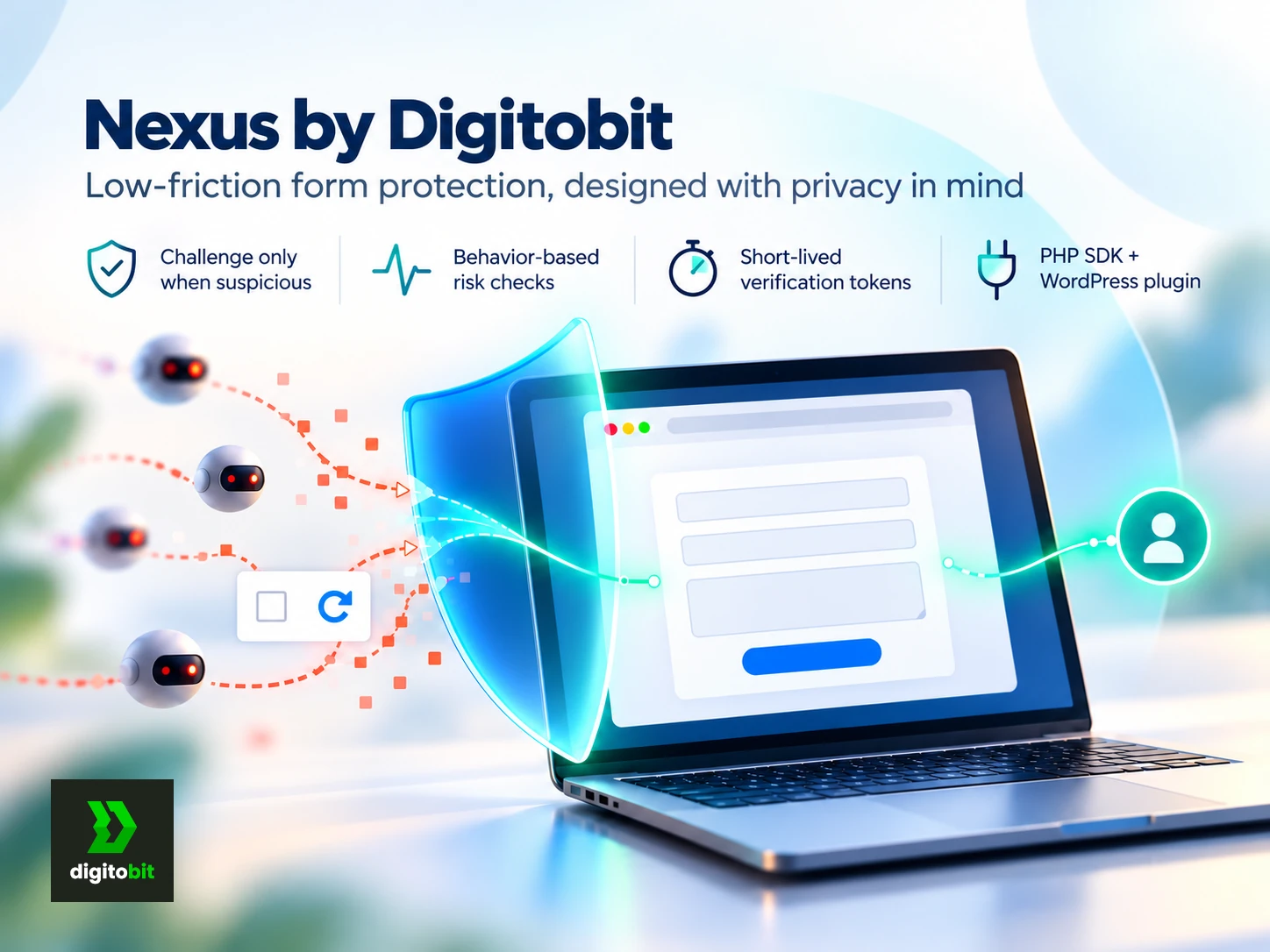
As websites face increasing form abuse from automated submissions and suspicious requests, protecting contact forms without disrupting genuine visitors becomes an important challenge. To address this, Digitobit developed Nexus, an MVP that combines layered request assessment, risk-based challenges, rate limiting, and server-side verification to help reduce unwanted submissions while keeping the experience smooth for legitimate users. This case study explores the thinking behind Nexus, its privacy-conscious approach, and the lessons learned from testing it across real-world websites.
A real-world development story about building a layered system that challenges suspicious requests while keeping ordinary website visits smooth.
The challenge
Website forms help businesses receive enquiries, bookings and customer messages. But automated submissions and repeated abuse can clutter inboxes and make genuine enquiries harder to manage.
Digitobit wanted to build a form-protection system that could assess requests in the background, show a CAPTCHA-style challenge only when activity appeared suspicious, and be designed with privacy in mind.
The solution: Nexus
Digitobit developed Nexus, an MVP for form protection and abuse prevention. It evaluates requests using multiple checks, then allows, challenges or denies them based on the assessment.
Nexus combines:
- Risk-based challenges: CAPTCHA-style challenges appear when a request is suspected, rather than for every visitor.
- Browser and interaction signals: Checks can include automation indicators, timing, input behavior, mouse activity and tab visibility.
- Request limits: Global and website/action-specific limits help control repeated requests.
- Abuse handling: Warning accumulation, IP blocking and generic denial responses help respond to repeated suspicious activity.
- Challenge escalation: Available challenges include delay, arithmetic, emoji counting, colour selection, image CAPTCHA and sequence memory.
- Server-side verification: Requests that pass receive short-lived tokens for the website to verify.
- Integration options: A PHP SDK is available, and a WordPress plugin can be provided on request.
Privacy-conscious by design
Nexus is designed to avoid accumulating personal information. It focuses on request and summarized browser-behavior signals to assess possible abuse; it does not need form contents or raw keystrokes for that assessment.
Real-world testing and ongoing development
Digitobit has been testing Nexus on a few websites, including digitobit.com, to observe its behavior in live website environments. This work helps guide ongoing development and gives the team practical experience supporting real integrations.
Digitobit is building Nexus with a personal support approach: helping website owners with setup, staying available when questions arise and using customer feedback to prioritize improvements.
The outcome so far
Nexus has moved beyond a concept into an MVP being used and refined across multiple websites. The current focus is on improving the protection flow and making it practical for businesses that want help reducing form abuse without adding a challenge for every visitor.
What’s next
Digitobit plans to continue developing Nexus in response to real website needs and customer feedback. SDKs for additional programming languages are also planned for the future.
If unwanted form submissions are affecting your website, contact Digitobit to discuss whether Nexus could help.
If unwanted form submissions are affecting your website, contact Digitobit to discuss whether Nexus could help.