
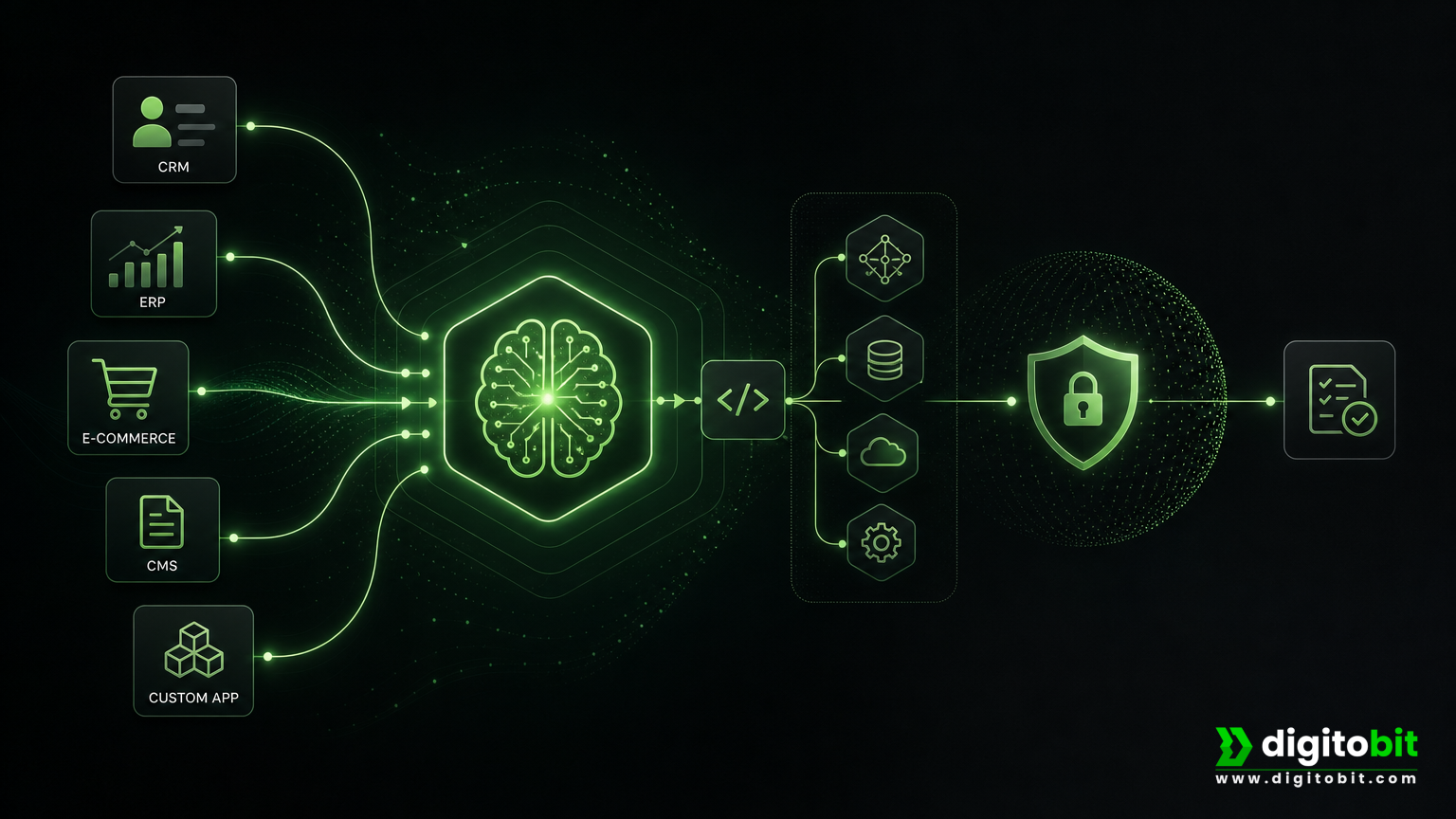
Businesses do not need to replace a reliable CRM, ERP, e-commerce platform, CMS, accounting system, or custom application to benefit from artificial intelligence. In many cases, the better approach is AI integration with existing software: add narrowly defined intelligent capabilities while retaining the application’s established database, permissions, workflows, and business rules.
This engineering-led approach treats AI as an additional service. It can classify a customer enquiry, extract fields from an invoice, summarize a support ticket, draft product content, or improve search. The existing application remains responsible for authentication, authorization, calculations, persistence, validation, and consequential actions.
This guide explains the architecture, implementation patterns, security considerations, and operational practices involved in integrating AI into business software. It also includes a practical CRM example and a Digitobit development example based on a PHP and MySQL application.
Why integrate AI into existing business software?
Most organizations already have valuable operational data and established processes. Replacing those systems simply to add AI can introduce migration risk, user disruption, and unnecessary cost. AI software integration is often more effective when it extends the tools employees already use.
For example, a CRM can continue to store customer records and enforce user permissions while AI classifies incoming enquiries. An ERP can remain the source of truth for inventory and accounting while AI extracts information from supplier documents. An e-commerce application can preserve its catalog and pricing logic while AI improves semantic search or drafts descriptions.
The division of responsibility is important:
- AI is useful for probabilistic tasks: classification, extraction, summarization, drafting, similarity matching, and language understanding.
- Application code is essential for deterministic tasks: authorization, financial calculations, stock changes, tax rules, record ownership, and irreversible actions.
This model makes AI useful without allowing an uncertain model response to become an uncontrolled business operation. It also makes the resulting system easier to test, monitor, and replace if a provider or model changes.
Common AI integration use cases
Document processing and information extraction
An AI service can extract supplier names, invoice numbers, dates, totals, tax values, addresses, or line items from documents. A robust workflow should not send an uploaded file directly to a model and immediately post the result to an accounting system.
A safer document workflow is:
- Check file type, size, ownership, and malware status.
- Extract text using a suitable parser or OCR service.
- Remove or mask unnecessary sensitive information.
- Send only the relevant content to the AI service.
- Validate the returned schema and domain values.
- Compare totals and supplier details against ERP data.
- Send uncertain or high-impact results to a reviewer.
- Post approved values through the existing accounting API.
Customer enquiry classification
CRM and help-desk systems often receive messages that must be assigned to a category, priority, team, or workflow. AI can interpret natural language more flexibly than a long list of keyword rules.
A classifier might return a category such as sales, technical_support, or billing, together with priority, sentiment, confidence, and a short rationale. The backend should validate those values before updating the CRM. Low-confidence results can create a review task instead of automatic routing.
Summarization and reporting assistance
AI can summarize a support conversation, meeting notes, or a long customer history. It can also draft commentary around approved business metrics. However, the metrics themselves should come from deterministic SQL or a reporting service. The AI should receive selected aggregates and definitions, not be trusted to calculate revenue or balances from raw text.
Content generation and CMS assistance
AI can suggest article outlines, product descriptions, metadata, email drafts, and social content. A CMS integration should save generated content as a draft, preserve the source inputs and prompt version, and require editorial approval before publication.
Intelligent search and duplicate detection
Embeddings can represent product descriptions, help articles, or internal documents as vectors. This enables semantic similarity, related-content suggestions, duplicate detection, and search that is less dependent on exact wording. Exact identifiers, permissions, pricing, and transactional filters should still be handled by the application’s database.
How AI APIs work
An AI API is a remote service accessed over HTTPS. An existing application sends an authenticated request containing instructions, selected business data, model settings, and sometimes retrieved context or tool definitions. The provider returns generated text, structured data, an embedding, or a proposed tool call.
A typical request lifecycle looks like this:
- A user action, scheduled job, webhook, or business event starts the process.
- The backend authenticates the user and checks record permissions.
- The application selects and minimizes the data sent to the AI service.
- An integration service builds the request and calls the provider over HTTPS.
- The provider returns a response or an error.
- The backend validates the transport response, schema, and business rules.
- The application stores the result, displays a draft, or starts a controlled workflow.
AI calls should be made server-side. Provider credentials must never be placed in browser JavaScript, mobile applications, WordPress themes, or public repositories. The frontend should call the business application, and the business application should call the AI provider.
Reference architecture for AI integration
A practical architecture usually contains the following components:
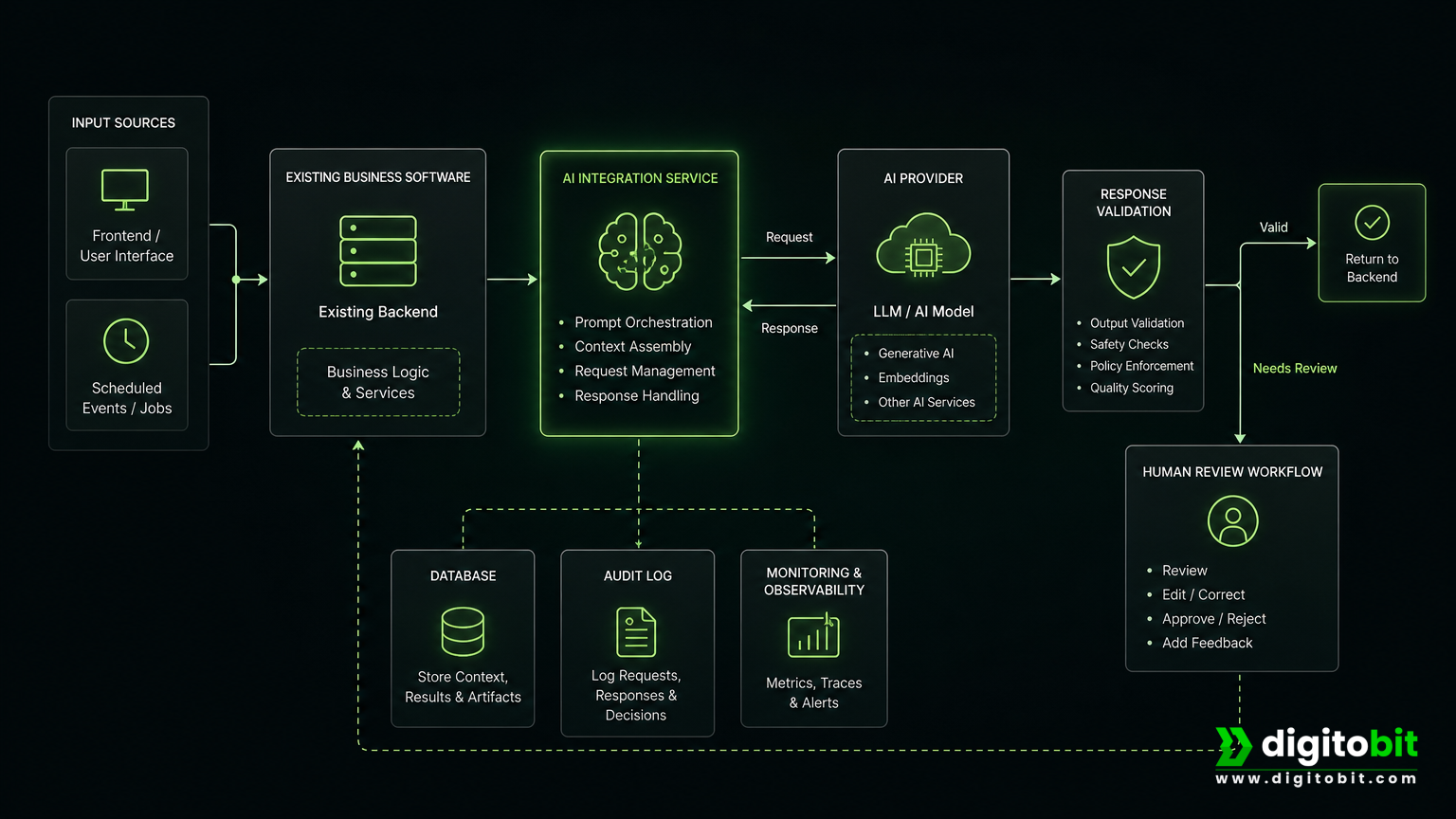
- Frontend: provides an action such as “Classify enquiry,” displays a draft, and shows approval status.
- Existing backend: handles sessions, authentication, tenant access, business rules, and record updates.
- AI integration service: isolates provider-specific HTTP calls, prompts, model configuration, retries, and error handling.
- Queue or worker: processes large documents, batch jobs, and slow requests asynchronously.
- AI provider: returns text, structured output, embeddings, or tool-call proposals.
- Database: stores business records, AI results, prompt versions, statuses, and audit metadata.
- Workflow and review layer: applies confidence thresholds, approval requirements, notifications, and controlled actions.
Frontend or scheduled event
        |
        v
Existing backend -- authentication and permissions
        |
        v
AI integration service -- prompt, provider request, retry policy
        |
        v
AI provider
        |
        v
Response validation -- schema, domain rules, confidence threshold
        |
        +--> database and audit log
        +--> draft or human review
        +--> controlled business workflow
The integration service should be an adapter rather than scattered provider calls throughout controllers. This makes it easier to change models, centralize logging, test failures, and apply consistent privacy controls.
Practical example: classifying CRM enquiries
Consider a CRM containing customer enquiries. When a new enquiry arrives, the backend can create a normalized payload containing the subject, message, communication channel, customer segment, and permitted metadata. It should not automatically send the entire customer record or unrelated tenant data.
The AI request might instruct the model to select one allowed category, assign a priority, identify a routing team, and return a confidence value. A response contract could look like this:
{
  "category": "technical_support",
  "priority": "normal",
  "routing_team": "support",
  "confidence": 0.91,
  "rationale": "The customer reports an error while using the dashboard."
}
The backend then performs several checks:
- Is the response valid JSON and does it contain all required fields?
- Are category, priority, and team values in the allowed enums?
- Is the confidence value numeric and within the expected range?
- Is the selected team valid for this tenant and enquiry type?
- Does the current user or system process have permission to update the record?
- Does the confidence exceed the threshold for automatic routing?
Safe categories with sufficient confidence may be routed automatically. Other results should create a review task. The CRM record should retain the original enquiry, the AI result, the model and prompt version, validation status, and any reviewer decision.
Implementation patterns for PHP, Laravel, CodeIgniter, Node.js, and Spring Boot
PHP, Laravel, and CodeIgniter
PHP applications can call an AI API using cURL, Guzzle, or a compatible provider SDK. In Laravel, a service-container binding can expose an AiClient or DocumentExtractionService to controllers, jobs, and commands. Provider credentials belong in environment configuration, not in source files.
Laravel queues and jobs are useful for document processing, report generation, and batch enrichment. Policies should authorize the user before a job is dispatched, while the job should re-check relevant permissions and record state before applying a result.
In CodeIgniter, a dedicated service class can handle configuration, request construction, response parsing, and exceptions. Controllers should coordinate the request rather than contain provider-specific logic. Cron-backed workers can process longer-running jobs and retry transient failures.
$result = $aiService->classifyEnquiry([
    'subject' => $enquiry->subject,
    'message' => $enquiry->message,
    'channel' => $enquiry->channel
]);

$validated = $classifier->validate($result);

if ($validated->requiresReview()) {
    $reviewQueue->create($enquiry->id, $validated);
} else {
    $crm->updateRouting($enquiry->id, $validated->routingTeam());
}
Node.js
Node.js applications can use an official or compatible SDK, environment-based configuration, asynchronous functions, and queues for background processing. Runtime validators such as Zod can validate returned objects after parsing the provider response.
REST endpoints should enforce authentication and tenant access before invoking the AI service. For high-volume applications, queue workers, concurrency limits, idempotency keys, and per-tenant usage controls help prevent one customer or workflow from consuming the entire allowance.
Java and Spring Boot
In Spring Boot, isolate provider communication behind an adapter or service. WebClient or a supported SDK can perform the HTTP call, while DTOs and Bean Validation can represent the expected response. Spring Security should handle user authorization independently of the model.
Scheduled jobs and message-driven workers are appropriate for batch extraction, reporting, and asynchronous enrichment. Exceptions should be classified as validation failures, authorization failures, provider errors, timeouts, or business-rule failures so that each category receives an appropriate response.
Structured prompts, JSON responses, and business validation
A prompt is not a substitute for an application contract. A production integration should define the task, permitted values, input boundaries, uncertainty behavior, and output schema explicitly. Prompts should be versioned like code or configuration, with change history and evaluation results.
Where supported, structured output features can constrain a model response to a supplied JSON Schema. See the OpenAI Structured Outputs documentation for the provider’s current behavior and limitations.
Structured output improves transport consistency, but valid JSON does not mean valid business data. Validation should occur in layers:
- HTTP status and response parsing.
- JSON structure and required fields.
- Types, ranges, and enumerated values.
- Cross-field consistency and domain constraints.
- Record ownership and user authorization.
- Existing business rules and workflow eligibility.
- Human approval for uncertain or consequential decisions.
Function calling is useful when a model needs to request an operation such as finding an order or creating a draft task. The model proposes the function call; application code validates the function name and arguments, checks permissions, executes the operation, and returns the result. It should never receive unrestricted database access. The function calling lifecycle provides a useful reference for this pattern.
Direct API calls, RAG, embeddings, and tools
Direct API integration
A direct API call is usually the best starting point for classification, extraction, summarization, drafting, and transformation tasks where the required context fits in the request. It has the lowest architectural complexity and is easier to evaluate.
Retrieval-augmented generation
Retrieval-augmented generation, or RAG, is appropriate when an answer depends on private, changing, or large document collections. The system retrieves approved content and supplies it as context to the model. A production RAG system needs document ingestion, chunking, embeddings, metadata filters, access-control propagation, source references, and retrieval evaluation.
RAG is unnecessary for a short CRM message or a small record whose required context can be supplied directly. Adding a vector database before proving the simpler design creates avoidable operational complexity.
Embeddings
Embeddings are useful for semantic similarity, recommendations, clustering, duplicate detection, and retrieval. They do not replace SQL filters, exact identifiers, tenant authorization, or authoritative calculations. When using embeddings, store tenant, record, and version metadata and enforce access filters before displaying results. The embeddings guide explains the underlying approach.
Tool-based workflows
Tools or function calls are appropriate when the model must request controlled application operations. Use an allowlist, strict argument validation, least privilege, confirmation for consequential actions, and idempotency. A model may propose “send an email” or “create a task,” but deterministic application code must decide whether that operation is permitted.
Security, privacy, and governance
AI integration introduces familiar application-security concerns and some additional risks. Customer messages, uploaded documents, and retrieved web content should be treated as untrusted input because they may contain prompt-injection instructions or attempts to influence a workflow.
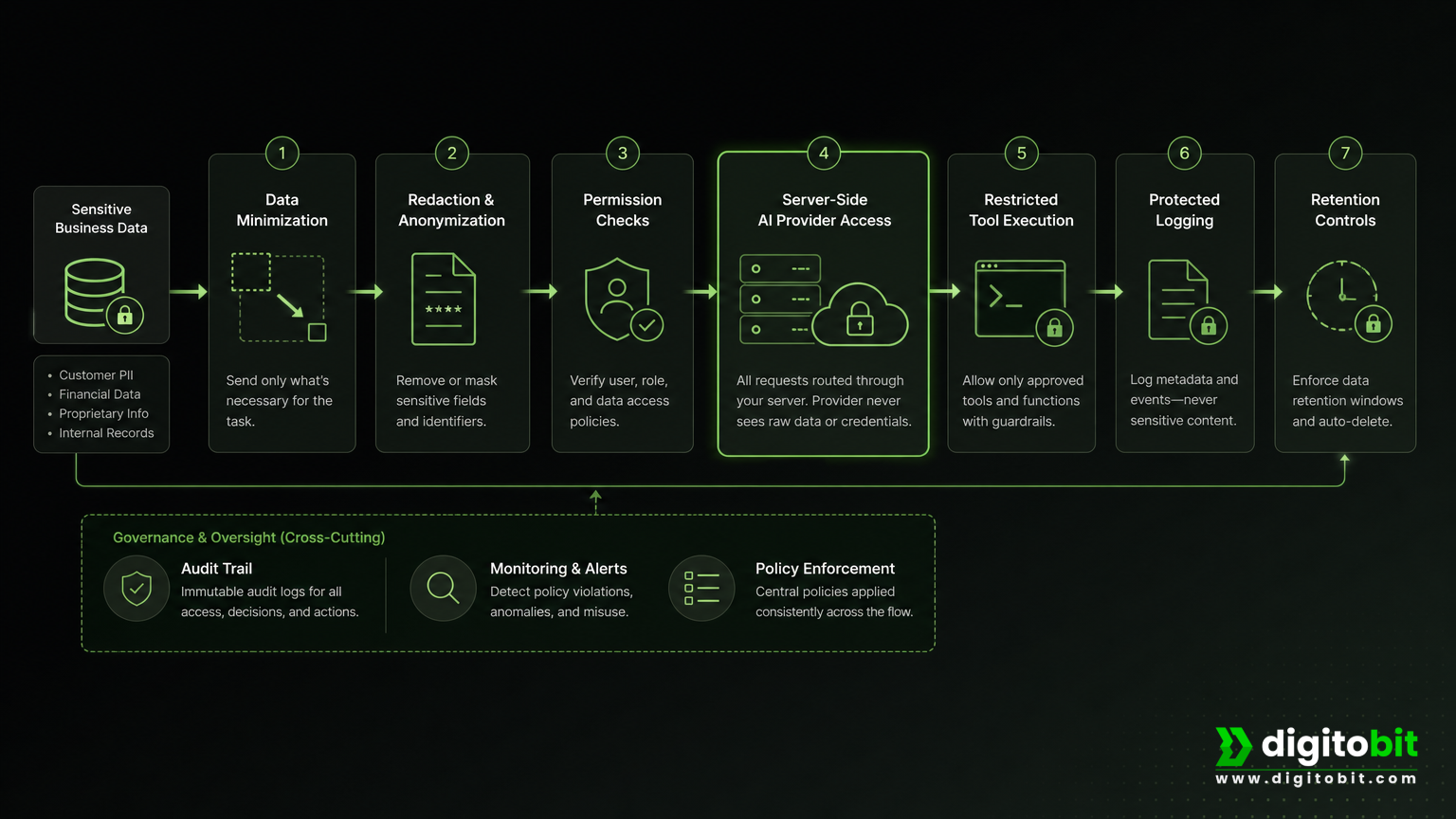
Important controls include:
- Store API credentials in a secrets manager or protected environment configuration.
- Keep provider calls on the server side.
- Send the minimum necessary data and remove unrelated personal information.
- Apply tenant and record permissions before retrieval, prompt construction, tool execution, and response display.
- Never allow model output to issue unrestricted SQL, alter user roles, approve payments, or perform irreversible actions.
- Redact secrets and sensitive content from application logs.
- Define retention, access, deletion, and audit policies for prompts and outputs.
- Review contractual and regulatory requirements for the data being processed.
OpenAI states that API data is not used to train or improve its models by default unless an organization explicitly opts in, according to its API data controls documentation. This does not remove an organization’s responsibility for privacy assessments, retention policies, access control, contracts, or regulatory obligations.
The OWASP Top 10 for LLM and GenAI Applications covers risks including prompt injection, sensitive-information disclosure, improper output handling, excessive agency, misinformation, and unbounded consumption. Security controls must exist outside the prompt; instructions alone are not a reliable authorization mechanism.
Rate limits, errors, cost, and reliability
Production AI integrations should expect timeouts, transient provider errors, malformed responses, rate limits, and service unavailability. Handle 429 and 503 responses with bounded exponential backoff and jitter, respect Retry-After where supplied, and avoid retrying permanent validation or authorization failures.
Use timeouts, circuit breakers, concurrency limits, queues, dead-letter handling, caching where appropriate, and idempotency keys. An idempotency key is particularly important when a retry could otherwise create duplicate tasks, messages, or workflow actions.
Costs generally depend on the selected model, input and output tokens, and optional tools or storage. Pricing and limits change, so production estimates should use the provider’s current pricing information and measured workloads rather than fixed assumptions.
Track usage per tenant and feature. A fast, smaller model may be suitable for high-volume classification after evaluation, while a more capable model may be justified for complex documents or high-quality drafting. Choose based on measured quality, latency, failure impact, and cost.
Human review and approval
Human-in-the-loop design is not a sign that an AI integration has failed. It is an appropriate control for low-confidence, customer-facing, financial, legal, or irreversible outcomes.
A review interface should show the original input, the AI proposal, confidence or uncertainty indicators, source evidence where available, editable fields, the reviewer identity, approval time, and explicit reject or retry actions. The application should record whether the reviewer accepted, changed, or rejected the proposal. Those outcomes become valuable evaluation data.
Automatic processing may be appropriate for low-impact tasks such as assigning a non-critical tag or drafting an internal summary. Routing, customer communications, financial posting, and permissions changes require stronger controls and often explicit approval.
Testing, monitoring, and maintenance
AI features need more than a few successful demonstrations. Build a representative, anonymized evaluation set from historical examples and define the acceptable error types before production release.
Useful measures include extraction field accuracy, classification precision and recall, routing errors, refusal rate, reviewer override rate, latency, failure rate, and cost per transaction. For generated text, assess factual grounding, completeness, tone, and editorial acceptance rather than relying on a generic quality impression.
Store observability metadata such as tenant, use case, prompt version, model version, request ID, latency, token usage, validation status, retry count, and error category. Avoid storing raw sensitive content by default; apply redaction and retention limits where it is necessary for troubleshooting.
Use feature flags, shadow mode, canary releases, and rollback paths when changing prompts, schemas, models, retrieval logic, or provider settings. Re-run evaluations after changes. Model behavior can change, and business data can drift even when application code remains the same.
Digitobit example: conventional PHP architecture with AI capability
Digitobit’s Content Automation application demonstrates how AI services can be introduced into a conventional application architecture. The application was developed in a local PHP and MySQL environment and includes OpenAI API connection testing, topic research data storage, and an article image management structure.
These components illustrate three practical integration concerns:
- Provider connectivity: the OpenAI connection test isolates and verifies communication with the external AI service.
- Conventional persistence: topic research information is stored in MySQL rather than existing only in a transient model response.
- Media relationships: the article image structure treats images as managed application records that can be associated with content.
In an expanded production workflow, a PHP application could use a dedicated AI service class for research or drafting calls, persist request and result metadata, and move longer operations to a queue. Editors could then review generated material before publication.
It is important to distinguish the tested components from planned or incomplete functionality. The connection testing, research data storage, and image-management structure demonstrate practical integration building blocks. They should not be presented as evidence that every planned content-generation workflow is complete, fully autonomous, or production-ready.
This reflects Digitobit’s broader engineering principle: AI proposes or transforms; PHP, CodeIgniter, Laravel, Node.js, or Spring Boot application logic authorizes, validates, persists, and executes.
Common AI integration mistakes
- Calling the provider directly from the browser or committing API keys to source control.
- Sending entire database rows, credentials, unnecessary personal data, or unrelated tenant records.
- Treating valid JSON as proof that the business data is correct.
- Allowing generated output to send messages, modify payments, or change records without deterministic checks.
- Adding RAG, agents, or fine-tuning before testing a direct API call with curated context.
- Logging complete prompts and responses without redaction, access controls, and retention limits.
- Retrying every error blindly and creating duplicate workflow actions.
- Using unversioned prompts or hard-coding assumptions about one model’s output.
- Claiming guaranteed accuracy, autonomous operation, or productivity gains without task-specific evaluation.
Practical checklist for AI integration
- Define the business decision and the acceptable consequences of errors.
- Choose a narrow use case with measurable input and output requirements.
- Identify which data is necessary and remove or mask unnecessary sensitive fields.
- Keep provider credentials and AI calls on the server side.
- Define a versioned prompt and response schema.
- Validate transport, schema, domain rules, permissions, and workflow eligibility.
- Decide where human approval is mandatory.
- Use direct API integration before introducing RAG or embeddings unless the data genuinely requires retrieval.
- Implement timeouts, backoff, rate limits, idempotency, queues, and failure states.
- Track model version, prompt version, usage, cost, latency, and reviewer outcomes.
- Test with representative anonymized examples and establish a rollback path.
- Review privacy, retention, security, and regulatory requirements.
Build AI into the software you already rely on
Successful business AI integration does not begin with replacing a dependable application. It begins by identifying a specific task where language understanding, extraction, classification, or semantic similarity can improve an existing workflow while leaving authoritative business logic in place.
Digitobit can help organizations assess suitable use cases, design secure AI API integrations, and extend PHP, Laravel, CodeIgniter, Node.js, Java/Spring Boot, WordPress, CRM, ERP, and custom applications. Explore Digitobit’s AI & Business Automation Solutions, API Development & Integration, and Custom Software Solutions services to plan an integration that complements your existing systems.

Author: Neeraj Mourya
Founder, Systems Architect – Digitobit
Specializing in scalable backend architecture and performance-focused SaaS systems