
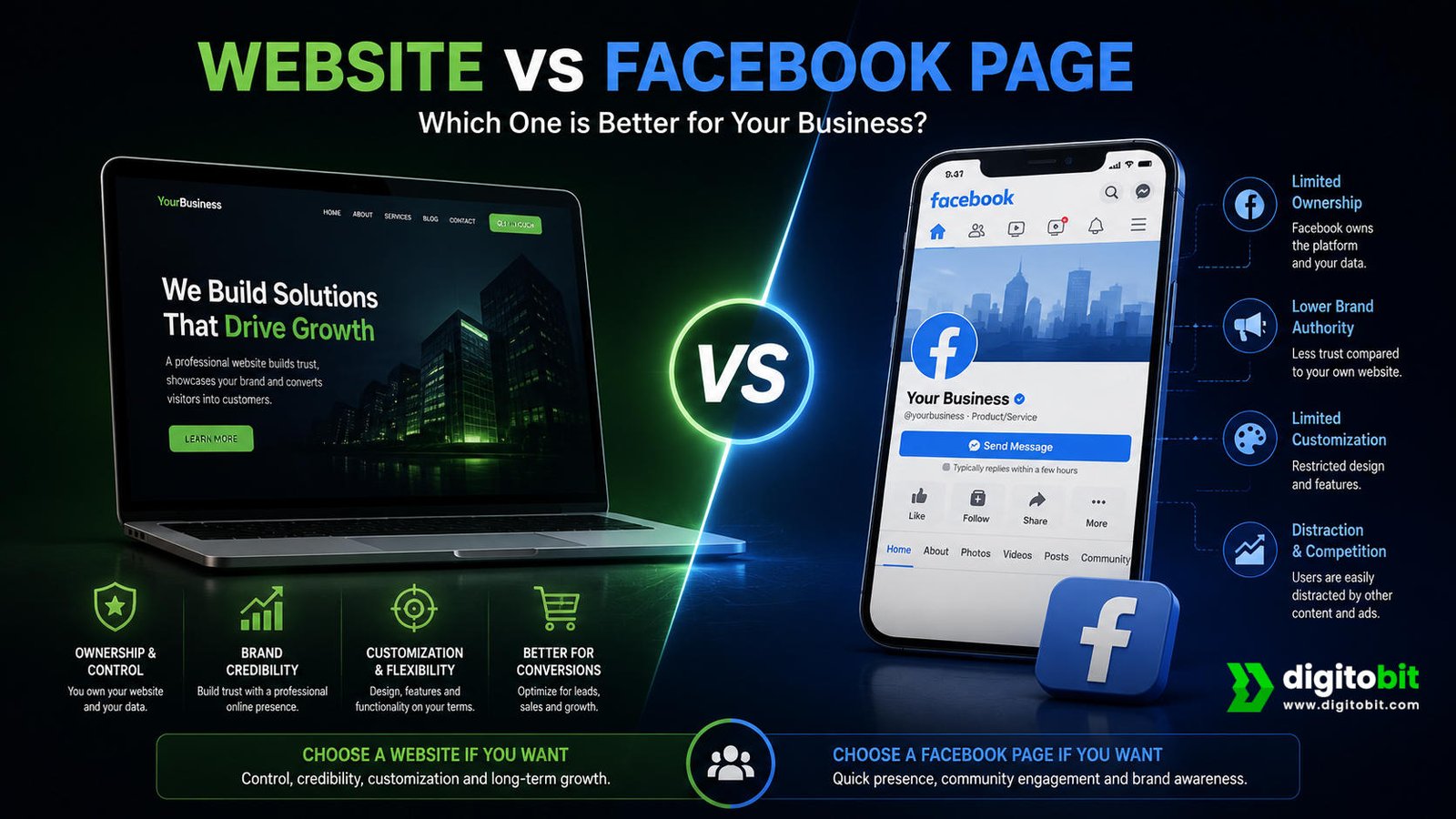
If you’re running a business in 2026, chances are you already have a Facebook page. It’s quick to set up, free to use, and gives you access to a large audience instantly.
But here’s the real question: Is a Facebook page enough to grow your business consistently?
Many business owners struggle with low reach, inconsistent leads, and dependency on paid ads. This guide will help you clearly understand whether you need a website or if Facebook alone is enough.
Table of Contents
- The Real Problem Business Owners Face
- Quick Answer
- Website vs Facebook Page: Key Differences
- What is a Website? (Business Perspective)
- What is a Facebook Page?
- Benefits of a Website
- Benefits of a Facebook Page
- Limitations of Relying Only on Facebook
- Website vs Facebook: ROI Comparison
- When Should You Use a Website?
- When is Facebook Enough?
- Best Strategy: Website + Facebook (Hybrid Approach)
- Real Business Example
- Common Myths (Debunked)
- Final Verdict
- Frequently Asked Questions
The Real Problem Business Owners Face
Most business owners start with a Facebook page because it’s easy and free. Initially, it works—you get some engagement, a few leads, and visibility.
But over time, problems begin to appear. Your posts stop reaching people, engagement drops, and leads become inconsistent.
This happens because Facebook controls everything. You don’t own your audience, and your reach depends on algorithms.
This creates a serious business risk: your growth depends on a platform you don’t control.
Building an independent online presence starts with controlling your domain registration and understanding your responsibilities as a registrant, as explained in ICANN’s guide to domain name registrants.
Quick Answer
- Facebook Page: Good for engagement and awareness
- Website: Best for conversions and long-term growth
A Facebook page helps you connect with people, but a website helps you convert visitors into customers and grow your business consistently.
Website vs Facebook Page: Key Differences
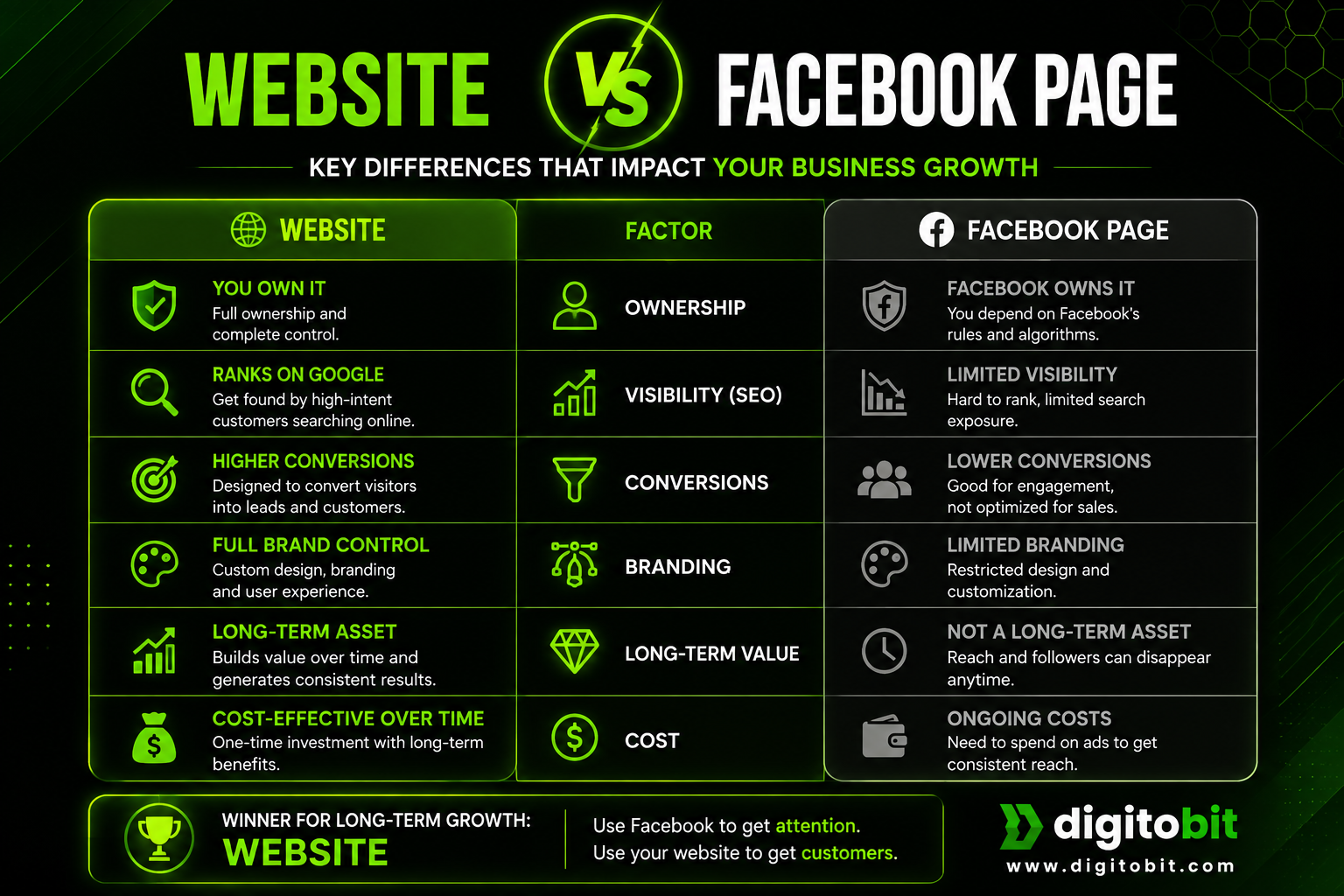
| Factor | Website | Facebook Page |
|---|---|---|
| Ownership | You own it | Facebook owns it |
| Visibility | Ranks on Google | Limited reach |
| Conversions | High | Moderate |
| Control | Full control | Limited control |
| Scalability | High | Limited |
What is a Website? (Business Perspective)
A website is your business’s digital headquarters. It is a platform you fully own and control.
It allows you to present your services, build trust, and convert visitors into customers without relying on third-party platforms.
With a website, you can generate leads 24/7, rank on Google, and build a long-term business asset.
Example: A service business can showcase services, display testimonials, and collect inquiries directly through the website.
What is a Facebook Page?
A Facebook page is a social media platform designed for businesses to connect with their audience.
It is mainly used for posting updates, engaging with followers, and running ads.
While it helps in building awareness and communication, it is not designed to generate consistent leads or conversions.
Best use: Facebook should act as a marketing channel that drives traffic to your website—not replace it.
Benefits of a Website
- Full ownership: You control everything from content to data
- Organic search visibility: A well-structured, useful website can attract relevant visitors through Google Search. Follow Google’s SEO Starter Guide to understand the fundamentals of helping search engines discover and understand your content.
- Higher conversion rates: Designed to turn visitors into customers
- Professional credibility: Builds trust instantly
- Long-term asset: Works for your business 24/7
Benefits of a Facebook Page
- Quick setup: Start in minutes with zero cost
- Built-in audience: Access to existing users
- Engagement focused: Easy interaction with customers
- Low starting cost: No upfront investment required
- Audience targeting: Meta advertising tools let businesses configure audiences and campaign delivery to reach people relevant to their marketing objectives. Learn more through Meta’s business advertising resources.
Limitations of Relying Only on Facebook
While Facebook is useful, relying on it as your only platform can limit your business growth significantly.
- No ownership of audience: You don’t control your followers
- Declining organic reach: Fewer people see your posts over time
- Algorithm dependency: Visibility depends on Facebook rules
- Paid ads required: Growth often needs continuous spending
- Risk of account issues: Pages can be restricted or removed
Website vs Facebook: ROI Comparison
Website
- Long-term ROI growth
- Free organic traffic
- High-quality leads
- Scalable marketing system
- Free to start
- Requires paid ads for reach
- Lower conversion rates
- Short-term visibility
When Should You Use a Website?
- When you want consistent leads
- When you offer services or high-ticket products
- When you want to rank on Google. You can monitor your website’s search visibility, clicks, queries, and indexing issues using Google Search Console.
- When you are building long-term brand authorityA Facebook page is a social media platform designed for businesses to connect with their audience. Businesses can use Facebook Pages to publish updates, communicate with followers, and share information about their products and services; see Meta’s business resources for an overview of Facebook Pages for businesses.
When is Facebook Enough?
- Early-stage business testing ideas
- Community-driven brands
- Very small local operations with limited goals
Best Strategy: Website + Facebook (Hybrid Approach)
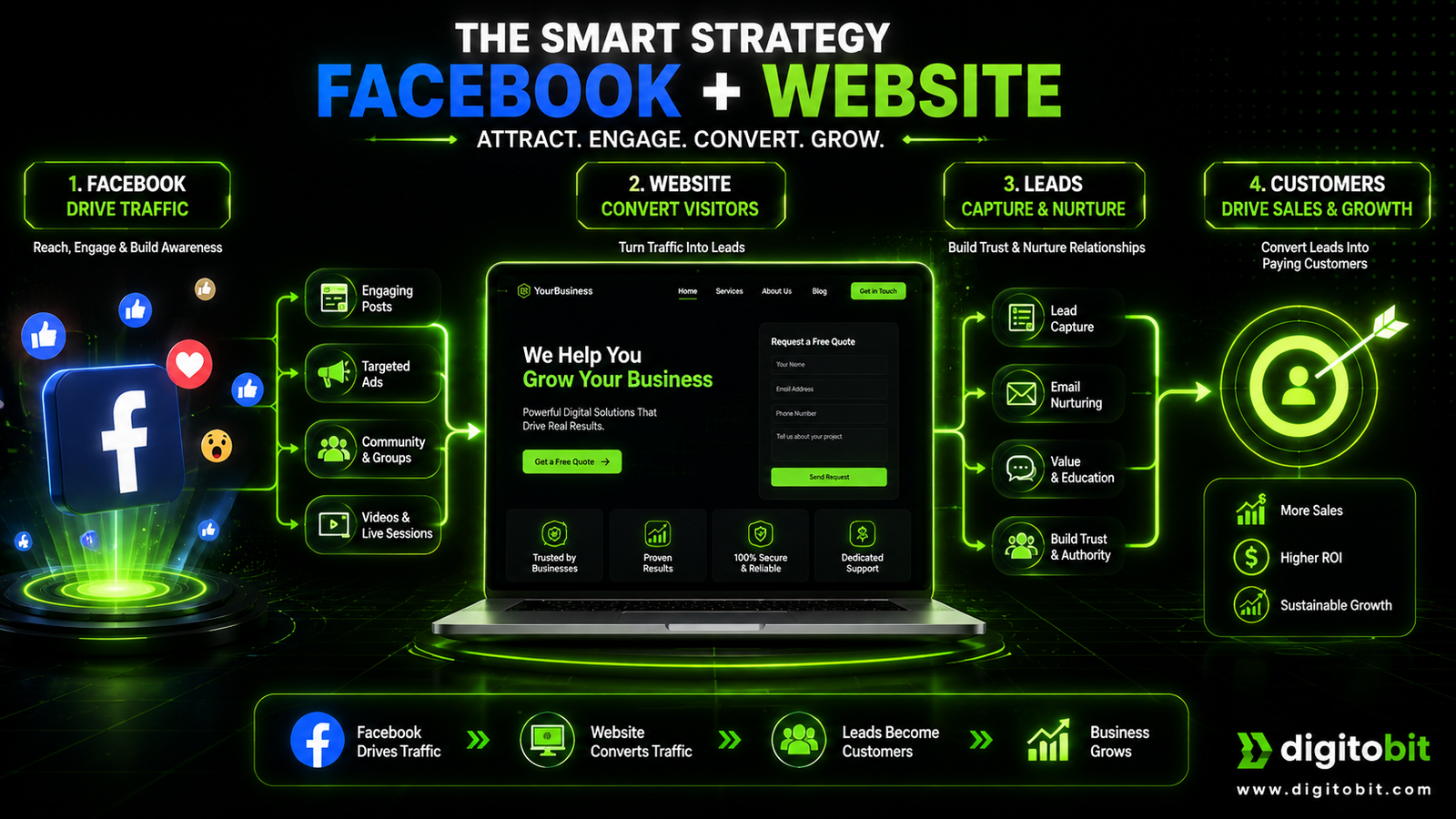
The smartest businesses don’t choose between a website and Facebook—they use both strategically.
Facebook should be used to attract attention and engage users, while your website should convert that traffic into leads and customers. A website can also attract people who are actively looking for relevant products or services through organic search; Google’s explanation of how Search works describes how content is discovered and presented in search results.
- Facebook: Awareness, engagement, traffic
- Website: Conversion, lead capture, sales
This creates a simple but powerful funnel: Facebook → Website → Lead → Customer
Instead of relying on one platform, you build a system that works together to grow your business.
Real Business Example
Consider a local service business that relies only on Facebook for leads. Initially, they receive inquiries through posts and messages.
But over time, their reach drops and they start spending money on ads just to get the same results.
After building a website, things change:
- They start ranking on Google
- They receive consistent inquiries through contact forms
- They build trust with testimonials and case studies
- Their dependency on ads decreases
This shift transforms their business from unpredictable growth to a stable lead generation system.
Common Myths (Debunked)
- “Facebook is enough” – It’s not. You don’t own your audience or reach.
- “Websites are expensive” – A website is an investment that generates long-term ROI.
- “I don’t need SEO” – Without SEO, you miss out on free traffic and leads.
- “Social media replaces websites” – Social platforms support your business, they don’t replace it.
Understanding these myths helps you make smarter decisions for long-term growth.
Final Verdict
A Facebook page is a useful tool, but it is not enough to build a sustainable business.
If you want consistent leads, higher conversions, and long-term growth, a website is essential.
The best approach is to use Facebook to drive traffic and your website to convert that traffic into real business results.
Turn Your Online Presence Into a Lead Machine
Stop depending on algorithms. Build a high-converting website that brings you consistent leads and real business growth.
Frequently Asked Questions
No. While Facebook helps with engagement, it does not provide long-term control, SEO visibility, or consistent lead generation.
A website gives you full ownership, better conversions, Google visibility, and long-term growth opportunities.
Yes. The best strategy is to use Facebook for traffic and engagement, and your website for converting visitors into leads and customers.
A website is more cost-effective long-term because it generates free organic traffic and reduces dependency on paid ads.

Author: Neeraj Mourya
Founder, Systems Architect – Digitobit
Specializing in scalable backend architecture and performance-focused SaaS systems