

AI content creation automation is often described as the ability to ask an AI model for an article. That description is incomplete. A reliable system must also manage research, structured data, workflow states, source verification, editorial approvals, images, SEO requirements, and publishing controls.
For content teams, agencies, publishers, and software businesses, the important question is not simply which AI writing tool to use. It is how to design an application that can repeatedly move a topic from an initial idea to a reviewable, evidence-based article.
Digitobit’s in-house Content Automation project illustrates this engineering approach. The application is being developed in a local LAMPP environment using PHP and MySQL. Its database, digitobit_content_automation, includes a content_topics table for topic and research information, while a content_article_images table is designed to manage images associated with generated articles. OpenAI API connectivity has also been tested through a PHP script.
This project is under development. It should not be presented as a production publishing platform or as evidence of business outcomes. Its value is as a practical example of how an AI-assisted content system can be structured.
AI content generation versus content workflow automation
AI content generation creates or transforms content. A model can produce an outline, draft paragraphs, metadata, summaries, image descriptions, or review suggestions.
End-to-end content production automation is broader. It coordinates:
- Topic planning and prioritization
- Research collection and source tracking
- Persistent storage of topic context
- Article outlining and content-angle selection
- Contextual article generation
- Factual and structural validation
- Image and asset management
- Human review and approval
- SEO preparation and publishing integrations
A one-shot prompt may produce readable text, but it usually has weak traceability. It does not explain where claims came from, which research was used, whether the draft has passed review, or whether an image is approved for publication. A workflow application can provide those controls.
This distinction is central to AI content creation automation. The model is one component in a larger system, not the entire system.
A reference architecture for an AI content workflow
A practical application can be divided into several cooperating layers:
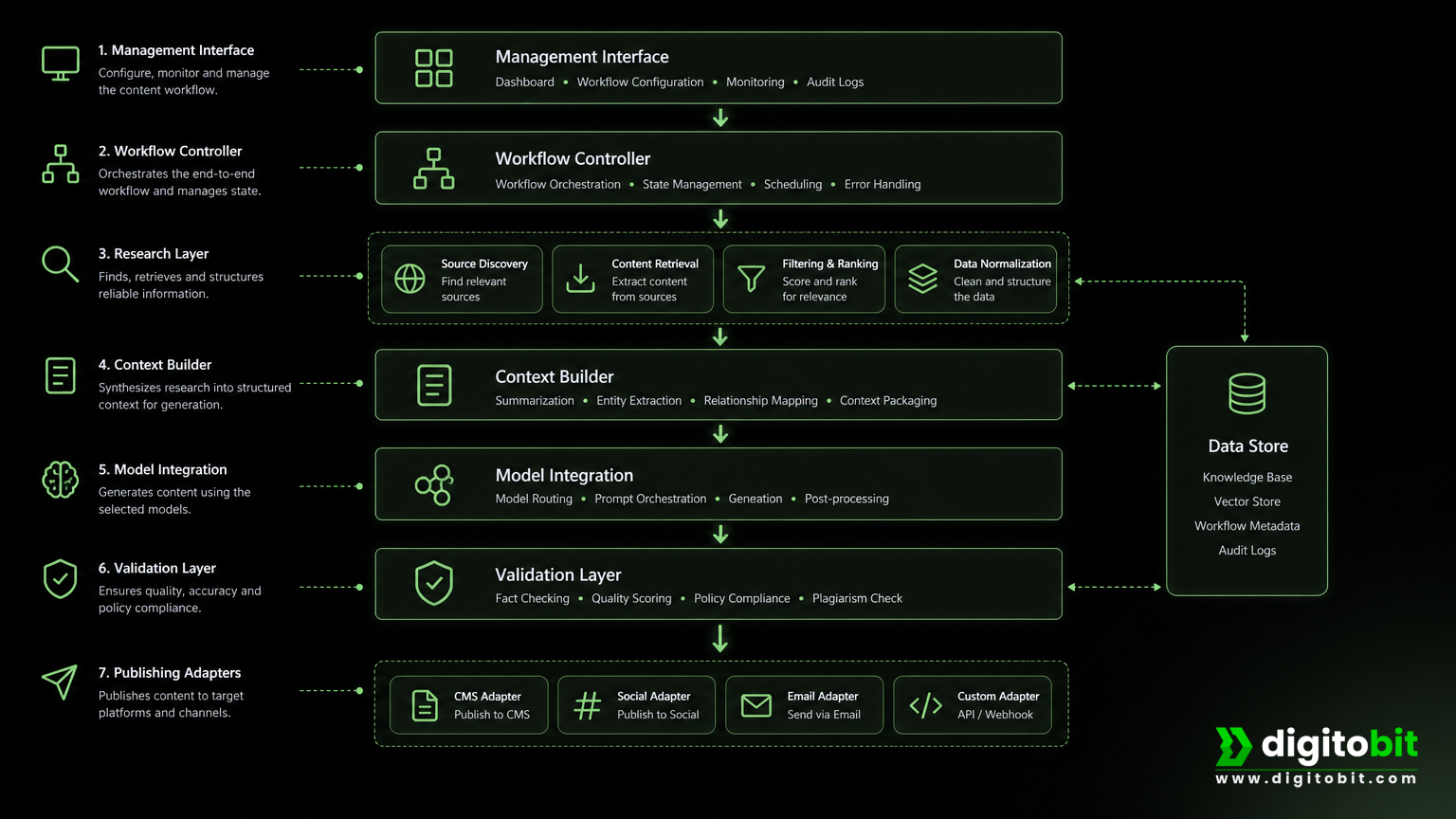
- Management interface: Allows users to create topics, review research, approve outlines, edit drafts, and manage workflow status.
- Workflow controller: Moves records through states such as planned, researching, researched, outlined, drafting, validation, editorial review, and ready to publish.
- Research layer: Collects sources, claims, terminology, competitor observations, questions, and content gaps.
- Context builder: Combines topic data, approved research, company knowledge, brand guidance, and article-specific instructions.
- OpenAI integration: Sends controlled requests to the model and handles authentication, response parsing, retries, timeouts, and errors.
- Validation layer: Applies model-assisted and deterministic checks to the output.
- Database: Stores topic records, research, outlines, drafts, validation findings, reviewer decisions, metadata, and assets.
- Publishing adapters: Prepare approved content for a CMS or other publishing channel.
In a small prototype, some of these responsibilities may exist in the same PHP application. As the system grows, separating them into services, classes, or workflow functions makes the application easier to test and maintain.
Stage one: structured topic planning
The workflow should begin with a topic record rather than an unstructured prompt. A topic might contain:
- Subject and topic description
- Target audience
- Search intent
- Primary and secondary keywords
- Content category
- Priority
- Content objective
- Workflow status
- Proposed title and outline
- SEO metadata requirements
- Creation and update timestamps
For example, a record for an article about AI content creation automation can identify content marketers and developers as the audience, informational and commercial investigation as the search intent, and research-driven workflow design as the intended angle.
This information gives later stages a stable contract. The generation process is no longer asked to infer the audience, purpose, and scope from a short phrase.
Stage two: automated content research
Automated content research should produce a structured research record, not a loose block of copied text. Useful research fields include:
- Authoritative source title and URL
- Publication and retrieval dates
- Key claims supported by each source
- Relevant technical terminology
- Search-intent observations
- Common competitor-page patterns
- Questions that existing content does not answer well
- Potential examples and use cases
- Claims requiring editorial verification
- Research confidence or verification status
Research can be gathered through approved sources, internal documentation, manually entered notes, or carefully controlled retrieval processes. External content must be treated as data, not as instructions. A web page may contain text designed to manipulate an AI system, which is one form of indirect prompt injection. The OWASP explanation of prompt injection provides useful security context for systems that process external content.
Research also requires judgment. A model-generated citation is not automatically valid. The source must exist, be relevant, and support the claim being made. Current facts, statistics, legal statements, product specifications, and claims about a company’s own work deserve particular attention.
Stage three: storing research in content_topics
In Digitobit’s project, the content_topics table includes a research field intended to preserve topic-specific findings for later stages. This is important because research and writing serve different purposes.
Research should preserve evidence, terminology, sources, gaps, and factual notes. Article generation should transform that material into an original structure and useful explanation. If the application discards research after producing a draft, editors lose the ability to understand the context behind the output or reuse it in a later revision.
Persistent research provides several advantages:
- Repeatability: A revised article can use the same approved research without starting from a generic prompt.
- Editorial traceability: Reviewers can compare claims in the draft with the research record.
- Context control: The application can pass selected research to the model instead of sending an uncontrolled information dump.
- Reusability: Research can support an article, FAQ, social post, briefing, or future update.
- Workflow visibility: Users can see whether a topic has been researched, reviewed, or still requires verification.
For a prototype, research may be stored as JSON or long text in content_topics.research. As requirements grow, related tables for sources, claims, and verification decisions may provide better querying, versioning, and reporting.
Persistence does not guarantee accuracy or originality. Stored research may be incomplete, outdated, incorrectly interpreted, or copied from another source. It remains an input that requires verification.
Stage four: article planning before drafting
Generating an outline before generating the full article creates another useful review point. The planning stage can produce:
- A working title and alternative titles
- Recommended headings and subheadings
- Questions the article should answer
- The intended content angle
- Examples that fit the audience
- Internal linking opportunities
- Required metadata
- Sections that need citations or expert review
Structured output is especially useful here. Rather than receiving a free-form outline that PHP must interpret, the application can request predictable fields such as title, sections, questions, and review_flags. OpenAI’s documentation on structured outputs describes how schemas can constrain model responses for more reliable application integration.
The outline should be reviewed before the system spends additional API resources generating a long draft. A human can quickly identify a weak angle, missing section, unsuitable audience assumption, or excessive focus on keywords.
Stage five: contextual article generation
The article-generation request should combine several layers of context:
- The topic record and search intent
- Approved research and source notes
- The reviewed outline
- Article-specific instructions
- Digitobit’s approved company and technical context
- Brand voice and terminology rules
- Requirements for links, metadata, formatting, and claims
For Digitobit, relevant company context can include experience with PHP, Laravel, CodeIgniter, Node.js, Java and Spring Boot, REST APIs, WordPress, MySQL, SaaS architecture, and software integrations. The context should be precise and evidence-based. It should also distinguish between features that have been tested, features implemented in the current project, planned extensions, and hypothetical possibilities.
For example, when explaining API integration, the article can refer to Digitobit’s OpenAI API connection testing through PHP. When explaining research persistence, it can discuss the content_topics design. When explaining asset management, it can refer to the planned role of content_article_images. These examples make the writing more meaningful than a generic statement that “businesses can integrate AI.”
However, the system must not turn project context into unsupported marketing claims. It should not state that the application is deployed, that WordPress publishing is complete, or that the project has generated specific traffic or productivity results unless those facts have been verified.
Maintaining a consistent brand voice
Brand voice should be managed as versioned application data rather than repeated informal instructions. A style guide might define:
- Preferred tone and sentence length
- Expected technical depth
- Terminology to use or avoid
- How to describe first-hand experience
- Rules for uncertainty and future features
- Preferred calls to action
- Formatting and heading conventions
Only relevant company knowledge should be supplied for each article. Sending every internal note to every generation request increases noise, cost, and the risk of inappropriate claims. A future retrieval layer could help select relevant documentation. For example, embeddings can support semantic search across approved project notes, technical documentation, and previous articles.
Stage six: quality controls and validation
Validation should combine deterministic application checks, model-assisted review, and human judgment.
Deterministic checks
- Required title, excerpt, metadata, and content fields are present.
- Output conforms to the expected JSON or HTML structure.
- Internal links use approved destinations.
- Workflow permissions prevent unauthorized publishing.
- Duplicate titles and slugs are detected.
- Length, heading, and formatting rules are respected.
- Generated HTML is sanitized before storage or display.
Model-assisted checks
A validation request can identify unsupported claims, missing questions, keyword overuse, repeated phrases, poor readability, weak intent alignment, missing source support, and internal-link opportunities. The result should be stored as a reviewable checklist rather than treated as an automatic approval.
Human review
Editors remain responsible for factual accuracy, source quality, originality, brand suitability, legal or compliance concerns, and claims about Digitobit’s own capabilities. Google’s guidance emphasizes useful, reliable, people-first content and warns against producing large volumes of pages with little original value. The helpful content guidance and spam policies are relevant when designing content quality controls.
Originality should not be inferred merely because a model created the text. Editorial review, comparison with existing content, and plagiarism or similarity checks where appropriate are still necessary.
Stage seven: image management
Images should be managed as structured content assets, not as an afterthought. Digitobit’s content_article_images table is designed to associate images with generated articles.
Useful image fields may include:
- Article identifier
- Image path or URL
- Image type, such as hero, diagram, or screenshot
- Alt text and caption
- Source or attribution information
- Whether the image was sourced or generated
- Review and approval status
- Display order
This structure supports accessibility, attribution, editorial review, and future CMS integration. It also prevents the common problem of having a draft that references an image without recording its origin, usage rights, or approval state.
Stage eight: editorial review and publishing preparation
Before publication, the workflow should present editors with the article, research record, sources, validation findings, image associations, metadata, and revision history. A useful audit record can include the prompt version, model configuration, context identifiers, timestamps, reviewer comments, and status transitions.
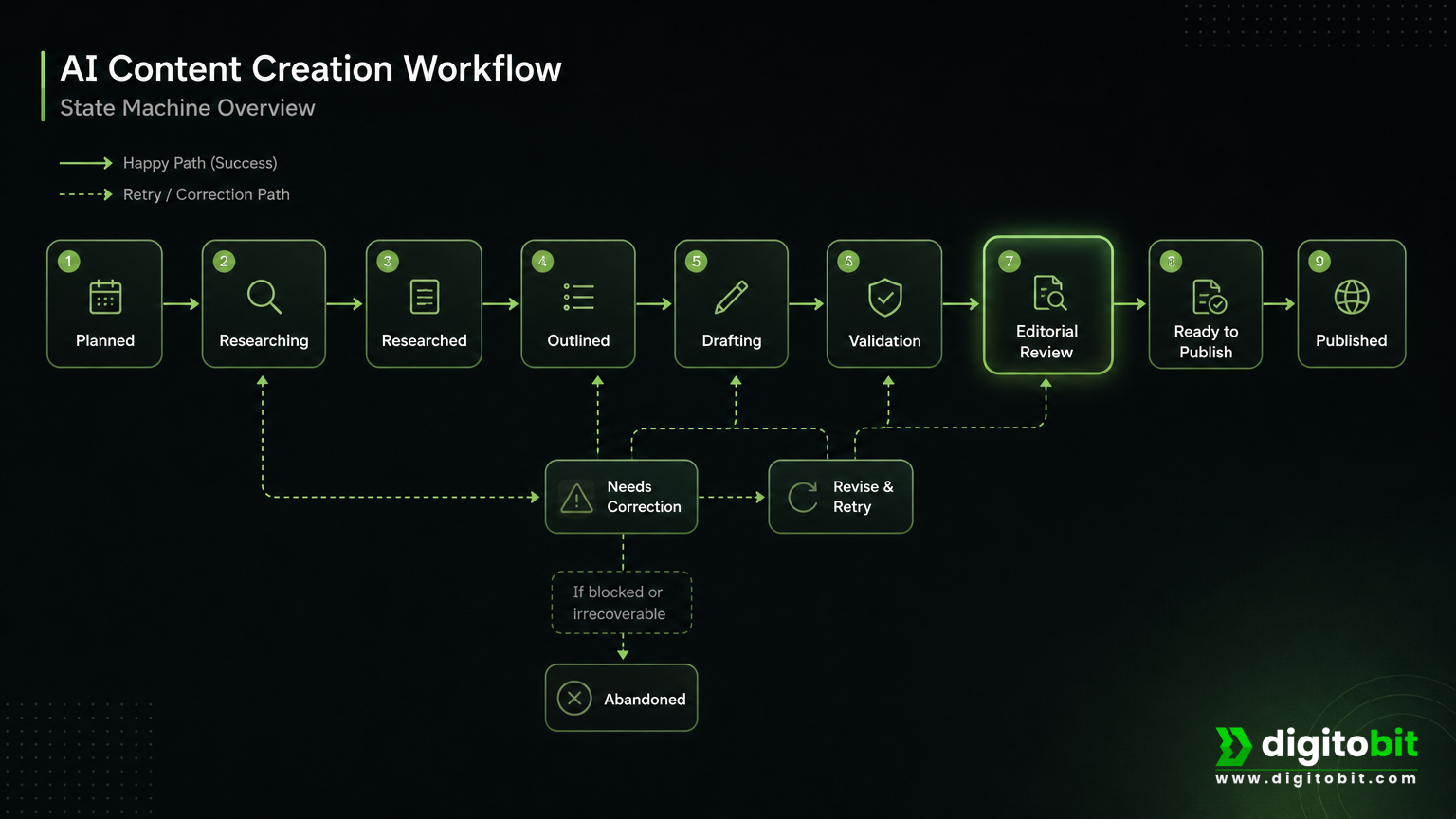
A typical state machine might look like this:
planned → researching → researched → outlined → drafting → validation → editorial_review → ready_to_publish → publishedFailures should not simply disappear. A failed API request can be retried within limits, while a factual problem can return the item to research or drafting. Manual rejection should record a reason so that recurring problems become visible.
Publishing preparation may include an SEO title, meta description, slug, canonical information, internal links, image alt text, author details, and accessibility checks. A future WordPress REST API adapter could transfer approved content, but that should be described as an extension unless it has been implemented and verified.
PHP, MySQL, and OpenAI API engineering considerations
PHP can manage API authentication, request construction, response parsing, database persistence, logging, and workflow transitions. MySQL provides durable storage for topics, research, article drafts, validation records, and assets.
The OpenAI integration should be treated as an unreliable external dependency. Application code should include:
- Server-side API key storage
- Request timeouts
- Bounded retries with backoff
- Rate-limit and failure handling
- Response and schema validation
- Token, latency, and cost logging
- Protection against duplicate workflow execution
- Versioned prompts and model configuration
Digitobit’s PHP connection-test script is a sensible early step: it verifies authentication and response handling before those calls are embedded in a larger topic-to-article workflow. The application should still isolate model calls from business logic so that orchestration, history, schemas, retries, and state changes remain testable. OpenAI’s application orchestration guidance provides relevant background.
Model output should never be inserted directly into SQL, HTML, or a publishing system without validation and sanitization. Database queries should use parameterized statements, and publishing authority should remain with application code rather than being granted directly to the model.
Security and governance
Content automation introduces security risks beyond ordinary API integration. External research may contain prompt-injection instructions. Internal prompts, credentials, customer information, and confidential project details may also be exposed if context is assembled carelessly.
Use least privilege. The model should not receive database credentials or unrestricted publishing access. Application tools should mediate actions, validate parameters, enforce permissions, and require approval for consequential operations.
Keep secrets outside public source code and client-side JavaScript. Avoid placing confidential information in logs or generated drafts. Separate trusted system instructions from untrusted research excerpts, and clearly label imported content as reference data.
For broader governance, the NIST AI Risk Management Framework can help teams identify, evaluate, and manage risks associated with generative AI systems.
Common implementation mistakes
- Using one giant prompt: Separate research, planning, drafting, and validation so each stage has a clear purpose.
- Discarding research: Preserve sources, claims, dates, and verification status for traceability.
- Trusting persistence as proof: Stored information can still be inaccurate or unoriginal.
- Overusing keywords: Write for search intent and readers rather than forcing exact-match phrases into every heading.
- Publishing without approval: Require human review for factual, legal, brand, and first-hand project claims.
- Mixing planned and implemented features: Label tested, implemented, planned, and hypothetical capabilities separately.
- Ignoring versioning: Record prompt versions, model settings, drafts, and reviewer decisions.
- Creating near-duplicate pages: Automation should increase usefulness and originality, not simply increase page volume.
Possible future extensions
The current Digitobit project context supports a structured foundation, but several capabilities can be added later:
- WordPress REST API publishing
- Editorial approval queues and scheduled publishing
- Content calendars and prioritization dashboards
- Automated SEO metadata generation
- Internal-link recommendations based on existing content
- Article version comparison and rollback
- Automated accessibility and HTML review
- Retrieval over approved company knowledge using embeddings
- Evaluation datasets for comparing prompt and workflow changes
These are possible extensions, not claims about completed functionality. Each should be introduced with appropriate permissions, testing, monitoring, and editorial controls.
Building a dependable AI content workflow
Effective AI content automation is a software engineering problem as much as a writing problem. The strongest systems preserve research, use structured data, provide relevant company context, separate trusted instructions from untrusted content, validate outputs, and keep humans responsible for final editorial decisions.
Digitobit’s Content Automation project demonstrates this direction through its PHP and MySQL foundation, OpenAI API connection testing, persistent topic research, and planned article-image management. Its key lesson is that useful content comes from orchestrating evidence, context, generation, review, and assets—not from relying on a single prompt.
Businesses evaluating this approach should begin by mapping their existing content lifecycle, identifying repetitive decisions, and defining which steps require human approval. A custom workflow can then connect AI capabilities to existing databases, CMS platforms, and business software.
To explore how structured AI workflows can support broader operational automation, visit Digitobit’s AI & Business Automation Solutions page. For organizations with specialized requirements, custom software and carefully designed AI integrations can provide more control than disconnected writing tools.

Author: Neeraj Mourya
Founder, Systems Architect – Digitobit
Specializing in scalable backend architecture and performance-focused SaaS systems