
Choosing to outsource web development to India can give a business access to a large technical talent market, specialist skills, and flexible delivery capacity. It can also introduce communication overhead, quality risk, security exposure, and coordination costs if the engagement is poorly structured.
The right decision depends less on geography than on scope, governance, team quality, and the total cost of ownership. A brochure website, a transactional platform, and a regulated SaaS application require very different delivery models.
This guide explains how to evaluate Indian freelancers, agencies, dedicated teams, and product-development partners. For broader technical planning, see Digitobit’s Web Development resources.
What does outsourcing web development to India mean?
Outsourcing may involve:
- A freelancer handling a defined feature or website build
- A boutique agency delivering design, development, and QA
- A dedicated offshore team working continuously with your product organization
- A full-service product partner responsible for architecture, implementation, deployment, and support
These options differ in accountability, continuity, role coverage, and cost. A freelancer may be efficient for a bounded WordPress project, while a SaaS product usually needs product management, architecture, frontend and backend engineering, QA, DevOps, security, and post-launch support.
India web development costs: benchmarks and budgeting
Published benchmarks are directional rather than guaranteed quotes. Upwork reports Indian web developers at approximately $16–$35 per hour, based on historical worldwide contracts. Clutch lists Indian web-design companies at approximately ₹1,600–₹7,000 per hour, or roughly $20–$85 per hour. These ranges reflect different engagement types and should not be compared as equivalent agency and freelancer rates.
For illustration, 800 hours at $20–$85 per hour produces a development-cost range of approximately $16,000–$68,000, before project-specific expenses. This is an example, not a market average or a reliable quote for a particular project.
Rates can vary because of:
- Developer seniority and technical specialization
- City, hiring market, and availability
- English proficiency and client-facing responsibilities
- Agency overhead and management structure
- Whether design, QA, DevOps, security, and project management are included
- Compliance maturity and experience with regulated industries
- Required support hours and time-zone coverage
India’s large export-oriented IT-services sector supports a broad global-delivery ecosystem. NASSCOM-reported FY2025 estimates cited in a SEBI filing put IT-industry exports at approximately $224 billion and exports at about 79% of industry revenue. This demonstrates ecosystem scale, but it does not validate the quality of an individual supplier.
Website costs versus web application costs
A marketing website is often cheaper and easier to specify than a web application. However, comparing proposals by page count alone can be misleading.
For a marketing site, define templates, CMS configuration, content migration, redirects, analytics, accessibility, performance targets, browser support, training, and maintenance. For a web application, define architecture, integrations, authentication, authorization, data models, security controls, environments, automated testing, monitoring, deployment, and support.
Calculate total cost of ownership
The vendor invoice is only one part of the business case. Include:
- Discovery, requirements, UX, and technical architecture
- Internal product-owner and stakeholder time
- Project management, meetings, and decision delays
- QA, security testing, accessibility remediation, and performance work
- Cloud hosting, domains, licenses, APIs, payment fees, and monitoring
- Travel, foreign-exchange, payment, and procurement costs
- Rework caused by unclear requirements or weak acceptance criteria
- Onboarding, replacement, knowledge transfer, and transition expenses
- Post-launch maintenance, support, vulnerability remediation, and feature work
The lowest hourly rate can produce the highest delivered cost when senior review, testing, documentation, and communication are missing.
Pricing models for Indian development partners
Fixed price
Fixed-price contracts work best when requirements, deliverables, dependencies, and acceptance criteria are stable. They improve budget predictability but require disciplined scope management. Ambiguity commonly leads to exclusions, change orders, or rushed implementation.
Time and materials
Time-and-materials contracts suit evolving products and discovery-heavy work. They support iteration, but require a maintained backlog, weekly reporting, budget limits, approval controls, and visibility into actual effort.
Dedicated team
A dedicated team is appropriate for ongoing product development where continuity and domain knowledge matter. Agree on named personnel, allocation, working hours, replacement procedures, holidays, responsibilities, and minimum commitment.
Retainer or support agreement
A retainer can provide predictable access to maintenance and development capacity. Define included hours, rollover rules, response times, severity levels, unused-hour treatment, and rates for work outside the retainer.
Hybrid delivery
A practical approach is to use fixed-price discovery followed by iterative time-and-materials delivery. Discovery can produce a validated backlog, architecture, delivery plan, risks, and estimates before substantial implementation begins.
Benefits and limitations of outsourcing to India
Potential benefits
- Talent access: Businesses can source frontend, backend, mobile, cloud, QA, data, and security skills without building every capability internally.
- Scalability: Agencies and larger providers may add specialists as the product evolves.
- Lower labor costs: Labor costs may be lower than in some markets, although delivered cost depends on seniority, scope, management, and rework.
- Specialization: Established providers may have reusable experience with particular stacks, integrations, or industries.
- Delivery coverage: India Standard Time, or IST (UTC+5:30), can support European daytime collaboration and planned overlap with North American teams. Upwork provides additional context on Indian hiring and working arrangements.
Potential limitations
- Time-zone differences can slow decisions if no overlap or escalation process exists.
- Communication quality varies between vendors and individual team members.
- Portfolio quality may not reflect the proposed team’s actual experience.
- Staff turnover or undisclosed subcontracting can reduce continuity.
- Weak requirements and acceptance criteria can create rework and disputes.
- Cross-border data access, IP ownership, and applicable laws require explicit contracts.
Nearshore providers may reduce time-zone and travel friction, while India may offer broader talent availability and lower labor costs. Compare delivered output, overlap hours, communication burden, replacement risk, and internal management effort—not hourly rate alone.
How to choose an Indian web development partner
1. Define the engagement before requesting quotes
Prepare a short request for information, followed by a detailed RFP for credible candidates. Describe business goals, users, platforms, integrations, expected launch date, compliance requirements, support needs, and known constraints.
Ask every bidder to state assumptions and exclusions. Require a line-item proposal covering UX, UI design, copy, development, content migration, cloud setup, third-party subscriptions, security testing, accessibility, launch support, and warranty fixes.
2. Verify the portfolio
Request case studies that identify the team’s actual contribution, technology choices, project duration, role of the vendor, and measurable outcomes where disclosure is permitted. Ask for two or three client references with similar complexity.
A portfolio is not proof that the proposed developers delivered the work. Confirm who will be assigned and whether the agency used subcontractors.
3. Evaluate the proposed team
Request résumés and conduct technical or role-specific interviews. For a SaaS application, a suitable structure may include:
- Product manager or delivery lead
- Technical architect or senior engineer
- Frontend and backend engineers
- QA engineer responsible for test planning and automation
- DevOps or cloud support
- UX or UI design support where required
Clarify who owns product decisions, architecture, code review, QA sign-off, release approval, incident response, and client communication.
4. Run a paid discovery sprint or pilot
A small paid engagement is often more informative than a sales presentation. Evaluate the vendor’s requirements quality, estimates, technical decisions, code review discipline, test coverage, documentation, communication, and responsiveness.
The pilot should have a real deliverable and measurable criteria. Do not use unpaid production work as an evaluation exercise.
5. Check operational maturity
Ask about financial stability, employee retention, insurance, business continuity, incident handling, backup procedures, security training, and subcontractor controls. For sensitive systems, request relevant security policies and audit evidence proportionate to the risk.
Team structure, time-zone overlap, and communication
India operates on IST (UTC+5:30). A time difference can be useful when planned, but it is not automatically a productivity advantage. Agree on a daily or several-times-weekly overlap window; even a 30–60 minute period can support decisions and unblock work.
Define:
- Core collaboration hours and holiday calendars
- Expected response times by communication channel
- Who is available for urgent production issues
- Meeting cadence, attendees, and decision owners
- Written status-update format
- Escalation path for blocked work and incidents
A useful asynchronous update covers completed work, next steps, blockers, risks, decisions needed, and changes to estimates. Keep requirements and decisions in a shared system rather than allowing important scope changes to remain in chat.
Project governance and contracts
A strong contract turns expectations into measurable obligations. At minimum, use a master services agreement and a project-specific statement of work.
The statement of work should include:
- Scope, assumptions, dependencies, milestones, and deliverables
- Functional, performance, accessibility, security, and content acceptance criteria
- Named team members, allocation, and approved subcontractors
- Reporting cadence, demos, sprint reviews, and risk-register ownership
- Change-control procedure, including estimation, approval, pricing, and scheduling
- Payment milestones tied to accepted deliverables, not dates alone
- Warranty period, defect definitions, support hours, and service levels
- Termination rights, transition assistance, and handover obligations
A vague requirement such as “complete the website” is difficult to enforce. A better criterion might specify supported browsers, page templates, responsive behavior, performance thresholds, accessibility target, SEO redirects, analytics events, and content responsibilities.
IP ownership, open source, and exit rights
Confidentiality does not automatically transfer ownership of the work. Contractually address:
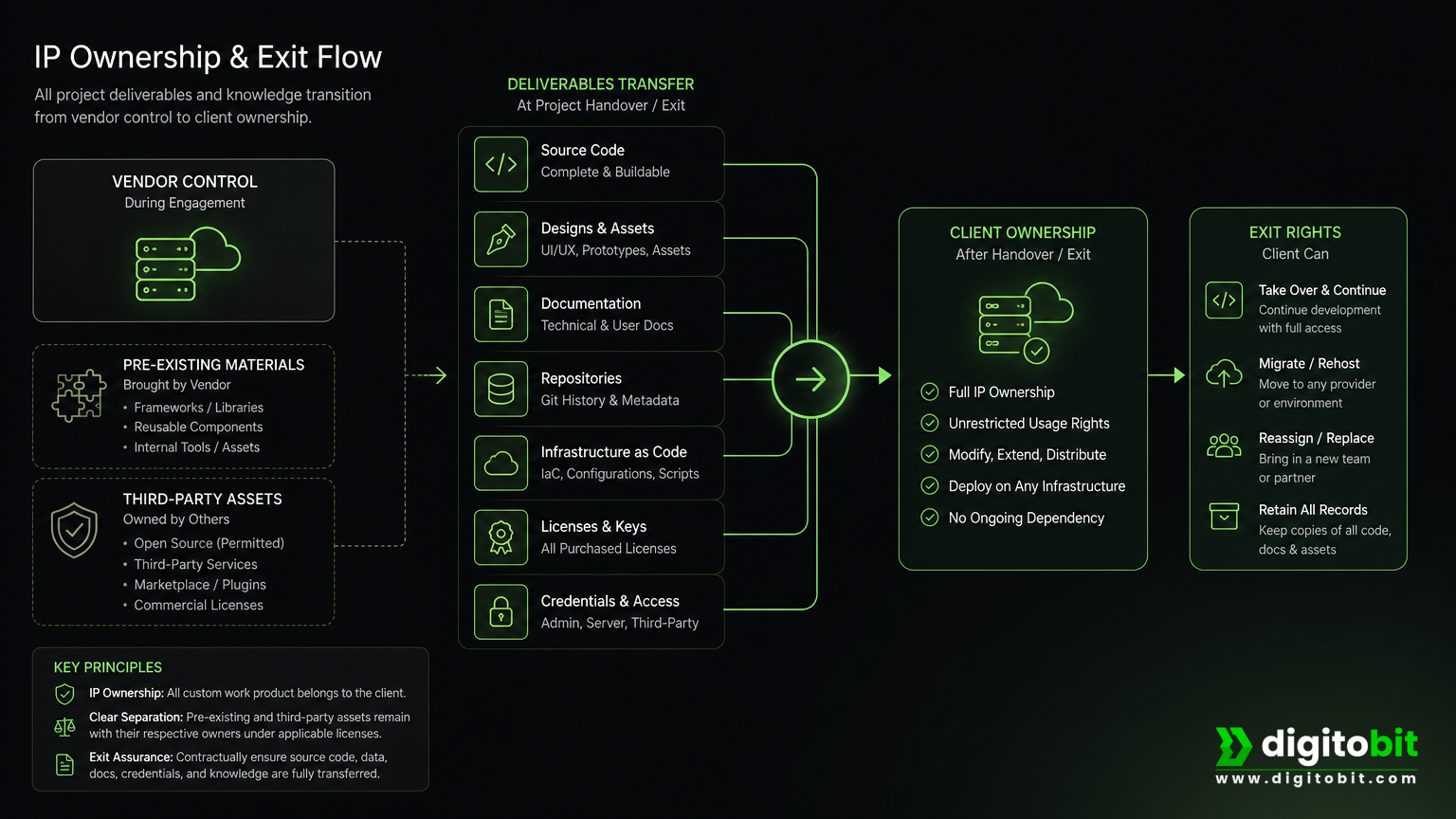
- Source code, object code, designs, documentation, test assets, and configurations
- Pre-existing vendor materials and reusable libraries
- Third-party assets, fonts, images, and software licenses
- Open-source components, license obligations, vulnerabilities, and approval of copyleft software
- Repository, cloud-account, domain, CI/CD, and production-data ownership
- Rights to derivative works, modifications, and future use
Under India’s Copyright Act, a copyright assignment must be written and signed, identify the work, and specify rights, duration, and territorial extent. Use counsel to draft an explicit assignment suited to the engagement rather than relying on a generic confidentiality clause.
Plan for exit from the beginning. Require repository transfer, documentation, infrastructure diagrams, credential return, knowledge-transfer sessions, data export, and reasonable transition assistance.
Data protection and secure development
Determine what data the vendor can access, where it will be stored, which subprocessors are used, and which laws apply. India’s Digital Personal Data Protection Rules, 2025 were notified on November 13, 2025, with phased commencement dates. Confirm the implementation date relevant to the engagement and do not assume Indian compliance satisfies GDPR, CCPA/CPRA, HIPAA, PCI DSS, or sector-specific obligations.
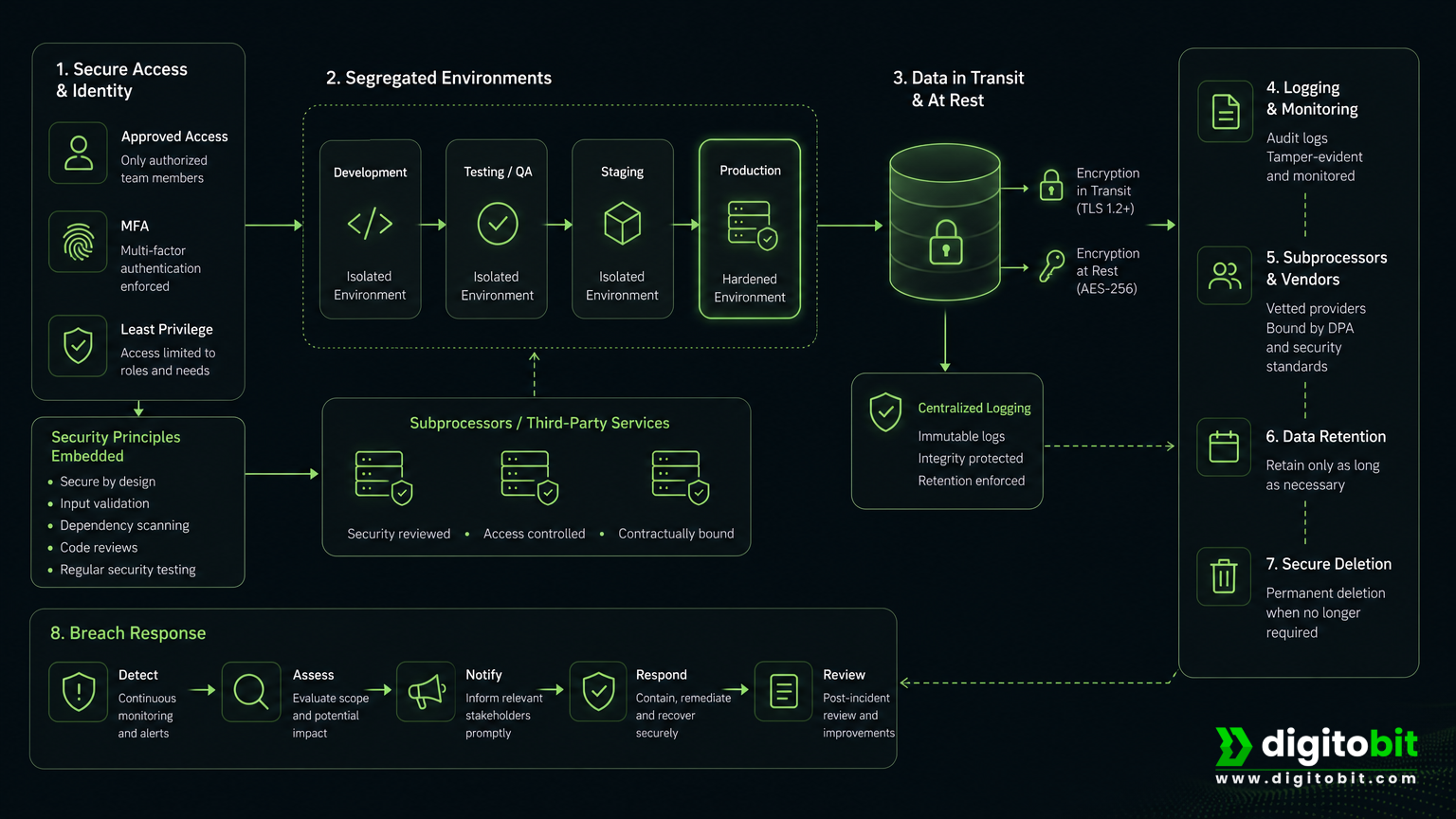
Contracts should address:
- Controller/processor or equivalent responsibilities
- Approved subprocessors and data locations
- Least-privilege access, MFA, logging, and environment separation
- Encryption in transit and at rest where appropriate
- Retention, deletion, return of data, and secure disposal
- Breach notification, cooperation, audit rights, and incident response
- Credential rotation and prohibition on personal production accounts
Use a recognized secure-development baseline. The NIST Secure Software Development Framework provides practices for integrating security into the SDLC and managing software-supplier expectations. For contract language, the OWASP Secure Software Contract Annex covers security requirements, testing, coding practices, personnel, acceptance, and remediation.
QA, deployment, and launch governance
QA should begin during planning, not after development is supposedly complete. Require a test strategy covering:
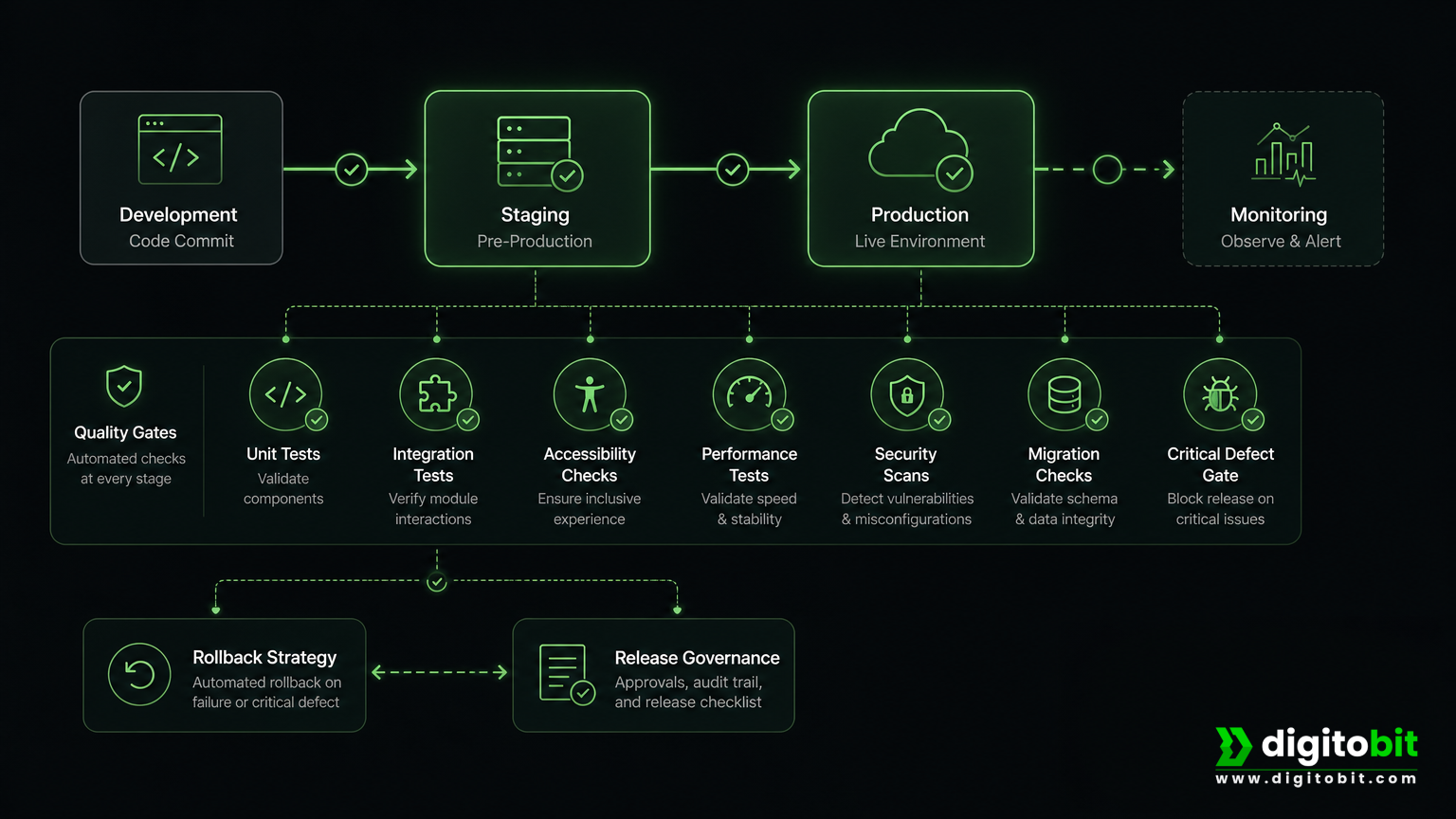
- Unit, integration, API, end-to-end, regression, and exploratory testing
- Browser, device, responsive-layout, and localization coverage
- Accessibility testing and remediation
- Performance targets and load testing where appropriate
- Authentication, authorization, input validation, and error handling
- Dependency scanning, vulnerability assessment, and proportionate penetration testing
- Backup, restore, deployment, monitoring, and rollback procedures
Use separate development, staging, and production environments. Establish a release gate requiring accepted functionality, resolved critical defects, security review, migration checks, monitoring, and a rollback plan.
For applications with ongoing risk, request dependency inventories or an SBOM, evidence of code review, test reports, vulnerability-remediation records, and documentation for operational ownership.
Common mistakes to avoid
- Choosing the lowest quote: Compare role mix, seniority, QA allocation, project management, warranty, security, and maintenance.
- Accepting an unverified portfolio: Confirm authorship, team assignment, and client references.
- Allowing undisclosed subcontracting: Require prior written approval and equivalent confidentiality and security obligations.
- Ignoring time zones: Set overlap hours, response targets, holiday coverage, and escalation procedures.
- Giving broad production access: Use least privilege, MFA, logging, separate environments, and credential rotation.
- Relying only on confidentiality language: Add explicit IP assignment, open-source, repository, and handover terms.
- Testing only happy paths: Include security, accessibility, performance, failure, migration, and recovery testing.
- Omitting exit provisions: Contract for documentation, repository transfer, credentials, knowledge transfer, and transition support.
Practical partner-selection scorecard
Score shortlisted providers against the same criteria:
- Relevant technical and domain experience
- Quality and availability of the named team
- Clarity of architecture, delivery plan, and assumptions
- Security, privacy, QA, and compliance maturity
- Communication process and time-zone coverage
- Commercial transparency and total delivered cost
- References, financial stability, and continuity plan
- Contract quality, IP ownership, and exit assistance
Ask finalists to provide an implementation plan, staffing chart, risk register, acceptance approach, support model, and itemized commercial proposal. A partner that cannot explain exclusions and risks before signing is unlikely to manage them well after work begins.
Final decision framework
Outsourcing web development to India can be a strong option when the project has clear ownership, measurable delivery controls, appropriate security practices, and a realistic communication model. It is less suitable when the business cannot provide timely product decisions, has no internal technical oversight, or expects a low hourly rate to compensate for undefined scope.
Compare partners using blended delivered cost and business risk. Select the team that can demonstrate relevant work, communicate clearly, protect your data and IP, produce testable software, and support an orderly handover—not simply the vendor with the cheapest quote.
Sources

Author: Neeraj Mourya
Founder, Systems Architect – Digitobit
Specializing in scalable backend architecture and performance-focused SaaS systems