

The monolith vs microservices decision is not a choice between “old” and “modern” software. It is a decision about deployment boundaries, team ownership, data responsibility, scaling behavior, and how much distributed-systems complexity an organization is prepared to operate.
A monolith can be a well-structured, scalable application. Microservices can provide valuable independence, but they also introduce networks, partial failures, distributed data, and more operational work. The right architecture depends on the product’s domain, team structure, workload, release requirements, and operational maturity.
What Is a Monolithic Architecture?
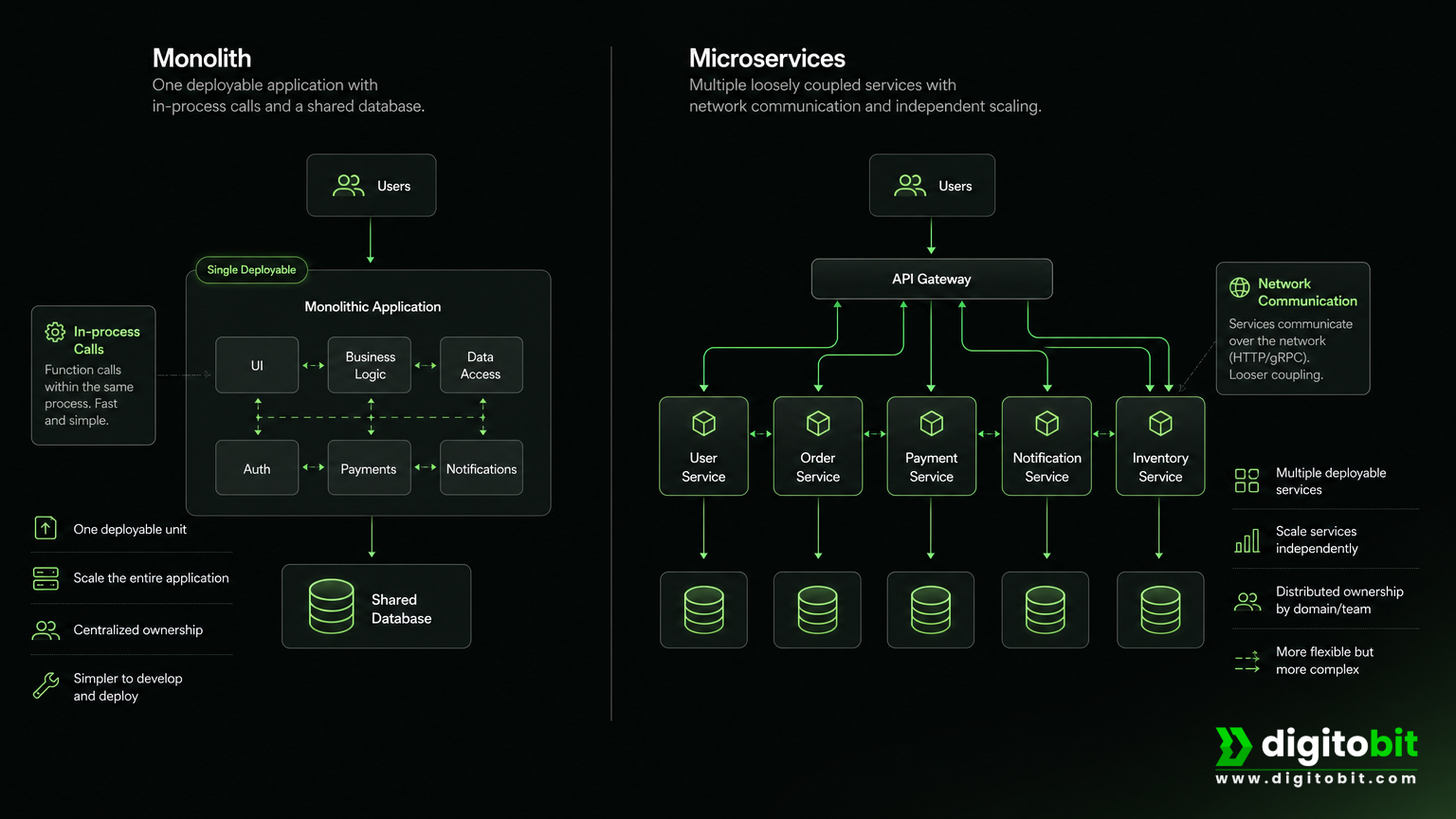
In a monolithic architecture, the application’s primary components run as one deployable unit. User interfaces, business logic, background jobs, and data-access code may be organized into modules, but they are typically built, tested, deployed, and scaled together. A monolith may use one database, although the architecture itself does not require a particular database design.
Deployment topology and internal code organization are separate concerns. A monolith can have strong module boundaries, explicit interfaces, and disciplined ownership. This is commonly called a modular monolith. It preserves many benefits of internal modularity without introducing a network boundary between every module.
For example, an e-commerce application might contain separate Catalog, Accounts, Orders, Payments, and Notifications modules inside one application process. The modules can expose internal interfaces and restrict direct access to each other’s data while still being released as one artifact.
Microsoft’s overview of common web application architectures describes why a single deployment unit can remain appropriate when the application’s scaling and operational requirements are relatively uniform.
What Is a Microservices Architecture?
Microservices split an application into multiple independently deployable services. Each service is organized around a business capability or bounded context, such as Payments, Search, Identity, or Fulfillment. Services communicate through explicit APIs, events, or messaging rather than direct in-process calls.
A service should ideally have clear ownership of its code, runtime, API contract, and data. This does not necessarily mean every service must use a different technology or database. Technology diversity is possible, but introducing it without a business or technical reason increases support costs.
Microservices are therefore more than multiple repositories or containers. The architecture is valuable when services can evolve, deploy, scale, or fail with meaningful independence. Microsoft’s guidance on microservices and monolith migration emphasizes bounded contexts, service ownership, and data isolation as central design concerns.
Monolith vs Microservices: The Structural Difference
| Concern | Monolith | Microservices |
|---|---|---|
| Deployment | One primary deployable application | Multiple independently deployable services |
| Communication | Usually in-process method or module calls | APIs, events, or messaging across processes |
| Scaling | Usually scales the whole application | Individual services can scale selectively |
| Data | Often centrally managed and transactionally coordinated | Usually owned by individual services |
| Failure behavior | Fewer network failure points, but a process failure can affect the application | Potential failure isolation, with more dependency and network failure modes |
| Team model | Often suited to one team or a closely coordinated group | Works best when teams own complete business capabilities |
| Operations | Fewer deployment and monitoring components | More services, pipelines, contracts, security boundaries, and observability requirements |
The key distinction is not codebase size. A large monolith can be modular, and a collection of tiny services can be tightly coupled. The important question is whether the runtime and ownership boundaries create useful independence.
Advantages of a Monolith
Simpler development and operations
A monolith usually requires fewer deployment pipelines, runtime components, credentials, network policies, dashboards, and incident procedures. Developers can run more of the system locally, and a release generally involves one application artifact.
This simplicity is especially valuable for a small team. Instead of solving service discovery, distributed tracing, contract compatibility, and cross-service authentication, the team can focus on product behavior and domain correctness.
Straightforward transactions and consistency
When related data is stored in one database, local transactions are easier to implement and reason about. An operation such as creating an order, reserving inventory, and recording payment state can often use familiar transaction mechanisms, provided the underlying data model supports them.
In a microservices design, these operations may belong to different services and databases. The system may need events, sagas, retries, idempotency, and compensating actions instead of one distributed transaction.
Efficient local communication
Calls between modules in the same process generally avoid network latency, serialization, timeouts, and remote authentication. This makes request flows easier to understand and can be useful for latency-sensitive operations.
Simple testing and debugging
End-to-end tests can exercise more of the application in one environment. Logs and stack traces usually provide a more direct explanation of failures because a request does not cross multiple service boundaries.
Lower initial platform cost
A monolith can often run on a small number of application instances behind a load balancer. It may still use containers, continuous delivery, managed databases, queues, and autoscaling, but it does not require a separate operational model for every business capability.
Limitations of a Monolith
Whole-application deployment
A change to one module may require building, testing, and deploying the entire application. This can slow delivery when different teams need to release at different rates or when a small change must wait behind unrelated work.
Whole-application deployment is not automatically harmful. It becomes a problem when release coordination is frequent, risky, or inconsistent with the organization’s delivery goals.
Coarse-grained scaling
A monolith can scale horizontally by running multiple instances behind a load balancer. However, this normally replicates the whole application. If image processing consumes most of the CPU while account management is lightly used, scaling all components together may waste resources.
Growing coupling
Without architectural discipline, a monolith can become difficult to change. Modules may access one another’s tables, share global state, depend on implementation details, or create long chains of hidden dependencies.
The solution is not necessarily immediate decomposition. Enforcing module boundaries, restricting data access, separating domain logic, and adding architectural tests can keep a monolith maintainable.
Larger process-level blast radius
A memory leak, deployment error, or unhandled failure in the application can affect multiple capabilities at once. A well-designed monolith can mitigate this with isolation inside the process, feature flags, graceful degradation, and multiple instances, but its process boundary remains broad.
Advantages of Microservices
Independent deployment
A service can be released without rebuilding the entire platform, provided its API and event contracts remain compatible. This can reduce coordination between teams and allow high-change capabilities to move faster.
Independent deployment is a potential property, not a guarantee. Shared databases, synchronized schemas, tightly coupled synchronous calls, or coordinated workflows can still force services to release together.
Selective scaling
Services with different traffic or resource profiles can scale independently. For example, a media platform might keep user accounts and job management in a conventional application while running CPU- or GPU-intensive media processing as a separately scaled service.
Selective scaling does not remove bottlenecks. Shared databases, message brokers, caches, external APIs, and network capacity may still limit the system.
Fault isolation
When designed correctly, a failure in recommendations or notifications need not prevent users from browsing products or placing orders. Fault isolation requires deliberate dependency design, timeouts, circuit breakers, fallbacks, queue-based processing, and graceful degradation.
Simply placing code in separate processes does not create useful resilience. If every request requires a long chain of synchronous calls, one unavailable dependency can still cause a broad outage.
Team autonomy
Microservices can align software ownership with business capabilities. A team may own the Payments service from design through production operations, including its deployment pipeline, data, alerts, and API contract.
This model works best when teams are genuinely able to make decisions and operate their services. Creating services without clear ownership often produces more coordination rather than less.
Technology flexibility
Services can use different languages, frameworks, or storage technologies behind stable interfaces. This is useful when a specific capability has unusual performance, integration, or compatibility requirements. However, technology diversity should be managed as an explicit trade-off, not treated as an automatic benefit.
The Costs and Risks of Microservices
Distributed-systems failure modes
A local function call can become a network request with latency, timeouts, retries, serialization failures, authentication errors, and partial availability. A single user request may traverse several services, so both latency and failure probability can accumulate across the call chain.
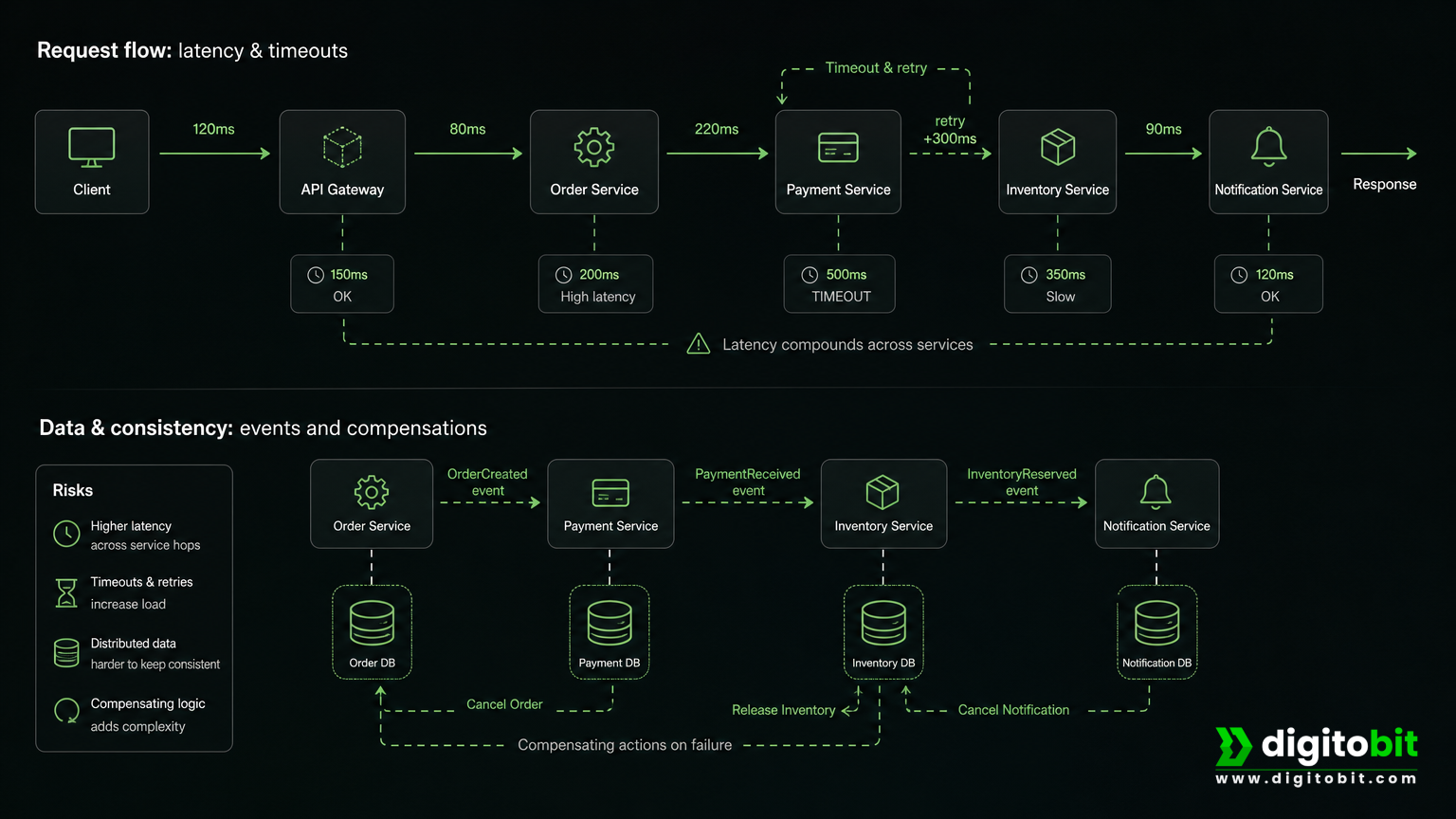
Reliable services typically need timeouts, bounded retries, idempotent handlers, circuit breakers, correlation IDs, and clear fallback behavior. Retries must be designed carefully: retrying a slow or overloaded dependency can amplify an outage.
Data ownership and consistency
Service-owned data reduces direct coupling but makes cross-service queries and workflows harder. A report that once used a database join may require APIs, replicated read models, events, or an analytics pipeline.
Business workflows may become eventually consistent. For instance, an Order service can create an order and publish an event; Inventory may reserve stock shortly afterward. If the reservation fails, the system needs a defined compensating action, such as cancelling the order or placing it in a pending state.
More demanding testing
Testing must cover individual services, API compatibility, message schemas, integration behavior, failure scenarios, and important end-to-end workflows. Contract testing can help verify that consumers and providers agree without requiring every service to be deployed for every test.
Operational overhead
More services create more release artifacts, health checks, dashboards, alerts, secrets, access policies, certificates, and incident paths. Container orchestration can automate deployment, health replacement, desired-state management, and autoscaling, but it also adds platform responsibilities. Microsoft’s guidance on container orchestration for microservices covers these operational concerns.
Centralized logs, metrics, distributed traces, service-level indicators, dependency maps, and consistent correlation IDs are essential. Without them, diagnosing a failed request across multiple services can be slower than debugging a much larger monolith.
Higher total cost in some environments
Microservices may improve resource efficiency through selective scaling, but the platform cost can rise because of duplicated runtime infrastructure, networking, observability, security, testing, and on-call requirements. The architecture should solve a measurable problem rather than add infrastructure for its own sake.
When Should You Choose a Monolith?
A monolith, particularly a modular monolith, is often the better starting point when:
- The product or domain is new and boundaries are still uncertain.
- A small team owns most of the application.
- Most features share transactional data.
- Traffic and resource requirements are reasonably uniform.
- Releases are already fast and coordination is manageable.
- The organization has limited platform or production-operations capacity.
- Low-latency local calls and straightforward consistency are important.
For example, a small SaaS administration tool with moderate traffic, one product team, and heavily shared business data may gain little from splitting into services. A modular monolith can provide clean boundaries while preserving simple deployment and debugging.
When Should You Choose Microservices?
Microservices become more attractive when the benefits of independent boundaries are clear and measurable:
- Business capabilities change at substantially different rates.
- Different capabilities require very different scaling profiles.
- Autonomous teams can own services end to end.
- A capability needs separate availability, compliance, or security isolation.
- Independent deployment is a meaningful business requirement.
- Specific components require specialized technology or compute resources.
- The organization already has mature CI/CD, observability, security, and incident response.
In an e-commerce platform, it may be sensible to begin with a monolith for catalog, accounts, checkout, and orders. Search, recommendations, notifications, or payment processing might later be extracted if their change rate, scaling needs, compliance requirements, or failure behavior justify a separate service.
A Practical Decision Framework
Evaluate the architecture against these questions:
- Where are the business boundaries? Can capabilities be described with clear responsibilities and stable interfaces?
- How often must parts of the system deploy independently? Is release coordination a real constraint or only a theoretical concern?
- Are workloads asymmetric? Does one capability require substantially more CPU, memory, storage, or throughput than others?
- What consistency is required? Can the business tolerate eventual consistency and compensating actions?
- Who owns production operations? Can each team support its service, alerts, dependencies, and data?
- What isolation is necessary? Are compliance, availability, security, or failure boundaries strong enough to justify separation?
- Can the platform support the architecture? Consider deployment automation, secrets management, observability, networking, testing, and local development.
If the answers are unclear, a modular monolith is often a lower-risk way to learn. Architecture can evolve when production evidence reveals a capability that genuinely needs independent treatment.
Migration: From Monolith to Microservices
Migration should be incremental rather than a large rewrite. First, identify modules, dependencies, data flows, ownership, change frequency, traffic patterns, and operational pain points. Then strengthen internal boundaries before introducing network boundaries.
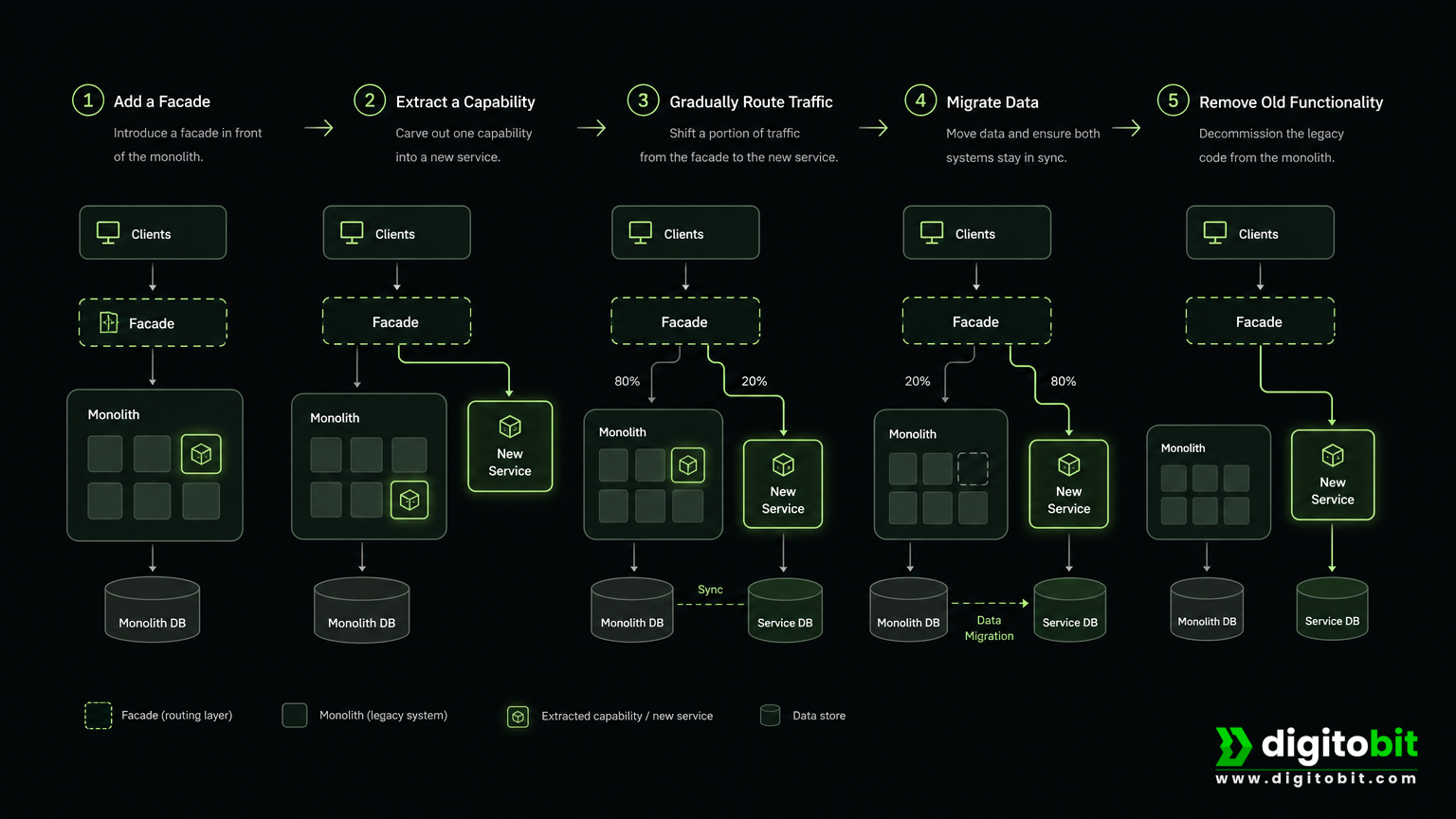
A common approach is the strangler-fig pattern:
- Place an API gateway, routing layer, or facade in front of the existing application.
- Choose one bounded capability with a clear boundary and measurable reason for extraction.
- Implement the capability as a new service while the monolith remains operational.
- Define ownership of its API, events, runtime, and data.
- Route selected traffic to the new service and monitor behavior.
- Synchronize or migrate data carefully, then remove the corresponding monolith functionality.
AWS describes incremental monolith decomposition as a way to reduce migration risk while keeping the existing system available. The first extraction should not merely be the easiest code to move; it should provide useful learning or address a real constraint.
Common Mistakes to Avoid
Splitting by technical layers
Creating separate services for controllers, repositories, or individual CRUD operations usually produces a chatty and tightly coupled system. Prefer business capabilities and bounded contexts over arbitrary technical divisions.
Building a distributed monolith
A system is not meaningfully independent if services share tables, require synchronized releases, or make frequent synchronous calls to complete basic operations. This arrangement combines distributed failure modes with monolithic coordination costs.
Assuming containers require microservices
Containers are a packaging and deployment technology. A modular monolith can run effectively in containers, and microservices can exist without adopting every available orchestration feature. Choose service boundaries based on domain and operational needs.
Ignoring contracts and compatibility
Independent releases require backward-compatible APIs and events, schema evolution practices, contract tests, ownership rules, and deprecation policies. Without these, each service release can remain dependent on every consumer.
Extracting before understanding the domain
Early boundaries are hypotheses. Measure coupling, change frequency, latency, failure rates, deployment coordination, and team ownership after the system runs in production. Boundaries can be refined as understanding improves.
Final Recommendation
Choose a monolith when simplicity, transaction handling, low operational overhead, and domain uncertainty matter more than independent scaling or deployment. Choose microservices when clearly bounded capabilities, autonomous ownership, uneven workloads, isolation requirements, or release independence provide measurable value.
For many teams, the most practical answer is hybrid: keep cohesive, transaction-heavy domains in a modular monolith and extract only capabilities with distinct scaling, reliability, compliance, technology, or ownership needs. The best architecture is not the one with the most services. It is the one that gives the organization useful boundaries without imposing complexity it cannot operate.

Author: Neeraj Mourya
Founder, Systems Architect – Digitobit
Specializing in scalable backend architecture and performance-focused SaaS systems