

A reliable API is more than a collection of endpoints. It is a long-lived contract between producers and consumers, defining how software exchanges data, reports failures, handles change, and enforces access. Good API design best practices reduce integration friction today while preventing compatibility and operational problems later.
This guide covers the principles that matter most when designing production APIs: resource modeling, HTTP semantics, schemas, pagination, errors, reliability, security, versioning, documentation, and observability.
1. Treat the API as a stable contract
Consumers should not need to understand your database schema, internal service boundaries, or deployment architecture. Design the public API around business concepts and consumer needs, then map those concepts to internal models.
This separation allows you to change tables, storage systems, and service implementations without forcing every client to migrate. It also prevents accidental exposure of internal fields, identifiers, relationships, or administrative data.
Before implementation, define:
- Which resources and operations are public.
- Which fields are required, optional, immutable, input-only, or output-only.
- What consistency guarantees clients receive after a write.
- How authentication, authorization, errors, limits, and retries work.
- Which changes are backward-compatible and which require migration.
An API contract includes more than paths and JSON shapes. Field meanings, enum values, ordering, status codes, pagination behavior, authentication claims, and error types can all affect compatibility.
2. Model resources around business concepts
Resource-oriented design gives APIs a consistent structure. Use nouns for resource paths and let HTTP methods express the operation:
POST   /v1/orders
GET    /v1/orders/123
PATCH  /v1/orders/123
DELETE /v1/orders/123
GET    /v1/customers/42/orders
Avoid action-heavy paths such as /createOrder or /getCustomerOrders when a standard HTTP operation expresses the intent clearly. Custom actions are sometimes necessary, but they should represent genuine business operations that do not map naturally to creating, reading, updating, or deleting a resource.
Use relationships where they improve discoverability and authorization boundaries. For example, /customers/42/orders represents orders associated with a customer, while a top-level /orders/123 remains useful when an order has its own lifecycle.
Do not mirror every database table automatically. A public resource may combine data from several tables, omit sensitive attributes, or present a simpler representation than the persistence model.
3. Apply HTTP semantics consistently
HTTP already provides a vocabulary for operations and outcomes. Using it consistently makes APIs easier to integrate with browsers, proxies, gateways, SDKs, and monitoring tools.
- GET: Retrieve a representation. It should be safe and should not trigger a business mutation.
- POST: Create a subordinate resource or request an operation. It is generally not idempotent.
- PUT: Replace a resource representation. Repeating the same request should have the same intended effect.
- PATCH: Apply a partial modification according to explicitly documented patch rules.
- DELETE: Remove or deactivate a resource. Repeating the request should not create additional deletion effects.
Choose status codes that communicate the result accurately. A successful creation commonly returns 201 Created with a Location header. A successful request with no response body may use 204 No Content. Validation failures generally use 400 Bad Request or, where applicable, 422 Unprocessable Content. Authentication and authorization failures should use appropriate 401 or 403 responses.
Do not return 200 OK for every outcome and place the real meaning in an ad hoc message. Clients should be able to make decisions from status codes and structured response fields.
4. Design schemas with explicit field behavior
Every field should have a documented purpose and lifecycle. Define whether it is:
- Required on creation or only returned in responses.
- Optional, nullable, or assigned a default.
- Mutable after creation or permanently immutable.
- Accepted as input, returned as output, or both.
- Restricted to a known format, range, length, or enumeration.
Be precise about the difference between an omitted field and a field set to null. In a partial update, omission often means “leave unchanged,” while null may mean “clear this value.” That behavior must be documented and tested.
Separate input and output models rather than binding request JSON directly to a database entity. This prevents mass assignment vulnerabilities and lets you apply field-level authorization. Unknown or unauthorized fields should normally be rejected instead of silently ignored.
OpenAPI is useful for publishing these contracts. It can support documentation, client generation, validation, contract testing, and governance. However, an OpenAPI document does not guarantee that an implementation follows every business rule, so runtime and integration tests remain necessary.
5. Design collections for growth
Never assume a collection will remain small. Add pagination at the initial design stage; changing an endpoint from an unbounded response to paginated behavior later can break clients that expect every item in one response.
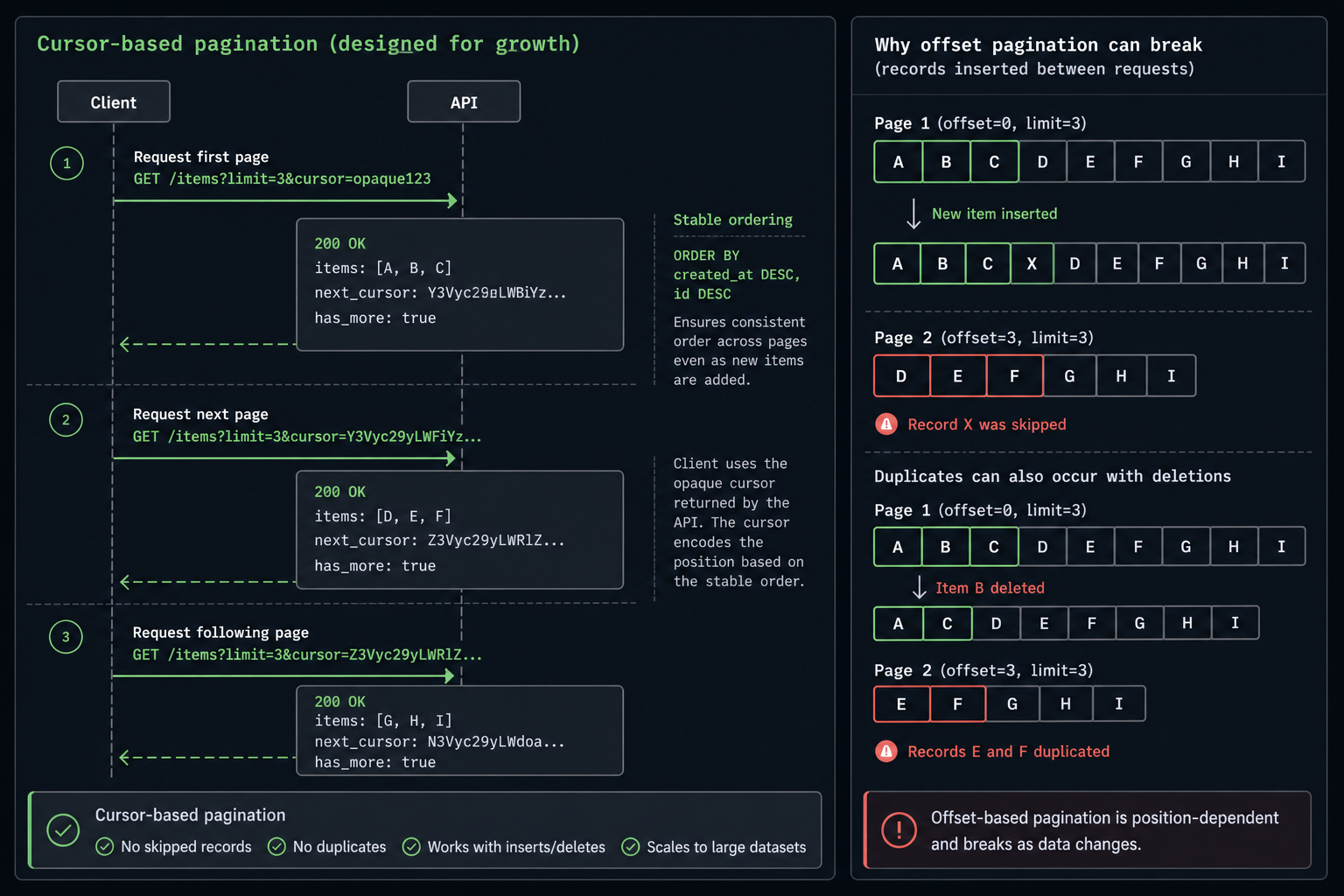
Define a maximum page size, a documented default, stable ordering, and a continuation mechanism. Cursor or page-token pagination is usually a better choice for large or changing datasets:
GET /v1/customers/42/orders?status=paid&limit=25&cursor=opaque-token{
"items": [
{ "id": "ord_123", "status": "paid" }
],
"next_cursor": "opaque-token"
}Offset pagination is simple and easy to bookmark, but inserted or deleted records can cause duplicates or skipped items between requests. Cursor pagination is more stable, though it requires opaque cursor management and clear expiration or invalidation behavior.
Make ordering deterministic by including a stable tie-breaker, such as an ID when timestamps are equal. Document whether results are a consistent snapshot, eventually consistent, or a live view. Page tokens should not expose database details or function as authorization credentials.
6. Return machine-readable errors
Clients need errors they can classify and act upon. RFC 9457 Problem Details provides a standard structure using the application/problem+json media type:
{
  "type": "https://api.example.com/problems/validation-error",
  "title": "Invalid request",
  "status": 400,
  "detail": "email is invalid",
  "instance": "/requests/abc123"
}
You may add an application error code, field-level violations, or remediation information, but keep the format consistent. Avoid exposing stack traces, SQL errors, access tokens, personal data, or sensitive infrastructure details. A correlation or request identifier is useful for support without revealing internal failure information.
Validation errors should identify the affected field where safe. Authorization errors should not reveal whether a protected object exists when that distinction would create an information leak.
7. Make writes safe under retries and concurrency
Networks fail ambiguously. A client may send a request, lose the connection, and be unable to determine whether the server completed it. Reliability therefore depends on designing writes for repetition.
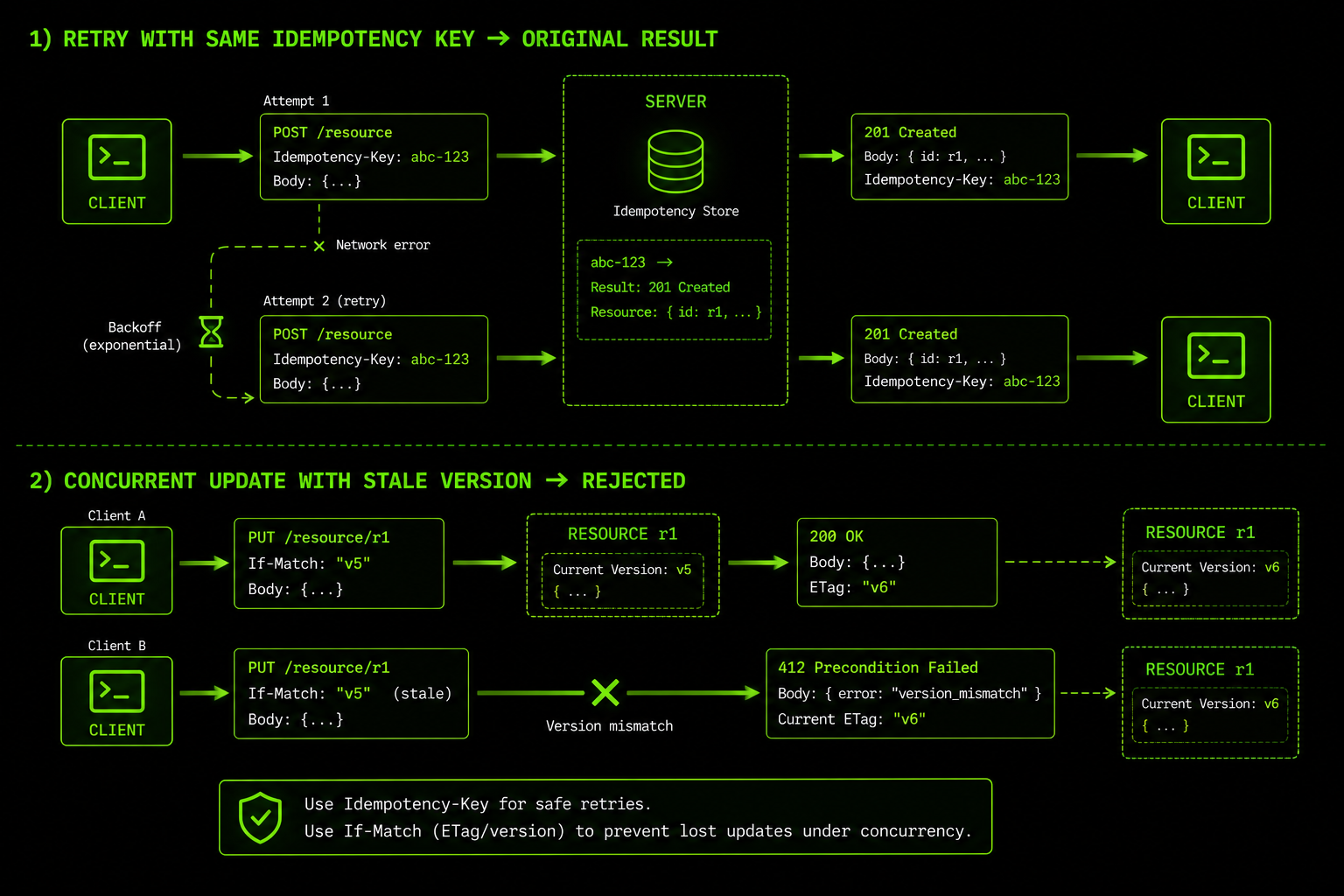
For operations such as payments, provisioning, and job creation, accept an idempotency key:
POST /v1/payments
Idempotency-Key: 8f1-example-key
The server should associate the key with the original operation and return the same result for a safe replay, while defining how long keys are retained and what happens if the same key is reused with different parameters.
Use retries selectively. Retrying a transient 503 or 504 may be appropriate for an idempotent request, but blindly retrying a non-idempotent POST, invalid request, authorization failure, or quota error can worsen the problem. Use bounded exponential backoff with jitter, timeouts, and a maximum attempt count.
For competing updates, support optimistic concurrency with ETags or version fields. A client can send If-Match with the version it read; if the representation has changed, return 412 Precondition Failed or another documented conflict response rather than silently overwriting newer data.
Use asynchronous workflows for long operations
Exports, large imports, reports, and provisioning tasks should not occupy a request until a gateway or client timeout occurs. Return 202 Accepted with an operation resource or status URL:
POST /v1/exports{
"operation_id": "op_123",
"status_url": "/v1/operations/op_123"
}Document polling intervals, completion states, failure details, cancellation behavior, and whether clients can receive a callback or webhook.
8. Build security into the contract
Authentication proves who a caller is; authorization determines what that caller may do. Validate access at the object, property, function, and tenant levels. A valid token alone does not authorize access to every resource.
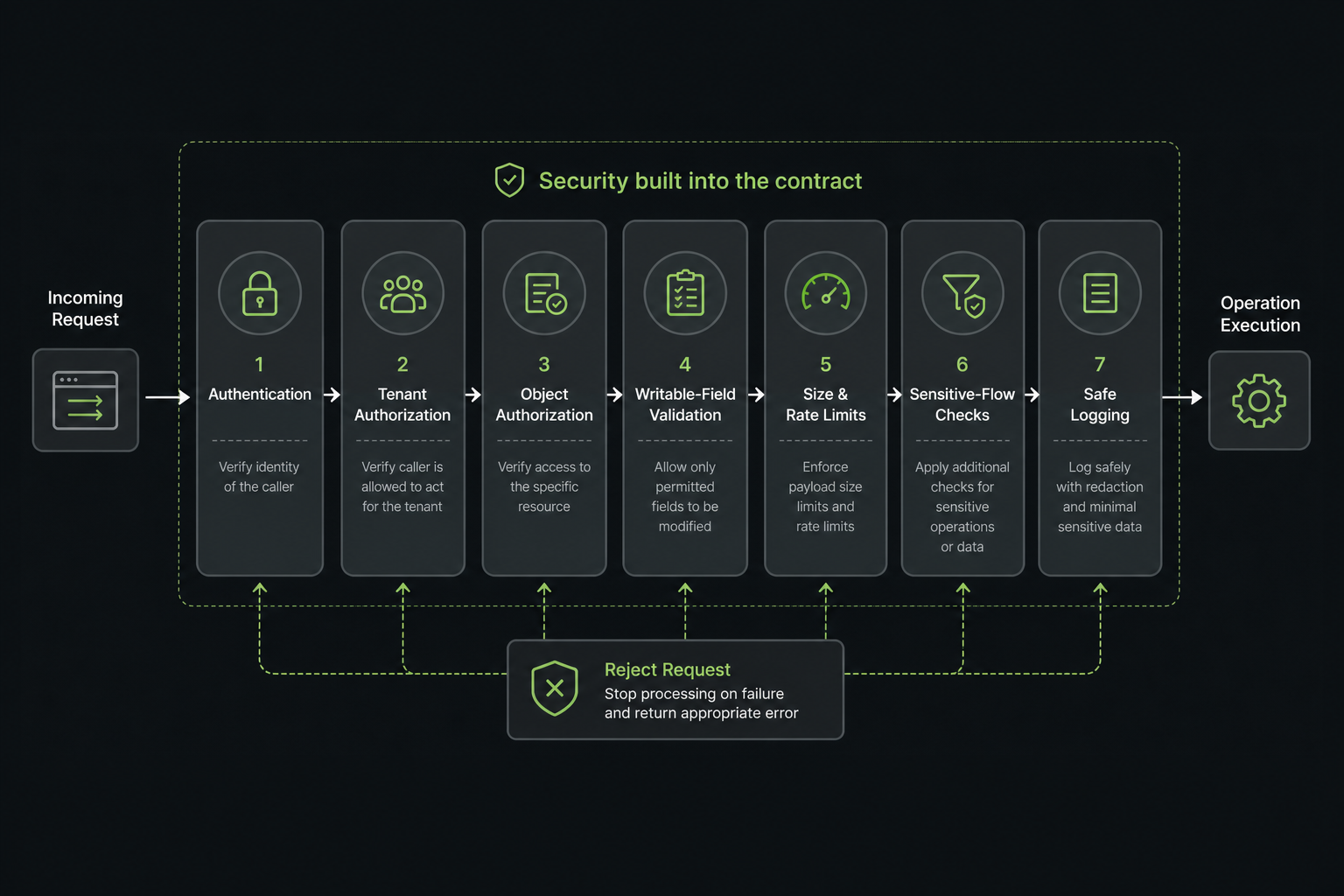
Threat-model common API risks, including broken object-level authorization, excessive data exposure, unrestricted resource consumption, unsafe third-party consumption, server-side request forgery, and poor inventory management. Additional controls include:
- Allowlisting writable fields and rejecting mass assignment.
- Enforcing maximum body sizes, upload sizes, query complexity, and concurrency.
- Applying rate limits by suitable dimensions such as identity, tenant, operation, and IP.
- Protecting sensitive business flows such as password resets, payments, and invitation creation.
- Validating URLs, redirect targets, file types, and webhook destinations.
- Removing secrets and sensitive personal data from logs and error responses.
Rate limiting should communicate actionable information. Use 429 Too Many Requests or an appropriate overload response and provide Retry-After when the client can reasonably retry. Service-wide protection and per-consumer quotas solve different problems; use both where necessary.
9. Version and evolve APIs deliberately
Prefer additive changes: new optional fields, new endpoints, or new media types. Avoid removing fields, changing their meaning, altering enum semantics, changing defaults, or modifying ordering and error behavior without a migration plan.
When a breaking change is unavoidable, provide a new version or a documented migration path. URI versioning such as /v2 is visible and straightforward. Header or media-type versioning keeps paths stable but can make caching, debugging, and documentation less obvious. Choose one strategy and apply it consistently.
Versioning is not complete when a new endpoint is published. Define ownership, deprecation notices, telemetry for old clients, migration documentation, a support period, and a removal date. Multiple versions without a retirement policy create ongoing operational and testing costs.
10. Document, test, and observe the API
Documentation is part of the product. Publish an OpenAPI description, authentication instructions, complete request and response examples, error definitions, rate-limit rules, pagination behavior, changelog, SDK guidance, and deprecation notices.
Test both successful and negative paths. Useful contract tests include malformed input, unknown fields, invalid cursors, unauthorized object IDs, stale ETags, replayed idempotency keys, oversized payloads, dependency timeouts, and rate-limit behavior.
Make the API observable by propagating trace or correlation context and recording structured outcomes. Monitor:
- Latency by endpoint, status code, and dependency.
- Error rates, timeout rates, and retry volume.
- Authentication and authorization failures.
- Rate-limit events and rejected requests.
- Queue depth and asynchronous operation duration.
- Dependency failures and circuit-breaker state.
Logs should support investigation without becoming a source of secrets or personal-data leakage. Redact sensitive values and define retention and access policies.
Practical pre-release checklist
- Are resources modeled independently of database tables?
- Are methods, status codes, headers, and idempotency rules consistent?
- Are field requirements, nullability, mutability, and authorization documented?
- Do all collections have bounded, deterministic pagination?
- Are errors structured, safe, and actionable?
- Can clients safely retry ambiguous writes?
- Are concurrency conflicts detected rather than silently overwritten?
- Are authentication, object authorization, limits, and sensitive workflows tested?
- Is there a versioning, deprecation, and migration policy?
- Are documentation, contract tests, metrics, tracing, and alerting ready?
Conclusion
The strongest API design best practices focus on predictability. Model business resources rather than storage tables, use HTTP semantics accurately, make schemas explicit, bound collection behavior, standardize errors, protect writes against retries and races, and treat security and observability as design requirements.
When the API contract is clear and deliberately evolved, consumers can build with confidence—and the service can scale without turning every internal change into a client-breaking event.

Author: Neeraj Mourya
Founder, Systems Architect – Digitobit
Specializing in scalable backend architecture and performance-focused SaaS systems