

Choosing a web development company for startups is not simply a matter of comparing hourly rates or reviewing attractive case studies. The right partner must turn an uncertain product idea into a testable release, make sensible technical decisions, communicate trade-offs clearly, and leave your startup in control of its code and production systems.
This guide explains what to evaluate when selecting a partner for an MVP or growing product. It covers discovery, portfolio evidence, architecture, team composition, delivery practices, security, ownership, support, and commercial models.
What the right startup development partner should do
A suitable partner should help you answer four questions:
- What is the smallest product that can test the most important business assumptions?
- Which technical and operational risks must be resolved before launch?
- How will progress, quality, and scope changes be managed?
- How will the startup retain control after delivery?
These questions matter because an MVP is not a feature-filled first release. It is the smallest testable product that delivers a defined user outcome and validates priority assumptions. A credible proposal should therefore describe user journeys, in-scope workflows, non-goals, acceptance criteria, integrations, launch constraints, and success measures—not just a list of screens.
For broader product-building guidance, see Digitobit’s Web Development services. If your product includes recurring billing, tenant management, permissions, and lifecycle operations, also review SaaS Development.
1. Evaluate discovery before evaluating the build
Discovery should convert business goals into a practical product and delivery plan. It should not be limited to producing visual mockups.
A strong discovery phase normally produces:
- Target users, problems, and desired outcomes
- Primary user journeys and critical-path workflows
- A prioritized product backlog
- Explicit MVP boundaries and non-goals
- Functional and non-functional requirements
- Integration, data, and compliance assumptions
- Architecture decisions and their trade-offs
- Key risks, unknowns, and validation activities
- Estimates, delivery milestones, and a proposed roadmap
Ask for testable acceptance criteria
“Users can manage their account” is too vague to estimate or test. A better requirement defines the behavior:
- A user can create an account using email and password.
- Email verification is required before accessing protected features.
- Invalid credentials produce a clear error without revealing whether an email exists.
- Password reset links expire after a defined period.
- The workflow is covered by automated tests and is usable on supported devices.
Ask the vendor to identify error states, permissions, edge cases, analytics events, and dependencies for every critical workflow.
Use paid discovery when uncertainty is high
A useful trial engagement is a paid discovery sprint containing a prioritized backlog, a clickable critical-path prototype, an architecture decision record, a risk register, estimates, and a phase-one statement of work. This gives both sides evidence of how they think and collaborate before a large implementation commitment.
2. Verify portfolio evidence, not presentation quality
Portfolio screenshots can demonstrate design ability, but they do not prove that a company solved comparable product or engineering problems. Ask what the vendor actually contributed and who will deliver your project.
Assess previous work against:
- Product type and business model
- Number and complexity of user roles
- Integrations and third-party dependencies
- Regulated or sensitive data
- Traffic and operational maturity
- Launch outcome and measurable delivery result
- Technologies and architecture used
- Specific responsibilities of the proposed team
Ask scenario-based questions
For a marketplace, ask how the team handled onboarding, listings, search, payments, messaging, moderation, administration, and failed transactions. A visually similar landing page is not evidence of marketplace experience.
For a B2B SaaS product, ask about tenant isolation, role-based access control, invitations, billing, audit logs, usage limits, API design, support tools, and future integrations. These concerns are central to SaaS Development and are easy to underestimate in an MVP.
Speak with references
Ask references whether the vendor:
- Raised risks early or merely accepted requirements
- Delivered the agreed scope and quality level
- Handled changes transparently
- Provided usable documentation and handover
- Responded effectively to production issues
Also confirm whether the people shown in the case study are the people assigned to your project. A sales team may present the work, while a different or less experienced team performs it.
3. Judge architecture by product needs, not fashion
Architecture should reflect product maturity, traffic patterns, team capability, budget, release needs, and compliance requirements. It should not be selected because a particular technology is currently popular.
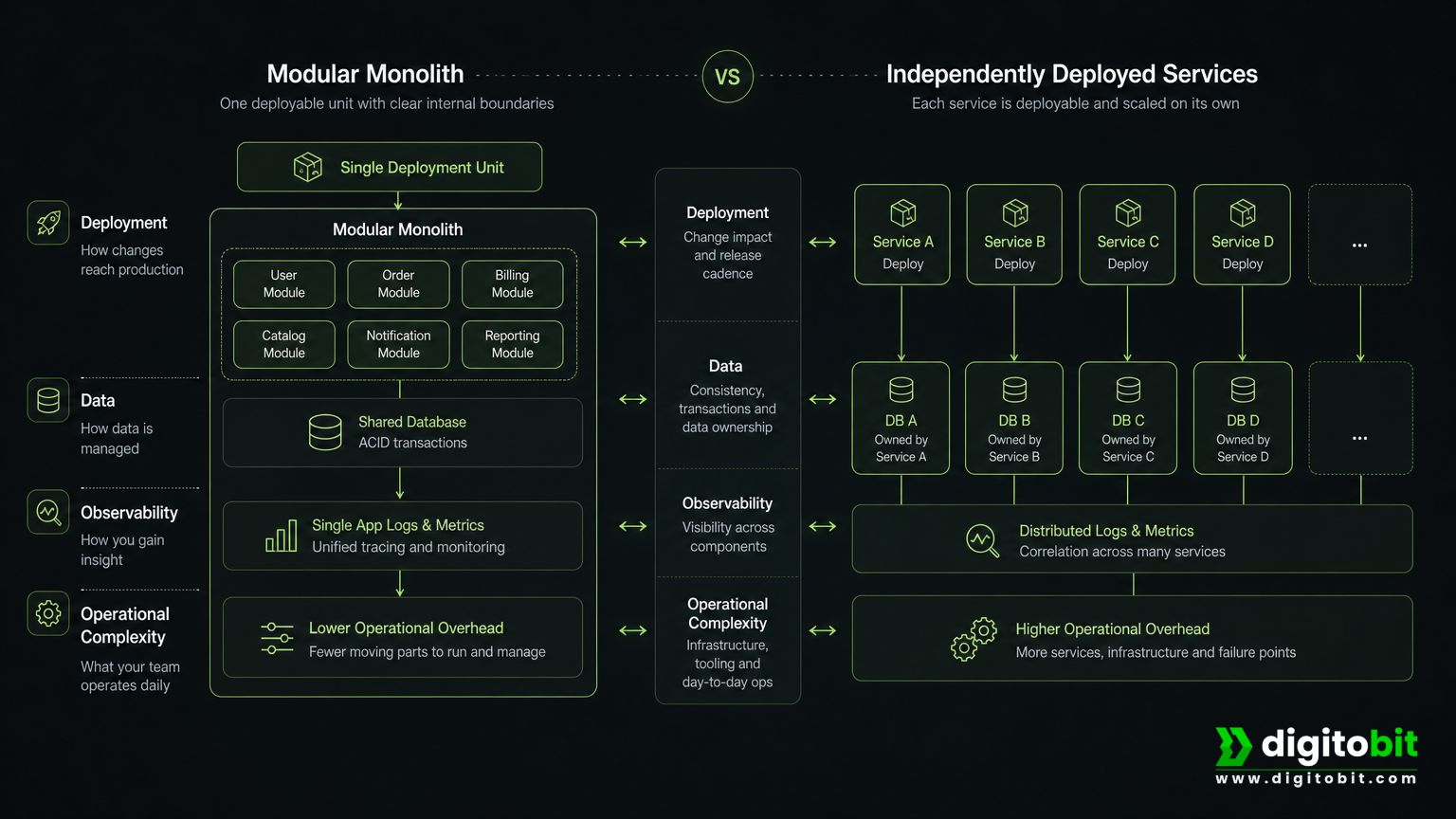
For many early products, a modular monolith with a relational database, clear domain boundaries, automated deployment, and observability is a sensible starting point. It can be faster and simpler for a small team, provided the codebase is structured to limit coupling.
AWS architecture guidance notes that distributed services can support independent deployment and scaling, but also introduce more operational complexity, latency, debugging, tracing, and deployment concerns.
Modular monolith versus microservices
| Approach | Potential advantages | Costs and risks |
|---|---|---|
| Modular monolith | Faster delivery, simpler deployment, easier local development, lower operating overhead | Requires disciplined boundaries and testing; poorly designed modules can become tightly coupled |
| Microservices | Independent deployment and scaling; separate team ownership where justified | Distributed data, observability, deployment, consistency, and incident-management complexity |
Ask the vendor to document the assumptions behind its recommendation, alternatives considered, expected costs, and migration triggers. A good architecture decision record might state that a service should be extracted only when it requires independent scaling, ownership, or release cadence.
Look for production fundamentals
Regardless of architecture, require a modular codebase, documented interfaces, automated tests, separate environments, deployment automation, monitoring, backups, and a documented path for future scaling.
Ask how the proposed solution addresses:
- Authentication, authorization, and session management
- Database migrations and rollback
- Third-party API failures and rate limits
- Background jobs and retries
- Logging, metrics, tracing, and alerting
- Backup restoration and disaster recovery
- Performance baselines and capacity assumptions
- Cloud cost visibility and operational ownership
An architecture diagram alone does not demonstrate scalability. Ask what happens when a dependency fails, a deployment must be rolled back, or traffic exceeds the original assumption.
4. Inspect the actual delivery team
The proposed team should match the product’s risks. Depending on scope, it may include:
- Product manager or business analyst
- UX/UI designer
- Frontend engineer
- Backend engineer
- QA engineer
- DevOps or cloud engineer
- Security specialist
One person may hold multiple roles, especially in a small engagement, but responsibilities must be explicit. Ask who makes technical decisions, who reviews code, who owns testing, and who responds to production incidents.
Also clarify availability, time-zone overlap, holidays, staff substitution, subcontractors, offshore handoffs, and knowledge-transfer procedures. An agency may provide broader coverage and redundancy than a freelancer, while a freelancer may offer lower overhead and more direct communication. The right choice depends on your risk tolerance and the product’s specialist needs.
5. Require a transparent delivery cadence
A credible delivery process includes a defined backlog, short iterations, regular demonstrations, acceptance criteria, decision logs, risk tracking, and a controlled method for scope changes.
Common delivery questions include:
- How is the backlog prioritized?
- How often will working software be demonstrated?
- When does a feature count as complete?
- How are defects classified and retested?
- Who approves acceptance?
- How are changes estimated and authorized?
- What metrics show progress and quality?
The official Scrum Guide describes the Product Backlog, Sprint, Increment, Sprint Review, and Retrospective as core elements of Scrum. You do not need to adopt Scrum exactly, but the underlying principles—visible work, frequent inspection, and adaptation—are useful for startup delivery.
Require demonstrations of working increments rather than relying only on status reports. The founder should appoint one decision-maker, provide timely feedback, maintain priorities, and reserve budget for iteration after user feedback.
6. Treat security as a delivery requirement
Security belongs in requirements, design, coding, testing, deployment, and maintenance. It should not be a final checklist before launch.
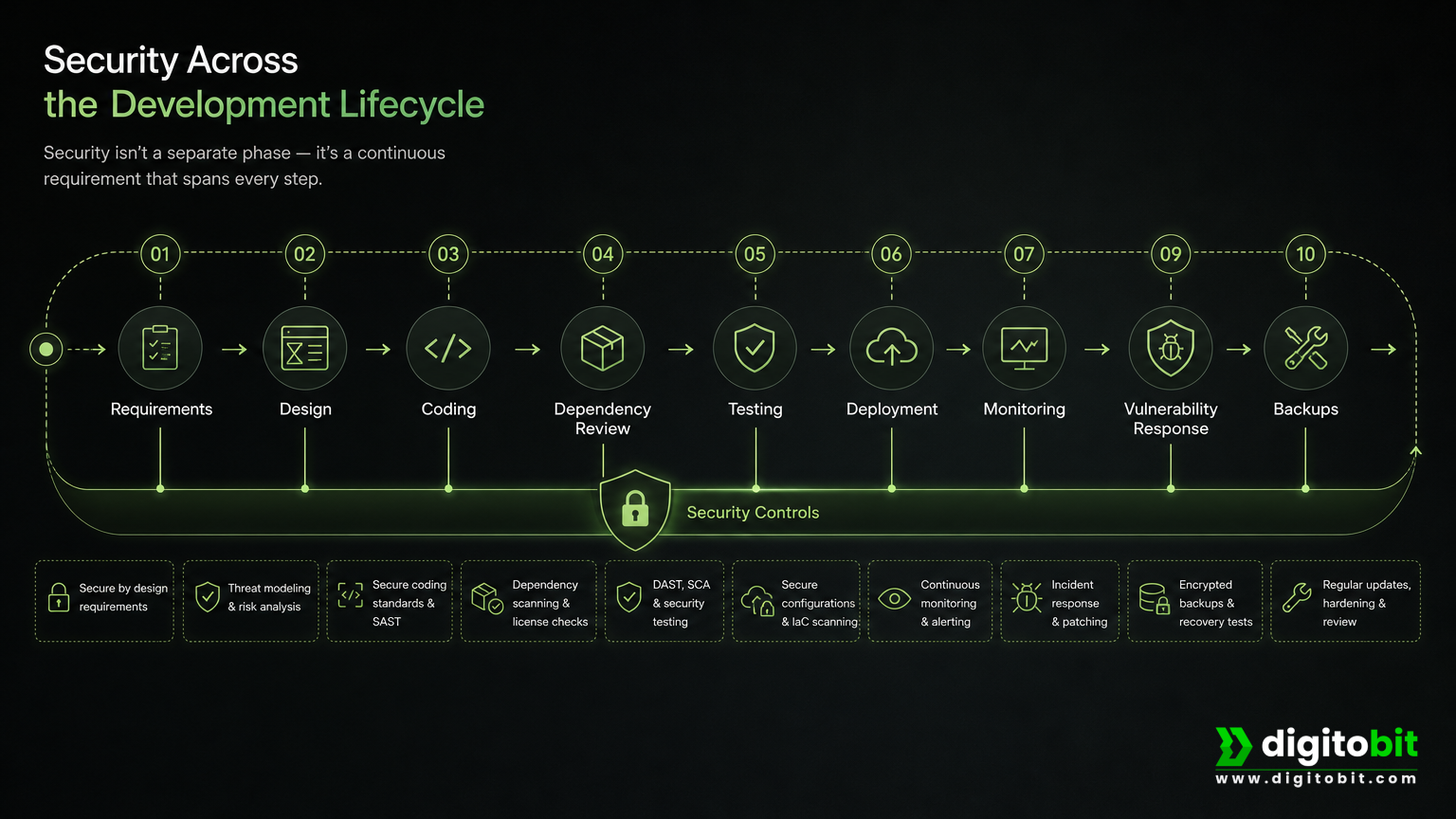
For testable web application requirements, use the OWASP Application Security Verification Standard as a reference. Relevant areas include authentication, authorization, session management, input validation, cryptography, logging, file handling, API security, and secure configuration.
For supplier discussions, the NIST Secure Software Development Framework provides a useful vocabulary for code review, dependency management, vulnerability remediation, secure builds, and release integrity.
Ask practical security questions
- How are secrets stored and rotated?
- Are production credentials separated from development credentials?
- How are dependencies scanned and updated?
- How are access permissions reviewed?
- What security tests are automated?
- How are vulnerabilities prioritized and communicated?
- What is the incident-notification process?
- How are backups encrypted and restoration tested?
For sensitive data, clarify retention, encryption, access logging, subprocessors, privacy obligations, deletion, export, and incident response. Production readiness should also cover monitoring, performance testing, service objectives, capacity planning, and operational runbooks. Google’s operational-excellence guidance is a useful checklist for these concerns.
7. Make ownership explicit from the beginning
The startup should own or control the systems required to operate the product. Use founder-owned organizational accounts wherever possible, granting the vendor least-privilege access.
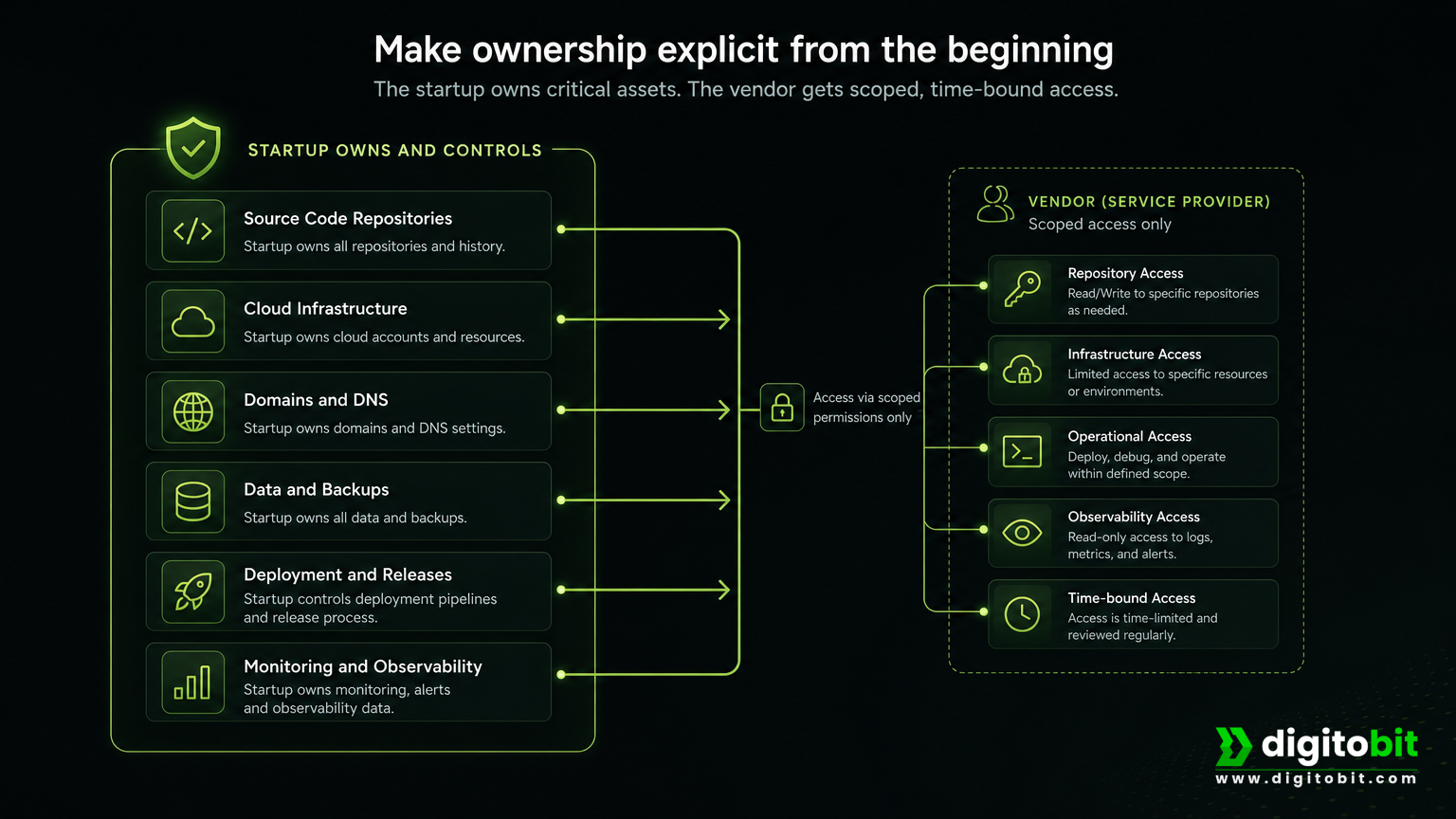
Ownership should cover:
- Source repositories and commit history
- Infrastructure-as-code and CI/CD configuration
- Design files and documentation
- Databases, backups, and data exports
- Cloud billing and hosting accounts
- Domains, certificates, and DNS
- Analytics, email, payment, and package-registry accounts
- Monitoring and incident-management systems
GitHub supports repository transfers to another account or organization, with the new owner receiving administrative control over repository contents, issues, pull requests, releases, projects, and settings. The repository transfer documentation is useful, but a technical transfer does not replace clear contractual terms.
Your agreement should address intellectual-property ownership, open-source obligations, third-party licenses, vendor lock-in, termination assistance, credential handover, data export, and knowledge transfer. Avoid allowing a vendor to create the only production repository or cloud account under its own control.
8. Define post-launch support before launch
Launch is the beginning of production responsibility, not the end of the project. A support agreement should define:
- Severity levels and response times
- Defect warranty period
- Included maintenance and security patches
- Monitoring and incident handling
- Release and deployment support
- Backup and restoration responsibilities
- Rates for new features
- Escalation contacts and working hours
- Documentation and knowledge-transfer obligations
Agree on measurable launch-readiness criteria, such as critical-path test completion, acceptable critical-defect thresholds, a successful backup restoration test, monitoring coverage, security review, performance baseline, accessibility checks, documentation, and operational handover.
9. Choose the engagement model deliberately
| Model | Best fit | Main trade-off |
|---|---|---|
| Fixed-price discovery | Early uncertainty about scope, risks, and architecture | Requires clear deliverables; it is not a substitute for implementation planning |
| Fixed-price delivery | Stable requirements and precise acceptance criteria | Incomplete discovery often leads to change orders, exclusions, or quality compromises |
| Time and materials | Evolving MVP requirements and iterative validation | Requires strong prioritization, budget controls, and reporting |
| Dedicated team | Sustained product capacity and internal knowledge building | Higher ongoing cost and greater need for active product leadership |
| Hybrid | Fixed-price discovery followed by flexible implementation | Requires a clean transition between phases |
Compare total cost rather than engineering rates alone. Include discovery, product management, QA, DevOps, security, cloud setup, documentation, revisions, support, third-party tools, and handover.
10. Use a vendor scorecard and watch for red flags
Score candidates consistently across product understanding, relevant evidence, technical approach, team quality, delivery transparency, security, ownership, support, price, and communication. Weight the categories according to your risk profile.
Common red flags
- A low quote excludes discovery, QA, deployment, accessibility, security, or support.
- The proposal uses vague features without acceptance criteria or non-goals.
- The sales team cannot identify the actual delivery team.
- The vendor recommends complex services without explaining the business reason.
- Repositories and cloud accounts will be owned by the vendor.
- Case studies show polished visuals but no technical contribution or outcome.
- There is no process for testing, release rollback, monitoring, or incidents.
- Different proposals use different assumptions, staffing levels, or support inclusions.
11. Prepare a vendor brief that produces comparable proposals
Give every candidate the same baseline information. Your brief should include:
- Business context and the problem being solved
- Target users and primary user journeys
- MVP hypotheses and measurable success metrics
- Functional requirements and explicit non-goals
- Non-functional requirements, including performance and accessibility
- Integrations, data sensitivity, and compliance considerations
- Target platforms, launch constraints, and preferred timeline
- Budget range and expected team structure
- Ownership, repository, account, and handover expectations
- Support requirements after launch
Ask each vendor to return the same information:
- Assumptions and exclusions
- Top three product risks and proposed validation steps
- Discovery deliverables
- Architecture recommendation and alternatives
- Named team members and availability
- Milestones, cadence, and acceptance process
- Testing and security approach
- Detailed cost by phase and role
- Ownership and handover terms
- Warranty and post-launch support options
Conclusion
The best web development company for startups is not necessarily the cheapest or the one with the most impressive technology stack. It is the partner that understands the business hypothesis, limits the MVP intelligently, explains technical trade-offs, works transparently, builds production-ready foundations, and preserves your ownership.
Before signing, validate the discovery process, proposed team, architecture assumptions, security practices, delivery cadence, account ownership, acceptance criteria, and support model. A disciplined selection process reduces avoidable risk and gives your startup a stronger foundation for learning after launch.

Author: Neeraj Mourya
Founder, Systems Architect – Digitobit
Specializing in scalable backend architecture and performance-focused SaaS systems