
Polaris: Building an AI-Powered Personal Operations Platform
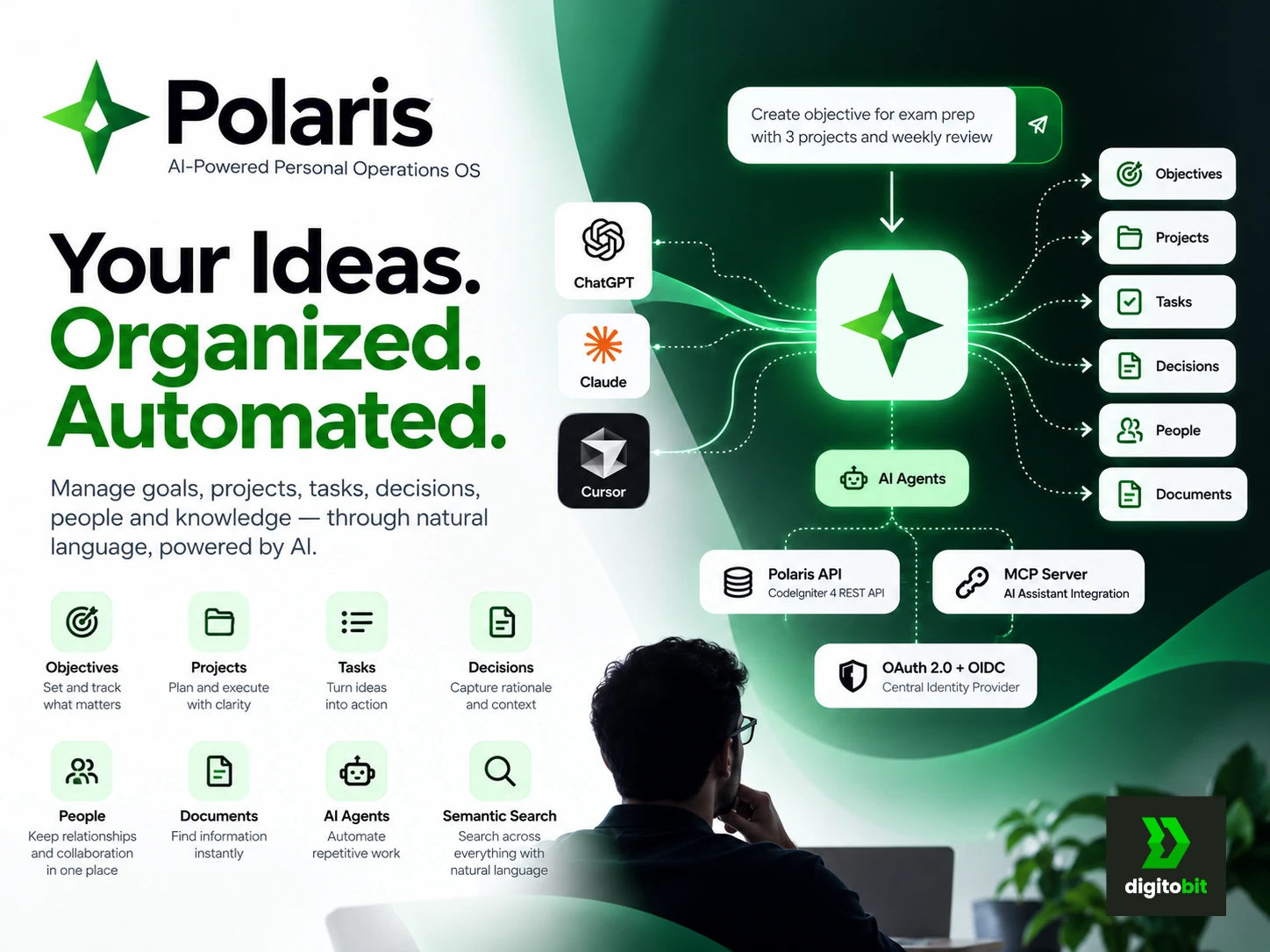
Modern productivity systems often separate tasks, projects, decisions and business knowledge across disconnected tools, making it harder to manage work efficiently. To explore a more connected, AI-native approach, Digitobit is building Polaris, a personal operations platform that combines a versioned REST API, AI assistant integrations through MCP, and semantic memory to connect information with actionable workflows. This case study explores the architecture behind Polaris, the engineering decisions shaping its development, and how its API-first foundation can enable more intelligent, context-aware business applications.
Client / Product: Polaris (an internal Digitobit product) · Category: AI automation, productivity SaaS and API development · Status: Private beta
How Digitobit is building an AI-native operations platform that connects tasks, objectives, decisions and semantic memory through APIs and AI assistant integrations.
Polaris is currently in private beta. The API and MCP server are live; the PWA dashboard is planned for a future phase. A demo is available on request.
Project overview
Polaris, formerly called CEO OS, is a personal operations system designed to bring objectives, projects, tasks, decisions, people, documents and AI agents into one connected environment. Its planned AI-first experience lets people use natural language to work with these resources instead of navigating a series of separate screens.
For example, a user could ask, “Create an objective for exam preparation with three projects and a weekly review.” The intended workflow uses AI agent tool calls to create and connect records, while semantic memory helps retrieve relevant context.
The challenge
Building an AI-enabled operations product meant solving several connected engineering challenges:
- Too many steps for routine work. Creating linked objectives, projects and tasks across separate screens can interrupt a user’s workflow.
- Frontend performance. A productivity interface should remain responsive without shipping a large bundle of code that users may not need.
- Natural-language interaction. Standard CRUD endpoints alone do not provide a conversational way to ask questions about decisions, tasks or previous work.
- Multiple AI clients and platforms. The backend needed an integration path for AI clients such as ChatGPT, Claude Desktop and Cursor, alongside a planned web/PWA interface.
- Consistent identity and data isolation. Multiple Digitobit products need a centralized authentication approach and user-scoped access to resources.
Digitobit’s approach
Digitobit designed Polaris around an API-first architecture. A centralized OAuth 2.0 and OpenID Connect (OIDC) identity service issues access tokens, the CodeIgniter 4 REST API manages application resources, and a PHP-based Model Context Protocol (MCP) server exposes selected capabilities as tools for compatible AI clients.
1. A versioned REST API
The API provides endpoints for objectives, projects, tasks, decisions, people, documents, tags, agents, memories and global search. A dashboard endpoint aggregates key information, while resource access is scoped to the authenticated user.
2. An MCP server for AI assistant integration
The PHP MCP server uses Streamable HTTP transport and JSON-RPC 2.0 to expose product operations as tools. After bearer-token validation, compatible clients can discover available tools and invoke supported actions through the MCP interface.
3. Semantic memory search
Embedding-based search is designed to retrieve relevant context across supported records, including tasks, decisions, documents and objectives. This creates a foundation for queries that rely on meaning and context rather than exact keyword matches alone.
4. AI agents that can take action
The agent architecture connects prompts with tool calls and application APIs. Instead of only generating a text response, an agent can be configured to perform supported operations—such as creating records—within the product’s available tools and access controls.
5. A lightweight frontend planned for the next phase
The planned PWA dashboard will use Digitobit’s UltraSPA and DUI frameworks, with native Web Components for interface elements such as task lists, objective cards, decision logs and AI chat. This frontend is designed for a lightweight, event-driven approach without a Virtual DOM.
Architecture at a glance
Central OAuth 2.0 / OIDC identity service
                  |
           Bearer access token
                  |
        Polaris REST API (CodeIgniter 4)
          |                   |
     MySQL resources     Semantic search
                  |
          PHP MCP server
                  |
   Compatible AI clients and assistants

Planned: UltraSPA + DUI PWA dashboard
The API and MCP server are live. The PWA dashboard and subsequent mobile-focused capabilities remain planned work.
Technology stack
| Layer | Technology | Role |
|---|---|---|
| Identity | OAuth 2.0 and OIDC | Centralized authentication across products |
| API | CodeIgniter 4, PHP and MySQL | Versioned REST endpoints and resource management |
| AI integration | PHP MCP server, Streamable HTTP and JSON-RPC 2.0 | Expose selected API capabilities as tools to compatible AI clients |
| AI capabilities | Agent tool calls and embeddings-based search | Action-oriented workflows and contextual retrieval |
| Frontend — planned | UltraSPA and DUI | Lightweight PWA interface using Web Components |
| Mobile distribution — planned | Service Worker, Web App Manifest and TWA | Potential route from web app to Play Store distribution |
Implementation highlights
- API specification: Versioned API with an OpenAPI specification (v2.3).
- Resource coverage: 18 API endpoints and 15 MCP tools are reported in the current implementation.
- Authentication: Bearer-token validation through Digitobit’s centralized identity service.
- Data isolation: Resource queries are scoped to the authenticated user’s ID.
- Standard operations: REST patterns support create, read, update and delete operations, along with pagination, filtering and search.
- Deployment practicality: The MCP server is built in PHP, avoiding a Node.js runtime dependency for that service and making it suitable for PHP hosting environments that support the required configuration.
Performance and current status
The project notes record the following implementation figures and design targets. They should be read as project-reported measurements or targets, not as an independent benchmark across all deployment conditions.
Under 150 ms
Reported average API response time.
Under 300 ms
Reported average MCP response time.
75 KB
Stated DUI framework size, compared in project notes with a 480 KB React prototype.
The original project notes describe the 75 KB versus 480 KB comparison as an 84% reduction. Bundle comparisons depend on what is included and how each build is measured, so this figure should be treated as a project-specific comparison rather than a universal framework benchmark.
What this architecture can enable for businesses
Polaris demonstrates engineering patterns that can be applied to business software beyond productivity tools:
- AI interfaces for existing software: Add natural-language commands to internal tools, SaaS platforms or operational dashboards.
- Semantic search for business knowledge: Help teams find relevant decisions, documentation, support records and project context.
- AI assistants that use business APIs: Expose selected, permission-controlled operations through MCP so compatible assistants can work with existing systems.
- Centralized authentication: Use an OAuth 2.0/OIDC identity provider across multiple applications.
- Lightweight web applications: Build responsive web and PWA experiences with a focus on performance and a shared codebase.
Project roadmap
- Current phase — completed: API, PHP MCP server and centralized OAuth/OIDC service.
- Next phase — planned: PWA dashboard built with UltraSPA and DUI.
- Future work — planned: Offline-first synchronization, voice input and mobile experience improvements.
- Future work — planned: Potential Play Store distribution through a Trusted Web Activity (TWA) and a public beta.
- Future work — planned: Agent marketplace, recurring workflows and public launch.
How Digitobit can help
Digitobit builds custom software and AI-enabled business workflows around real operational needs. Based on the patterns explored in Polaris, services can include:
- AI automation and agent workflows for repetitive, multi-step business processes.
- MCP server development to connect compatible AI assistants with existing APIs and systems.
- Semantic search integration for documents, decisions, tickets and internal knowledge.
- REST API development and secure integrations for business applications.
- OAuth 2.0/OIDC architecture for products that need centralized authentication.
- Lightweight web apps and PWAs designed around performance, usability and maintainability.
Discuss an AI automation project
Considering an AI assistant for your existing software, a secure MCP integration, or a workflow that can do more than return a text response? Digitobit can help assess the use case and design an API-first implementation suited to your systems.
Polaris is a Digitobit product in private beta. API and MCP capabilities are live; the PWA dashboard and roadmap items described above are planned, not yet released.
Built by Digitobit · AI automation and custom software development · Indore, India